The “Virtual Twin” Breakthrough: How Digital Maps of Your Body Are Revolutionizing Drug Trials
As a healthcare professional, I’ve spent years watching the “average” patient guide our medical decisions. In traditional medicine, if a drug worked for 70% of people in a study, we prescribed it to you—and then we waited. We waited to see if you’d be in that lucky 70% or if you’d be the one calling the clinic with a rash, nausea, or worse.
But the calendar has turned to 2026, and the “wait and see” era is officially ending. We are currently witnessing the most significant shift in clinical research since the invention of the placebo: the rise of the Digital Twin.
What Exactly is a “Virtual Twin”?
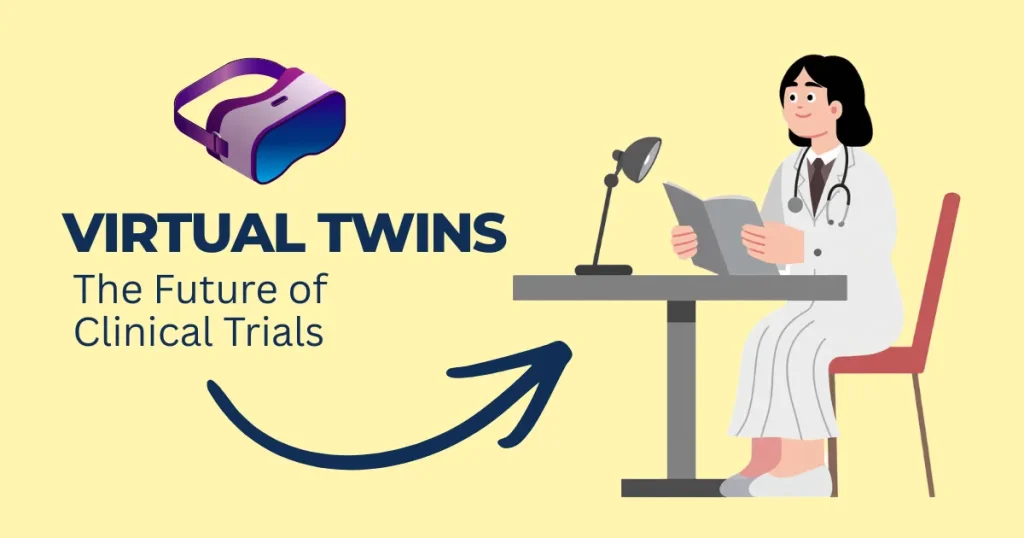
Imagine a high-definition, living digital map of you. This isn’t just a static 3D model like you’d see in a video game. A Digital Twin is an AI-powered replica of your specific physiology, built from your DNA, metabolic markers, lifestyle data from wearables, and medical history.
In 2026, these models have become so sophisticated that they don’t just look like you—they “breathe,” “process,” and “react” like you. Researchers are now using these “virtual humans” to run clinical trials in a digital space before a single volunteer ever swallows a pill.
The 2026 Shift: Trialing the Model, Not the Man
Traditionally, drug trials required thousands of human participants and years of observation. Today, pharmaceutical companies are using synthetic control arms. By using AI models of patients, researchers can simulate how a drug interacts with a specific heart valve or a particular liver enzyme.
- Predicting Side Effects: We can now “test” a new blood pressure medication on a million digital twins in a weekend. This allows us to spot rare, dangerous side effects that might have taken years to appear in real-world human trials.
- Accelerating Cures: Because we can simulate years of drug interaction in seconds, life-saving treatments for rare diseases are moving through the FDA pipeline at record speeds.
From the Lab to Your Doctor’s Office: The “N-of-1” Trial
This isn’t just “big science” happening in far-off labs; it’s coming to your local clinic. We are moving toward what we call N-of-1 trials.
In an N-of-1 trial, the “study” consists of exactly one person: you.
Soon, before your doctor prescribes a new medication for your cholesterol or depression, they will run a simulation on your Digital Twin. They will “give” the drug to your digital self first. If the AI predicts that the drug will cause you insomnia or won’t lower your levels effectively, your doctor will simply pivot to a different option. We are moving from “trial and error” to “simulate and succeed.”
Why This Matters for Your Health
The beauty of the Bio-Digital revolution is safety and precision. For the daily patient, this means:
- Lower Risk: You aren’t the guinea pig; your data is.
- Personalized Dosing: No more “standard” doses. Your twin tells us exactly how much your body needs.
- Proactive Care: Your twin can show us where your health might be heading in five years, allowing us to intervene today.
The Bottom Line
The “Virtual Twin” breakthrough is more than just a cool tech update; it’s a fundamental change in how we respect the uniqueness of the human body. As we move further into 2026, the question won’t be “Is this drug safe?” but rather “Is this drug safe for your digital twin?”
Health Disclaimer
This content is for informational purposes only and does not constitute medical advice, diagnosis, or treatment. Always seek the advice of your physician or other qualified health provider with any questions you may have regarding a medical condition. Digital Twin technology is an evolving field and may not be available for all medical conditions or in all geographic locations. DrugsArea
Sources & References
- FDA: Artificial Intelligence for Drug Development
- NIH: Enhancing Randomized Clinical Trials with Digital Twins
- Digital Twin in Healthcare Market Outlook 2032
- Journal of Pharmaceutical Research: Optimizing Healthcare Through Digital Twin Technology
People Also Ask
1. What is a “virtual twin” in medical research?
A virtual twin is a dynamic, digital replica of a human body, organ, or cell. Unlike a static 3D model, it uses real-world data—like your DNA, medical history, and even lifestyle habits—to simulate how your body functions. In research, it allows scientists to test treatments on a digital version of a patient before ever involving a real person.
2. How are virtual twins different from traditional clinical trials?
Traditional trials rely on large groups of physical volunteers, which can take years and cost billions. Virtual twins allow for “in silico” trials—essentially running experiments inside a computer. This can predict side effects faster and often requires fewer human participants, especially in the early stages of drug testing.
3. Can a digital map of the body really replace human testing?
Not entirely, but it’s getting close for certain stages. While we still need human data for final safety verification, virtual twins can replace “control groups” (the people who get a placebo). By simulating how a patient would have fared without the drug, researchers can focus human testing only on those actually receiving the new treatment.
4. What are the main benefits of virtual twins for drug development?
The biggest wins are speed, safety, and cost. Virtual twins help identify “dead-end” drugs early, preventing people from being exposed to ineffective treatments. They also make it easier to develop drugs for rare diseases where finding enough human volunteers is traditionally impossible.
5. Is virtual twin technology safe and accurate?
Its accuracy depends on the data fed into it. These models use AI and “mechanistic modeling” based on established laws of biology. While no simulation is 100% perfect, they are often more accurate at predicting human reactions than animal testing, as the models are built specifically on human physiology.
6. How does this technology help with “personalized medicine”?
Since a virtual twin can be built using your specific data, a doctor could “test-drive” several different medications on your digital self to see which one works best with your unique biology. This eliminates the “trial and error” approach to treating chronic illnesses like cancer or heart disease.
7. Are regulatory bodies like the FDA okay with using virtual twins?
Yes, and they are increasingly supportive. The FDA and the European Medicines Agency (EMA) have already begun creating frameworks for “model-informed drug development.” They see virtual twins as a way to bring safe, effective drugs to market much faster than the old-school methods allowed.
8. What kind of data is used to create a virtual twin of a patient?
It’s a massive “multi-omic” puzzle. It includes your genomics (DNA), proteomics (proteins), imaging (MRIs/CT scans), and even real-time data from wearables like smartwatches. All this information is combined to create a “living” map that evolves as you do.
9. Could virtual twins reduce the need for animal testing?
Absolutely. One of the most ethical breakthroughs of this technology is its potential to significantly reduce “in vivo” (animal) testing. Because virtual twins can simulate human-specific reactions that animals simply can’t replicate, they provide a more ethical and relevant alternative for early-stage labs.
10. What is the “Moonshot” goal for virtual twins?
The ultimate goal is to have a digital twin for every person, integrated directly into their medical records. This “living” model would be updated throughout your life, helping you and your doctors predict health risks, prevent diseases before they start, and tailor every treatment to your exact needs.