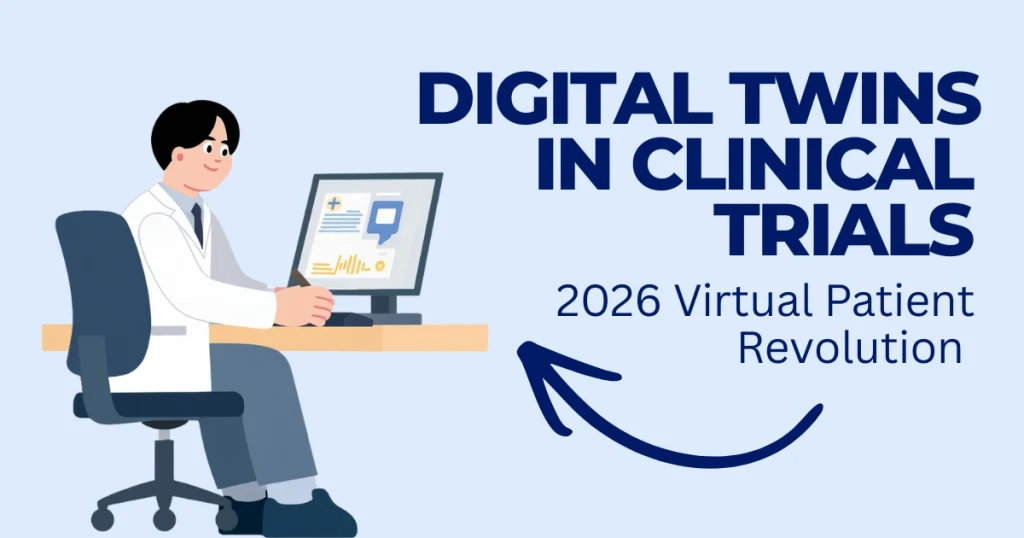
The “Virtual Patient” Revolution: How Digital Twins Are Predicting Trial Outcomes in 2026
As a healthcare professional who has spent years navigating the rigorous—and often frustratingly slow—corridors of clinical research, I can tell you that 2026 feels like a different world. For decades, we relied on “population averages.” We treated patients based on what worked for the average person in a trial, knowing full well that our patients are anything but average.
Today, that paradigm is shattering. The “Virtual Patient” revolution is no longer a futuristic concept discussed at niche tech conferences; it is the backbone of modern drug development. By utilizing Digital Twins, we are now predicting trial outcomes before the first human volunteer is even screened.
What is a Digital Twin in Healthcare?
At its core, a Digital Twin is a dynamic, high-fidelity virtual representation of a physical patient. It isn’t just a static computer model. In 2026, these twins are built by integrating a patient’s unique “multi-omics” data—genomics, proteomics, and metabolomics—alongside real-time data from wearable sensors and historical electronic health records (EHR).
Think of it as a “living” mathematical avatar. If I want to see how a new anti-arrhythmic drug might affect a 65-year-old female with a specific genetic mutation, I don’t have to wait for a Phase II trial. I can simulate the drug’s interaction with her Digital Twin thousands of times, identifying potential cardiotoxicity or efficacy gaps in a matter of hours.
Predicting Outcomes: The 2026 Impact
The integration of AI and Digital Twins has brought three major shifts to clinical research this year:
- Synthetic Control Arms: One of the most significant breakthroughs is the use of virtual patients to act as the “placebo group.” This reduces the number of human participants needed, especially in rare disease trials where finding volunteers is a massive hurdle.
- Precision Stratification: We no longer cast a wide net. Digital Twins allow us to “pre-test” virtual cohorts, ensuring that the human participants selected for the actual trial are those most likely to respond to the therapy.
- Real-Time Safety Signals: In 2026, regulatory bodies like the FDA and EMA have aligned on frameworks for “Good AI Practice.” This has cleared the path for in-silico trials to identify adverse events—like liver toxicity or cytokine storms—long before they reach a human subject.
The Role of AI and “In Silico” Testing
The “In Silico” approach—performing experiments via computer simulation—has reached a 97% accuracy rate in predicting certain neurodegenerative disease progressions. By simulating “what if” scenarios, pharmaceutical companies are cutting years off the traditional 10-year drug development cycle. This isn’t just about corporate profit; it’s about getting life-saving treatments to the bedside in 2026, rather than 2030.
Looking Ahead
As we move through 2026, the goal is “Precision for All.” We are moving away from trial-and-error medicine toward a future where your Digital Twin is updated at every healthcare touchpoint, acting as a guardian for your future health.
Sources & References
- Frontiers in Digital Health (2025/2026): Digital twins in healthcare: a comprehensive review
- PMC – National Institutes of Health: Enhancing randomized clinical trials with digital twins
- FDA Official Guidance (Jan 2026): Guiding Principles of Good AI Practice in Drug Development
- MarketsandMarkets Research: Healthcare Digital Twins Market Forecast 2025-2030
Health Disclaimer: The information provided in this article is for educational and informational purposes only and is not intended as medical advice. Always seek the advice of a qualified healthcare provider regarding any medical condition or treatment. The “Virtual Patient” and “Digital Twin” technologies described are tools used in clinical research and professional medical settings; they do not replace the clinical judgment of a licensed healthcare professional. DrugsArea
People Also Ask
2026 Virtual Patient Revolution: Top 10 FAQs
1. What exactly is a “Digital Twin” in a 2026 clinical trial?
A Digital Twin is a high-fidelity virtual replica of a specific patient’s biology. It is built using a combination of their real-world data—genomics, electronic health records (EHR), and real-time wearable sensor feeds. Unlike a simple computer model, a 2026 digital twin is dynamic; it evolves as the patient’s data updates, allowing researchers to simulate how that specific individual will respond to a new drug before or during a trial.
2. How are virtual patients replacing traditional “control arms” this year?
The biggest shift in 2026 is the rise of External Control Arms (ECAs). Instead of recruiting 100 sick patients to take a placebo (the control group), researchers use AI to generate “Digital Twin” controls based on historical data. This means every real person enrolled in the trial can actually receive the experimental treatment, making trials more ethical and much faster to fill.
3. Can a Digital Twin really predict side effects accurately?
Yes, with surprising precision. By 2026, “In Silico” (in-computer) testing has reached a point where we can simulate a drug’s interaction with complex biological systems—like a post-stroke brain or a diabetic’s metabolism—at the cellular level. This allows scientists to flag potential toxicity or adverse reactions in a virtual environment before a human ever takes a dose.
4. Are the FDA and EMA officially accepting digital twin data in 2026?
We’ve hit a major regulatory milestone. Both the FDA and EMA now have established frameworks for accepting “In Silico” evidence. While they don’t yet allow digital twins to replace human trials entirely, they are actively using twin data to support “Signal-Seeking” studies and to reduce the required size of Phase 2 and Phase 3 trials, especially for rare diseases.
5. What are the main benefits of the Virtual Patient Revolution for pharma companies?
- Reduced Costs: Smaller physical trial groups mean lower overhead.
- Faster Timelines: Recruitment cycles are slashed when you don’t need a large placebo group.
- Higher Success Rates: Companies can “stress-test” a drug on virtual cohorts to see if it will fail before spending millions on a full-scale trial.
6. Does this technology make clinical trials more inclusive?
It’s a double-edged sword. Digital twins can represent marginalized groups (like the elderly or those with rare comorbidities) who are often excluded from traditional trials. However, SEO and data experts warn that if the underlying historical data is biased, the digital twins will be too. In 2026, “Diversity-by-Design” in AI modeling is a major industry focus to ensure equity.
7. How does a “Virtual Patient” differ from a standard computer simulation?
A standard simulation uses general averages (e.g., “how an average 40-year-old male responds”). A 2026 Digital Twin is personalized. It uses your DNA, your current heart rate from your smartwatch, and your medical history. It’s the difference between a generic mannequin and a living, breathing digital map of you.
8. Is my health data safe if a company creates a “Twin” of me?
This is the hottest debate of 2026. While technologies like Federated Learning allow AI to learn from data without moving it from its original source, the “secondary use” of patient data remains a concern. Most trials now require specific “Digital Twin Consent” forms to ensure patients know their virtual likeness is being used for research.
9. What role does Generative AI play in this revolution?
Generative AI is the engine. In 2026, GenAI isn’t just writing text; it’s creating Synthetic Health Data. It can fill in the gaps in a patient’s record to create a “complete” digital profile, allowing for thousands of “what if” scenarios to be run in seconds—a process that used to take months.
10. Will digital twins eventually replace human testing entirely?
Not in the foreseeable future. Human biology is incredibly “noisy” and unpredictable. The consensus in 2026 is a Hybrid Model: Digital twins handle the heavy lifting of dose optimization and safety screening, but the final confirmation of efficacy still requires the “lived experience” and biological complexity of a real human being.