The Biological Clock We Forgot to Wind
As a healthcare professional, I’ve spent years watching the gradual decline of the human body. We often focus on the heart, the brain, or the joints, but there is a silent, shrinking architect of our health located just behind the breastbone: the thymus gland.
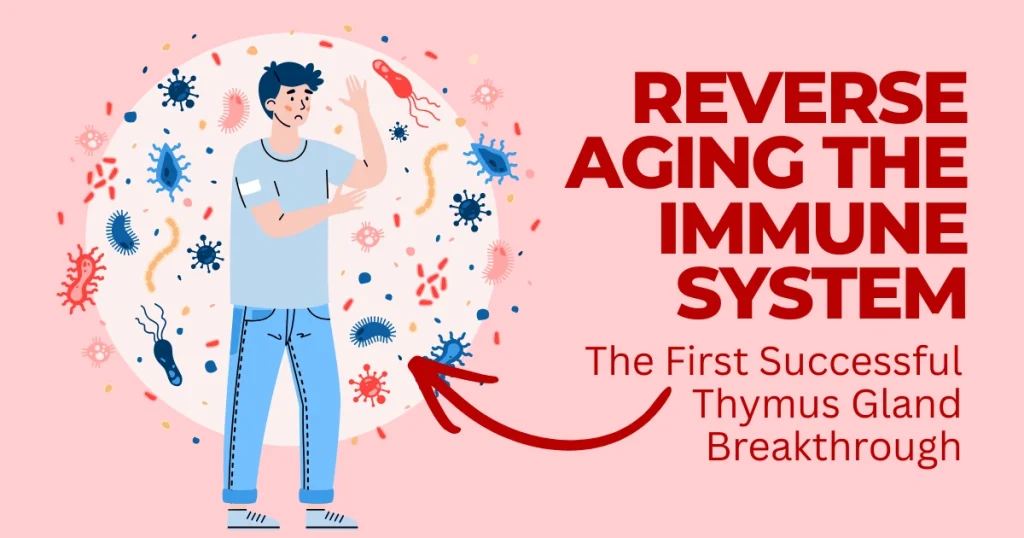
By the time you reach age 50, your thymus—the “school” where your immune system’s T-cells go to train—has largely turned into fat. This process, known as thymic involution, is why older adults are more susceptible to cancer, autoimmune diseases, and viral infections like COVID-19 or the flu.
For decades, reversing this was considered impossible. However, we have entered a new era. We aren’t just talking about “slowing down” aging anymore; we are discussing the first successful regeneration of the thymus gland. This is the holy grail of regenerative medicine.
Why the Thymus Gland is the Master Key to Longevity
To understand the magnitude of this breakthrough, we have to look at how the immune system functions. Think of your immune system as an elite military force.
- B-Cells: Produce the ammunition (antibodies).
- T-Cells: The front-line soldiers that identify and destroy infected cells or tumors.
T-cells are born in the bone marrow but must travel to the thymus to be “educated.” In the thymus, they learn to distinguish between “self” and “enemy.” If the thymus is gone or non-functional, your body stops producing new, “naive” T-cells. You are left with a dwindling army of aging soldiers who are tired, confused, and prone to “friendly fire” (autoimmunity).
The TRIIM Trial: The Spark That Changed Everything
The first real “proof of concept” that we could reverse thymic aging came from the TRIIM (Thymus Regeneration, Immunorestoration, and Insulin Mitigation) study. Led by Dr. Greg Fahy and Dr. Steve Horvath, this clinical trial used a cocktail of FDA-approved substances—Growth Hormone, DHEA, and Metformin—to see if they could regrow thymic tissue.
The Results Were Staggering:
- MRI Evidence: Magnetic resonance imaging showed that the fat in the thymus was being replaced by functional, healthy tissue.
- Epigenetic Reversal: Using “Horvath’s Clock” (a measure of biological age via DNA methylation), participants didn’t just stop aging—they reversed it by an average of 2.5 years.
The New Frontier: Bioengineering a Functional Thymus
While the TRIIM trial used chemical stimulation, the latest breakthrough involves bioengineering. Researchers at institutions like University College London (UCL) and the Francis Crick Institute have successfully rebuilt a human thymus using stem cells and a bio-scaffold.
How it Works: The “Decellularization” Method
Scientists took an organ scaffold and “reseeded” it with thymic epithelial cells (TECs) and interstitial cells derived from human tissue. By creating a microenvironment that mimics the womb, they coaxed these cells into forming a structured, functional gland.
When this bioengineered thymus was transplanted into lab models, it began producing new T-cells immediately. This isn’t just a “treatment”; it is a hardware replacement for the human immune system.
Clinical Implications: What This Means for You
As a clinician, I see four immediate areas where this technology will revolutionize medicine:
1. Eliminating Immunosenescence
Immunosenescence is the technical term for the aging of the immune system. By restoring the thymus, we can effectively “reset” the immune age of an 80-year-old to that of a 20-year-old. This could make vaccines more effective and common infections less lethal for the elderly.
2. Cancer Prevention and Treatment
Cancer is often a failure of immune surveillance. Aging T-cells miss the early signs of malignancy. A regenerated thymus ensures a constant supply of fresh T-cells capable of hunting down and destroying mutated cells before they form tumors.
3. Solving Autoimmune Disorders
Many autoimmune diseases stem from the thymus failing to “teach” T-cells properly. By regenerating a healthy thymus environment, we may be able to “re-educate” the immune system to stop attacking the body’s own tissues, offering a potential cure for conditions like Type 1 Diabetes or Multiple Sclerosis.
4. Transplant Tolerance
One of the greatest challenges in organ transplants is rejection. If we can co-transplant a bioengineered thymus from the same donor as a kidney or heart, we could train the recipient’s immune system to accept the new organ as “self,” eliminating the need for life-long, toxic immunosuppressant drugs.
Challenges on the Horizon: Ethics and Accessibility
Despite my excitement, we must remain grounded in the reality of medical development.
- Growth Hormone Risks: Using growth hormones (as seen in the TRIIM trial) carries risks of promoting certain cancers or causing insulin resistance. This is why the inclusion of Metformin was so vital.
- Cost and Scalability: Bioengineering organs is currently an incredibly expensive process. Moving from a laboratory breakthrough to a standard hospital procedure will take a decade or more of refinement.
- The “Immortality” Debate: If we solve immune aging, we solve one of the primary drivers of natural death. This raises significant societal questions about lifespan extension and resource management.
Actionable Steps: Can You Support Your Thymus Now?
While we wait for bioengineered thymus transplants to become available at your local clinic, there are evidence-based ways to support your current thymic health:
- Zinc Supplementation: The thymus is highly sensitive to zinc levels. A deficiency can lead to rapid thymic atrophy.
- Vitamin D3: Essential for T-cell activation and thymic function.
- Stress Management: High levels of cortisol (the stress hormone) are toxic to thymic epithelial cells.
- Intermittent Fasting: Some studies suggest that fasting cycles can “clear out” old immune cells and trigger the production of new ones.
Final Thoughts from a Health Perspective
The successful regeneration of the thymus gland represents the transition of “anti-aging” from the realm of science fiction into the realm of clinical reality. We are no longer just treating the symptoms of old age; we are targeting the biological engine that keeps us alive.
As a health professional, I believe we are less than a generation away from a world where “dying of old age” is no longer a foregone conclusion, but a manageable biological hurdle. DrugsArea
Sources & References
- Nature Journal: Reversal of epigenetic aging and immunosenescence trends in humans (TRIIM Trial)
- Nature Communications: Bioengineering a functional human thymus
- Science Direct: The Role of the Thymus in Immune Reconstitution
- UCL News: World first in regenerating a complex human organ
- The Lancet: Ageing and the immune system: the impact of immunosenescence
People Also Ask
1. Can the thymus gland actually be regenerated in humans?
Yes, a clinical trial known as TRIIM has successfully demonstrated thymus regeneration in humans.
For decades, scientists believed the thymus (the master gland for immune health) inevitably shrank and turned to fat as we aged—a process called involution. However, the 2019 TRIIM (Thymus Regeneration, Immunorestoration, and Insulin Mitigation) trial, led by Dr. Gregory Fahy, proved that a specific cocktail of existing drugs could not only regrow functional thymic tissue but also reverse the body’s epigenetic biological clock by approximately 2.5 years.
2. What is the drug cocktail used to reverse immune aging?
The breakthrough protocol used a combination of three common agents: Recombinant Human Growth Hormone (rhGH), DHEA, and Metformin.
- rhGH: The primary driver that stimulates the thymus to regrow and produce new T-cells.
- DHEA: A mild hormone added to counter the potential side effects of growth hormone (like high blood sugar).
- Metformin: A standard diabetes drug included to further manage insulin levels and provide its own anti-aging benefits.
Note: This is a medical protocol requiring strict doctor supervision, not a DIY supplement stack.
3. Why is the thymus gland so important for aging?
The thymus is the “university” where your T-cells go to learn how to fight viruses and cancer.
When you are young, your thymus is large and active, pumping out “naïve” T-cells that can adapt to new threats. By age 60, the gland is mostly fat, and your immune system is forced to rely on old “memory” cells. This decline (immunosenescence) is why older adults are more vulnerable to infections like the flu or pneumonia and have higher cancer risks. Regenerating the thymus essentially restocks your body’s defense reserves.
4. Did the TRIIM trial actually reverse biological age?
Remarkably, yes—participants didn’t just improve their immune systems; they became biologically younger.
Researchers measured “GrimAge,” an epigenetic clock that predicts lifespan and health risks. After one year of treatment, the participants’ biological ages were, on average, 2.5 years younger than at the start of the trial. This suggests that fixing the immune system might be a “master key” to slowing down or even reversing the overall aging process of the body.
5. Is thymus regeneration therapy safe?
The initial TRIIM trial showed the protocol was generally safe and well-tolerated, but it does carry risks.
The most common side effects were mild, including joint pain (typical with growth hormone) and slight changes in insulin sensitivity, which were managed with Metformin. However, because Human Growth Hormone (hGH) can stimulate cell growth, there is a theoretical concern about it fueling cancer cells, though the trial found no evidence of this. Larger studies (like the follow-up TRIIM-X) are currently underway to verify safety in a broader population.
6. How long does it take to see results from thymus therapy?
The TRIIM protocol was designed as a 12-month treatment, with significant changes observed after 9 months.
Thymus tissue doesn’t regrow overnight. In the trial, MRI scans showed that fat in the thymus was replaced by functional dark tissue gradually over the year. Similarly, the “age reversal” effect on the epigenetic clock seemed to accelerate in the final months of the trial, suggesting that consistent, long-term treatment is necessary to see the full anti-aging benefit.
7. Can I regenerate my thymus naturally without drugs?
While you cannot fully regrow a shrunken thymus naturally, you can slow its decline.
Lifestyle factors play a massive role in “immunosenescence.” High-intensity interval training (HIIT) and resistance exercise have been shown to boost T-cell function. Additionally, maintaining adequate zinc levels (crucial for thymic health) and caloric restriction (fasting) have shown promise in animal studies for preserving thymic function. However, these methods are maintenance strategies, not the aggressive regrowth seen in the drug trials.
8. What is the difference between TRIIM and TRIIM-X?
TRIIM was the pilot study with only 9 men; TRIIM-X is the larger, more inclusive follow-up study.
The original breakthrough (TRIIM) was small and limited to white men aged 51–65. The ongoing TRIIM-X trial aims to replicate those results in a much larger group (up to 100 people) that includes women and a wider age range (40–80). This new phase is critical for proving that the immune-rejuvenating effects work for everyone, not just a specific demographic.
9. How much does thymus regeneration therapy cost?
The therapy is currently expensive and not covered by insurance, estimated at $15,000 to $20,000 per year.
Since Human Growth Hormone (hGH) is a tightly regulated and costly medication, the “off-label” use for anti-aging is pricey. The cost includes the hormones, the supporting medications, and the specialized blood tests (like epigenetic aging clocks) required to monitor progress and safety. As the science matures, researchers hope to find cheaper alternatives or synthetic thymic factors.
10. Are there new technologies replacing the drug cocktail?
Yes, researchers are already testing mRNA technology and gene therapies as the “next generation” of thymus repair.
Recent studies (as of late 2025/2026) are exploring the use of mRNA lipid nanoparticles—similar to COVID vaccines—to instruct the liver to produce thymic proteins temporarily. This method could potentially offer a safer, more targeted way to boost T-cells without the systemic side effects of growth hormone. While the TRIIM cocktail is the current standard, mRNA may be the future.