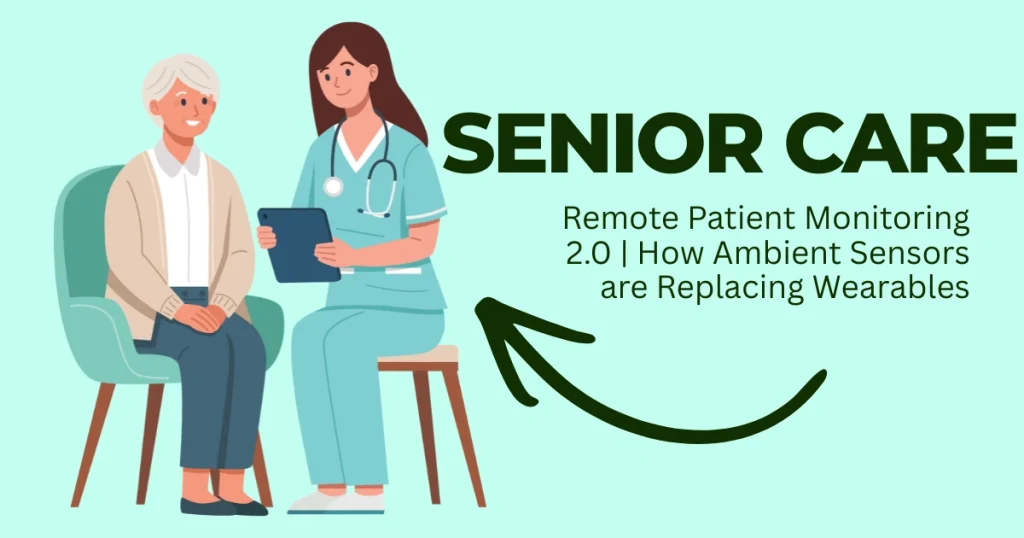
Remote Patient Monitoring 2.0 | How Ambient Sensors are Replacing Wearables for Senior Care
The Invisible Revolution in Geriatric Medicine
As a healthcare professional, I have spent years encouraging my senior patients to wear their medical alert pendants or sync their smartwatches. The reality? Compliance is the “Achilles’ heel” of traditional Remote Patient Monitoring (RPM). Whether it’s skin irritation, the cognitive load of daily charging, or simply the stigma of “feeling like a patient,” wearables often end up on the nightstand right when they are needed most.
Enter Remote Patient Monitoring 2.0. We are witnessing a fundamental shift from active monitoring (where the patient must do something) to passive or ambient monitoring (where the environment does the work). By integrating AI-driven sensors directly into the living space, we are finally moving toward a “frictionless” model of senior care that preserves dignity while enhancing safety.
The Problem with Wearables: Why 1.0 Hit a Ceiling
While the first generation of RPM brought us life-saving data, it relied on a flawed assumption: that a senior with potential mobility or cognitive challenges would consistently manage a piece of hardware.
- The Charging Gap: Most wearables require charging every 24–48 hours. For a senior with early-stage dementia or arthritis, this “simple” task is a significant barrier.
- The “Drawer Syndrome”: Research indicates that a staggering percentage of seniors stop using wearables within months of receiving them due to discomfort or perceived lack of utility.
- Reactive vs. Proactive: A fall pendant is reactive—it requires the senior to be conscious and capable of pressing a button. If they are incapacitated, the device is useless.
What is Ambient Sensing? (The Tech Behind RPM 2.0)
Ambient sensing, often referred to as “Invisible Health,” uses various technologies to monitor a patient’s health without any physical contact. In 2026, the three primary pillars of this technology include:
1. WiFi Sensing and mmWave Radar
Modern routers and dedicated wall-mounted sensors can now “see” movement by measuring how radio waves bounce off objects in a room. This technology is sensitive enough to detect the micro-movements of a person’s chest, allowing for the tracking of respiratory rate and heart rate without the patient wearing a single wire.
2. Acoustic AI and Vocal Biomarkers
Ambient microphones (utilizing edge computing to ensure privacy) can analyze sound patterns. They can distinguish between a “wet” cough indicative of CHF (Congestive Heart Failure) exacerbation and a dry cough. Furthermore, changes in speech cadence or tone can serve as early digital biomarkers for depression or cognitive decline.
3. Thermal and Optical Sensors
Thermal imaging allows for fall detection and gait analysis without capturing “identifiable” video. This protects the patient’s privacy—especially in high-risk areas like bathrooms—while providing clinicians with data on “near-misses” or shuffling, which are precursors to catastrophic falls.
Clinical Benefits: Beyond Just Vital Signs
As a clinician, the most exciting part of RPM 2.0 isn’t the hardware—it’s the longitudinal data. Ambient sensors provide a 24/7 “film” of a patient’s life rather than the “polaroid” snapshots provided by occasional blood pressure readings.
| Feature | Wearable RPM (1.0) | Ambient RPM (2.0) |
|---|---|---|
| Patient Effort | High (Wear, Charge, Sync) | Zero (Passive) |
| Data Continuity | Intermittent | Continuous (24/7) |
| Privacy | High (Personal device) | Very High (No cameras/wearables) |
| Fall Detection | Manual/Accelerometer-based | Predictive (Gait analysis) |
| Compliance | Fluctuates | 100% |
Early Detection of “Silent” Conditions
Ambient sensors excel at tracking Activities of Daily Living (ADLs). If the sensors detect that a patient is visiting the bathroom six times a night instead of their usual twice, we can intervene for a potential UTI before it leads to delirium or a fall. If the kitchen hasn’t been “active” by 10:00 AM, an automated alert can prompt a wellness check.
The 2026 Landscape: Privacy and Edge AI
A common concern among families is the “Big Brother” aspect of home sensors. However, the shift in 2026 is toward Edge AI. This means the data is processed locally on the device. The raw audio or movement data never leaves the home; only the “insight” (e.g., “Respiratory rate elevated” or “Fall detected”) is transmitted to the clinical team. This “Prescription-Based Privacy” ensures that monitoring is a medical necessity, not a surveillance tool.
The Verdict: A New Standard of Care
The transition to RPM 2.0 represents a move toward more empathetic medicine. By removing the “gadget” from the patient, we return their focus to living their lives, while we—the healthcare providers—receive a more accurate, objective stream of data to keep them safe.
The future of senior care isn’t a better watch; it’s a smarter home.
Health Disclaimer
The information provided in this article is for educational purposes only and is not intended as medical advice. Remote Patient Monitoring systems should be implemented under the guidance of a licensed healthcare provider. Always seek the advice of your physician or other qualified health provider with any questions you may have regarding a medical condition or the use of health technology. DrugsArea
Sources & Tags
Sources:
- The Future of Wearable Technologies and Remote Monitoring – PMC
- Understanding the Basics of Ambient Sensing – MatrixCare
- Ambient Diagnostics in 2026: Passive Sensors – ITBusinesstoday
- A Non-Wearable Approach to Elderly Monitoring – Origin Wireless
- AI in Remote Patient Monitoring: Use Cases 2025/2026 – HealthSnap
People Also Ask
Top 10 FAQs: Remote Patient Monitoring 2.0
1. What are ambient sensors in senior care?
Ambient sensors are “invisible” monitoring devices installed in a home’s environment (walls or ceilings) rather than worn on the body. Using technologies like radar (mmWave), AI-vision, or infrared, they track movement, sleep patterns, and falls without requiring a senior to remember to put on a device or charge a battery.
2. How is RPM 2.0 different from traditional wearables?
The main difference is passive vs. active participation. Traditional RPM (1.0) relies on wearables that seniors often forget to wear, find uncomfortable, or fail to charge. RPM 2.0 uses ambient intelligence to collect data automatically in the background, ensuring 24/7 coverage without any “tech friction” for the user.
3. Can ambient sensors detect falls as accurately as pendants?
Yes, and often more reliably. Modern ambient sensors use high-frequency radar to “see” a person’s posture in 3D. They can detect a fall even in the bathroom or while the person is sleeping—scenarios where seniors often take off their pendants. This eliminates the risk of a fall occurring while the life-saving device is sitting on a nightstand.
4. Do ambient sensors use cameras that invade privacy?
Most RPM 2.0 systems avoid traditional cameras. Instead, they use radar or thermal imaging that represents the person as a “dot” or a “heat map.” This allows the system to detect movement and falls with high precision while keeping the senior’s identity and specific activities private, even in sensitive areas like bathrooms.
5. How do these sensors help prevent health issues before they happen?
Through trend analysis. By monitoring daily routines, AI can flag subtle changes—like a senior taking 50% more trips to the bathroom (possible UTI) or sleeping significantly less (possible respiratory distress). These “digital biomarkers” allow caregivers to intervene days before an emergency room visit is necessary.
6. Do seniors find ambient sensors intrusive?
Generally, no. Research shows seniors prefer ambient sensors over wearables because they don’t feel “medicalized” or “branded” by a device on their wrist. Once installed, the sensors are often forgotten, allowing the senior to maintain their dignity and “age in place” without the constant reminder of their vulnerability.
7. Is the data from ambient sensors secure?
Leading RPM 2.0 providers use edge computing, meaning the data is processed locally on the device itself rather than in the cloud. Only “event alerts” (like a fall or a significant change in routine) are sent to caregivers, which significantly reduces the risk of data breaches.
8. Are ambient sensors more expensive than wearables?
The upfront cost of ambient sensors is typically higher due to the hardware and installation. However, they are often more cost-effective in the long run because they don’t get lost, broken, or require frequent replacements, and they provide much higher data compliance (near 100%) compared to wearables.
9. Can ambient sensors monitor vitals like heart rate?
Surprisingly, yes. Advanced mmWave radar sensors can detect the microscopic movements of a person’s chest to monitor heart rate and respiratory rate from across a room. This allows for clinical-grade vital monitoring without a single wire or strap touching the patient.
10. Can ambient sensors work alongside existing smart home tech?
Absolutely. Many RPM 2.0 systems are designed to integrate with smart home hubs. For example, if a sensor detects a senior getting out of bed at 3 AM, it can automatically turn on hallway lights to prevent a trip-and-fall accident, creating a truly proactive “Smart Care” environment.