The “QT45” Breakthrough: How a Tiny RNA Discovery Just Changed Medicine Forever
A Blockbuster Discovery in Molecular Biology
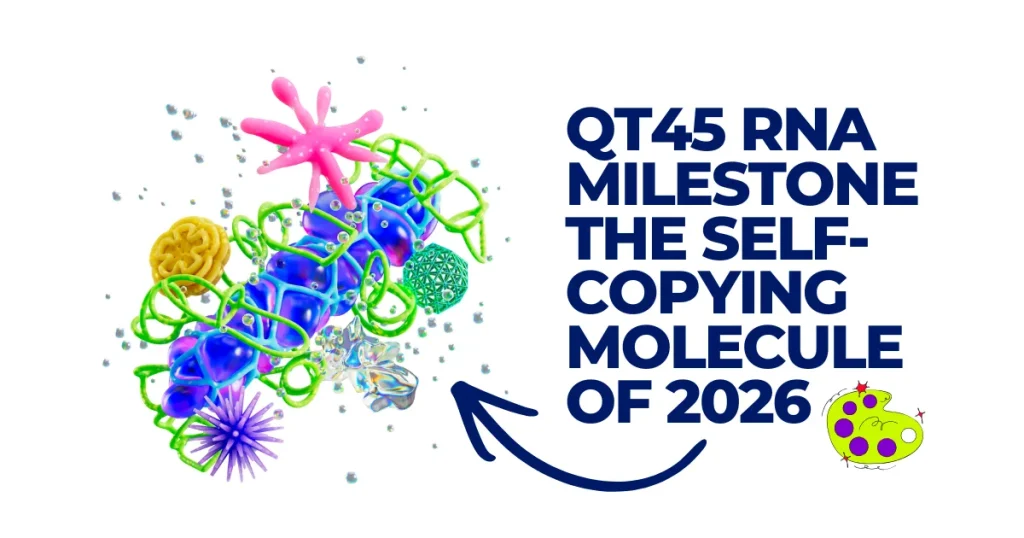
As a healthcare professional, I’ve seen many “breakthroughs” come and go, but the news hitting the wires today—February 13, 2026—is fundamentally different. Scientists at the MRC Laboratory of Molecular Biology (LMB) have just announced the identification of a tiny RNA molecule named “QT45.”
Why is the scientific community buzzing? Because QT45 can do something we previously thought required massive, complex biological machinery: it can copy itself.
This isn’t just a win for evolutionary biology; it is the starting gun for a new era of Synthetic Biology. If we can harness a molecule that replicates and repairs itself on a microscopic level, we are looking at a future where medical treatments don’t just “patch” a wound—they grow and adapt with the patient.
1. What is the “QT45” Molecule?
To understand QT45, think of a traditional cell as a giant, high-tech factory. Usually, to copy the “blueprints” (DNA or RNA) of that factory, you need heavy machinery, specialized workers (enzymes), and a lot of energy.
QT45 is the ultimate minimalist. It is a remarkably short RNA strand—a “polymerase ribozyme”—that acts as its own machine. Its small size is its greatest strength. Because it is so compact, it can navigate complex cellular environments and, most importantly, it can facilitate its own replication without needing the bulky protein enzymes that modern life usually relies on.
2. Why is “Self-Replication” Such a Big Deal?
In the medical world, we are used to “static” treatments. If you have a damaged heart valve or a worn-down knee joint, we replace it with a piece of plastic, metal, or non-living tissue. These materials eventually wear out because they cannot heal.
The discovery of QT45 proves that biological information can be self-sustaining at a tiny scale. This is the “missing link” scientists have been hunting for. It suggests that we can design synthetic biological systems that:
- Self-Repair: Tissues that fix their own “glitches” or wear-and-tear.
- Scale Up: Medical scaffolds that grow into full organs by replicating their own cellular instructions.
- Remain Stable: Small enough to be delivered via simple injections while remaining functional.
3. From “Origin of Life” to “Future of Tissues”
While the MRC LMB researchers are rightfully excited about how this explains the “RNA World” (how life began 4 billion years ago), the clinical implications for 2026 and beyond are staggering.
By mimicking the QT45 structure, bio-engineers are now working on “Programmable Tissues.” Imagine a liquid bandage infused with QT45-like molecules that, once applied to a severe burn, doesn’t just sit there. Instead, it begins to copy the necessary biological code to “build” new skin layers, effectively acting as a living, self-assembling graft.
4. How Does This Affect Today’s Patients?
You won’t see a “QT45 pill” at the pharmacy next week, but this discovery accelerates several key areas of medicine:
- Advanced mRNA Vaccines: Current vaccines are “one and done” instructions. Future versions could theoretically use self-copying RNA to provide longer-lasting immunity with much smaller doses.
- Cancer Therapy: We could design RNA molecules that only “replicate” inside a tumor, essentially out-competing the cancer cells for resources or delivering a localized treatment that grows exactly where it’s needed.
- Synthetic Organs: This is the foundation for “bioprinting” where the ink is alive and capable of perfecting its own structure.
The Health Professional’s Perspective
In my practice, I often tell patients that biology is the most advanced technology on Earth. We are finally learning how to write the code for that technology. The QT45 milestone is a reminder that the smallest molecules often hold the biggest solutions. We are moving away from “fixing” the body like a car and toward “growing” the body like a garden.
Health Disclaimer
This content discusses emerging laboratory research in synthetic biology and molecular genetics. These findings are currently in the experimental stage and are not yet available as clinical treatments. Always consult with a licensed healthcare provider regarding current medical therapies or participation in clinical trials. DrugsArea
Sources & References
- UK Research and Innovation (UKRI) – MRC LMB Breakthrough, MRC Laboratory of Molecular Biology – Official Site, Science Journal – QT45 RNA Polymerase Ribozyme Study, Nature Chemistry – Origins of Life Research
People Also Ask
1. What is the QT45 RNA discovery?
QT45 is a remarkably small ribozyme (a strand of RNA that acts like an enzyme) consisting of only 45 nucleotides. Discovered by researchers at the MRC Laboratory of Molecular Biology in 2026, it is the first “tiny” RNA found that can copy itself and its complementary strand. This proves that complex life could have started from very simple, short chemical chains, confirming the “RNA World” hypothesis.
2. Why is QT45 being called a “medical breakthrough”?
While the discovery is rooted in the origins of life, the medical implications are massive. Because QT45 is so small and efficient at self-replication, scientists can use it as a blueprint for a new generation of synthetic RNA drugs. It provides a “minimalist toolkit” for creating medicines that can replicate inside specific target cells (like tumors) to deliver continuous treatment without repeated dosing.
3. How does QT45 change the way we treat cancer?
Unlike current mRNA treatments that require large, fragile molecules, QT45-inspired therapies are “short and stable.” This allows for more precise RIBOTAC (Ribonuclease-Targeting Chimera) technology, where these tiny RNA molecules can be programmed to find and destroy specific cancer-linked RNA, such as TERRA, effectively starving brain and bone tumors at the genetic level.
4. Is QT45-based medicine safe for humans?
Yes, it is considered a major leap forward in safety. Because QT45 is so small, it is less likely to trigger the “immune overreaction” (flu-like symptoms) often associated with larger synthetic RNA strands. Its simplicity makes it more “stealthy” within the human body, allowing it to reach organs like the brain or heart more easily without being attacked by the immune system.
5. Can QT45 cure genetic diseases?
It’s a powerful new tool in the “undruggable” category. Because QT45 can copy itself, it offers a way to provide long-term gene regulation. For conditions like Spinal Muscular Atrophy (SMA) or Huntington’s Disease, QT45-derived molecules could potentially stay active in the nervous system longer than current treatments, reducing the need for frequent, invasive spinal injections.
6. How is QT45 different from the mRNA in COVID-19 vaccines?
The mRNA in vaccines is like a “instruction manual” that tells your cells to build a protein once. QT45 is more like a “photocopier.” It doesn’t just provide instructions; it has the catalytic power to build and replicate other RNA molecules. This means medicine can now be dynamic—replicating and responding to the body’s needs in real-time.
7. Does the QT45 discovery mean we can create life in a lab?
It brings us closer than ever. By showing that a 45-nucleotide chain can replicate, scientists have “bridged the gap” between simple chemistry and biological life. While we aren’t “creating life” in the sense of complex organisms, we have successfully recreated the functional engine that likely started evolution on Earth 4 billion years ago.
8. When will QT45-based treatments be available in hospitals?
We are currently in the “platform development” stage. While the discovery was finalized in early 2026, the first clinical trials for QT45-derived antivirals and oncology tools are expected to begin within the next 18–24 months. Because it uses existing RNA manufacturing infrastructure, the “lab-to-bedside” timeline is expected to be much faster than traditional drugs.
9. Can QT45 help fight viral pandemics?
Absolutely. Researchers are using the QT45 “engine” to design broad-spectrum antivirals. These would target the “frameshifting” mechanisms that many viruses (like Coronaviruses or Influenza) use to replicate. A QT45-style drug could essentially “jam” the virus’s ability to copy itself by out-competing it at the molecular level.
10. Will this discovery make personalized medicine more affordable?
In the long run, yes. The “smallness” of QT45 makes it cheaper to synthesize and easier to transport (it doesn’t require the ultra-cold storage that larger mRNA molecules do). Its ability to be “digitally designed” means that pharmaceutical companies can rapidly customize a 45-nucleotide sequence for a single patient’s specific mutation at a fraction of the current cost.