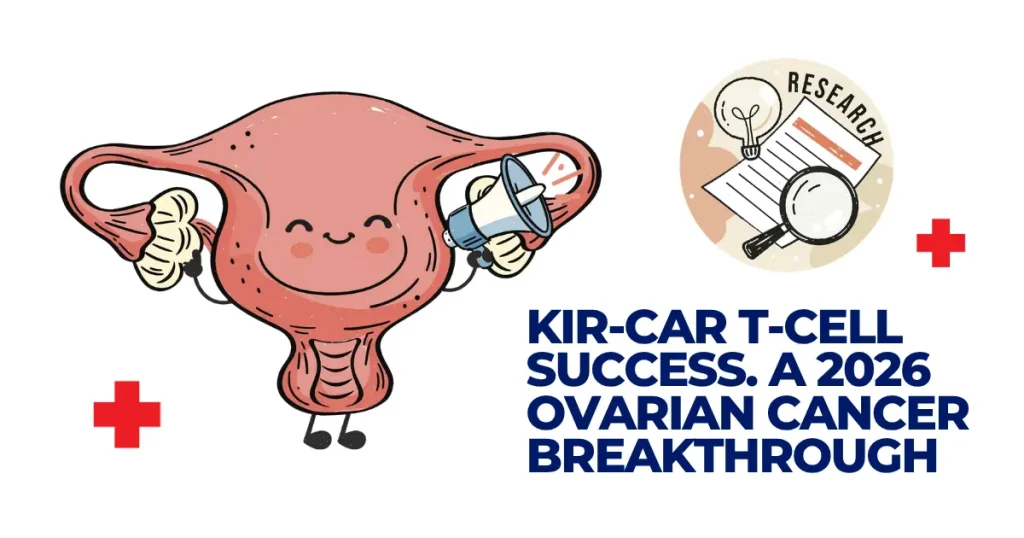
KIR-CAR Breakthrough: The New “NK-Logic” Beating Ovarian Cancer Exhaustion
The Landmark STAR-101 Results: Why April 2026 is Different
As a pharmacist, I talk to a lot of patients who feel like they have no other options when standard chemotherapy or first-generation immunotherapies stop working. But on April 13, 2026, a big change happened at the AACR (American Association for Cancer Research) Annual Meeting.
Researchers showed the important results from the STAR-101 Phase 1 Trial. For people with treatment-resistant ovarian cancer and mesothelioma, this news is truly life-changing. We are leaving behind the time when cells “burn out” and entering the time of the KIR-CAR platform.
The Problem: The “T-Cell Burnout” Barrier
You need to know why traditional CAR T-cell therapy had trouble with solid tumors in order to understand why this is a big deal. T-cells work like a sprint in blood cancers: they find the target and kill it. But solid tumors, like those in the lungs or ovaries, are more like running a marathon through a swamp.
The tumor makes a “microenvironment” that is bad for immune cells. The T-cells get “exhausted” after a few days. They lose their energy, stop dividing, and basically go to sleep while the cancer keeps growing.
The Solution: What is KIR-CAR?
KIR stands for Killer Cell Immunoglobulin-like Receptor. Scientists have borrowed the logic of Natural Killer (NK) cells instead of the “wires” that standard T-cells use to send signals.
As a health professional, I’m very interested in this “NK-Logic” because
- Natural Signaling: It uses the same internal pathways that NK cells use to tell the difference between healthy tissue and a threat.
- Stops Over-Stimulation: Traditional CAR-T often “fires” too hard and too fast, which makes people tired too soon. KIR-CAR is made to be more accurate and last longer.
- Survival in the “Swamp”: The STAR-101 trial showed that these engineered cells could stay active inside a solid tumor for a lot longer than older therapies.
What This Means for Patients in 2026
This is the conversation you should have with your oncology team right now if you or someone you care about has mesothelin-expressing tumors, which are common in advanced ovarian cancer and mesothelioma.
The STAR-101 trial, which used the drug candidate SynKIR-110, showed that these cells don’t just “hit” the tumor; they stay there. For a patient, “persistence” means that the body is actively fighting the cancer for a longer time without needing to be re-infused all the time or having to deal with the toxic “cytokine storms” that older technology often causes.
A Pharmacist’s Perspective on “NK-Receptor” Protocols
We look at how the drug works on the body in the pharmacy. The KIR-CAR platform is great because it can change how the immune system works. It resembles a highly trained tactical team rather than a bomb.
For patients who haven’t responded to standard immunotherapy with PD-1 or CTLA-4 inhibitors, 2026 has opened up a “secondary pathway.” These NK-Receptor protocols are showing that we can change the immune system so that it stays awake until the job is done.
Summary of the STAR-101 Impact
| Feature | Traditional CAR-T | KIR-CAR (2026) |
| Primary Target | Blood Cancers | Solid Tumors (Ovarian, Mesothelioma) |
| Durability | High risk of “Exhaustion” | Sustained activity via NK-signaling |
| Logic | T-Cell Receptor based | Killer Cell (KIR) Receptor based |
| Availability | Standard Care | Advanced Clinical Trials / STAR-101 |
Health Disclaimer
This article is for educational purposes and reflects recent clinical trial data as of April 2026. It is not a substitute for professional medical advice, diagnosis, or treatment. Always seek the advice of your physician or other qualified health provider with any questions regarding a medical condition or eligibility for clinical trials. DrugsArea
Sources & References
- AACR Annual Meeting 2026 Official Proceedings,
- ClinicalTrials.gov: NCT05568680 (SynKIR-110),
- Verismo Therapeutics Clinical Data Release,
- Nature: Advances in Solid Tumor Immunotherapy