
Managing COPD in 2026: The Global Push for First-in-Class Inhaled Anti-Inflammatories
As a healthcare professional who has spent years watching patients struggle with the “inhaler shuffle”—juggling three different devices just to get through a morning—the news today, January 27, 2026, feels like a pivotal moment in respiratory medicine.
The National Medical Products Administration (NMPA) has officially accepted the New Drug Application for ensifentrine (Ohtuvayre) for review. Following its successful integration into U.S. clinical practice over the last year, this global expansion signals a shift toward a more streamlined, effective, and “human-centric” approach to Chronic Obstructive Pulmonary Disease (COPD) management.
The Problem with the Old Paradigm
For decades, we have treated COPD by compartmentalizing its two main drivers: bronchoconstriction and inflammation.
Typically, this required a combination of:
- Long-Acting Beta-Agonists (LABA) or Muscarinic Antagonists (LAMA) for opening the airways.
- Inhaled Corticosteroids (ICS) to dampen inflammation.
While effective, this polypharmacy approach often leads to “device fatigue.” Patients, particularly the elderly, may struggle with different inhalation techniques for different devices, leading to suboptimal dosing and frequent exacerbations.
Why Ensifentrine is a “Game-Changer”
Ensifentrine represents a “first-in-class” mechanism. It is a selective dual inhibitor of phosphodiesterase 3 and 4 (PDE3 and PDE4).
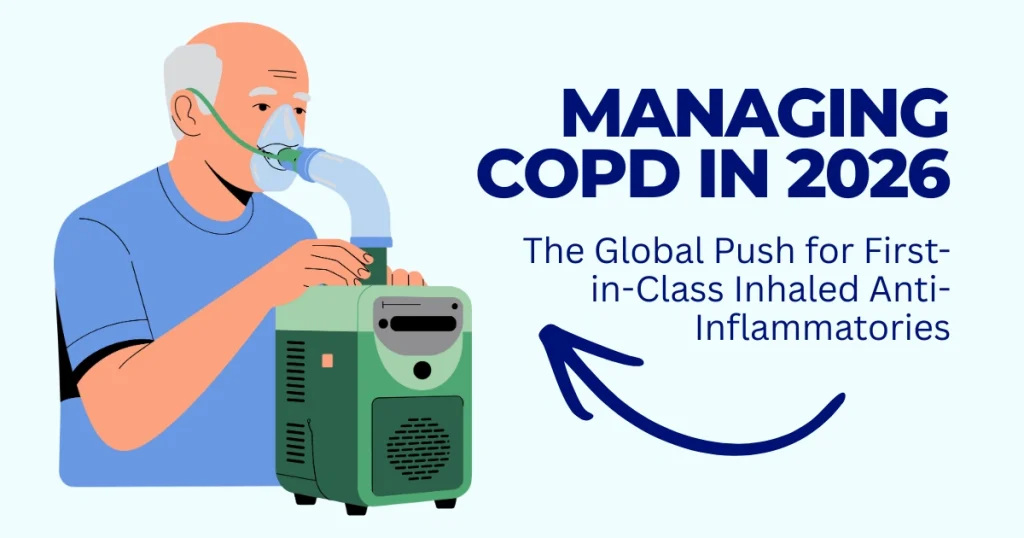
What does that mean in plain English? It means a single molecule, delivered via a standard jet nebulizer, simultaneously relaxes the smooth muscles in the lungs (bronchodilation) and reduces the cellular triggers of swelling and mucus (anti-inflammatory).
- PDE3 Inhibition: Focuses on immediate relief by relaxing airway muscles.
- PDE4 Inhibition: Focuses on long-term stability by suppressing the inflammatory cells (like neutrophils and macrophages) that drive COPD progression.
Clinical Impact: Beyond the Lab
The ENHANCE clinical trials demonstrated that patients using ensifentrine experienced a significant reduction in the annual rate of moderate-to-severe exacerbations. For my patients, an “exacerbation” isn’t just a statistic; it’s a terrifying trip to the ER and a permanent notch down in their baseline lung function.
By reducing the need for multiple separate devices, we aren’t just improving lung function numbers—we are improving adherence. When a treatment is easier to take, it actually gets taken.
The Landscape of 2026
As we move through 2026, the push for non-steroidal anti-inflammatories is gaining momentum. While steroids have their place, their long-term use in COPD is often limited by risks of pneumonia or systemic side effects. Ensifentrine offers a non-steroidal pathway to inflammation control, filling a massive gap for patients who are symptomatic despite maximal “standard” triple therapy.
Sources & Tags
Sources:
- Nuance Pharma Announces NMPA Acceptance of Ohtuvayre (Jan 2026)
- FDA Prescribing Information: Ohtuvayre (Ensifentrine)
- The ENHANCE Trials: Efficacy and Safety of Ensifentrine (PubMed)
Health Disclaimer: This content is for informational purposes only and does not constitute medical advice, diagnosis, or treatment. Always seek the advice of your physician or other qualified health provider with any questions you may have regarding a medical condition. Never disregard professional medical advice or delay in seeking it because of something you have read here. DrugsArea
People Also Ask
1. What are the “first-in-class” inhaled anti-inflammatories for COPD in 2026?
The headline breakthrough is Ensifentrine (Ohtuvayre). It is the first therapy in decades to combine a bronchodilator (which opens airways) with a non-steroidal anti-inflammatory in a single molecule. Unlike traditional steroids, it works by inhibiting both PDE3 and PDE4 enzymes, offering a dual-action approach to reducing lung swelling and mucus production.
2. How does 2026 COPD management differ from previous years?
The 2026 approach is moving away from “one-size-fits-all” inhalers toward precision medicine. Doctors are now using “treatable traits”—like high eosinophil counts or specific genetic markers—to prescribe targeted biologics (like Dupilumab) or dual-action inhibitors rather than just relying on generic triple-therapy inhalers.
3. Is Dupilumab (Dupixent) now available for COPD patients?
Yes! As of early 2026, Dupilumab has been approved by major health bodies (including NICE in the UK) as a breakthrough add-on maintenance treatment. It’s specifically for adults with uncontrolled COPD and high blood eosinophils, marking the first time a biologic has been used to target the underlying type-2 inflammation in COPD.
4. Are these new anti-inflammatories better than steroid inhalers?
“Better” depends on the patient, but they are certainly different. Traditional inhaled corticosteroids (ICS) can sometimes increase pneumonia risk in certain COPD patients. First-in-class medications like Ensifentrine provide anti-inflammatory benefits without the typical side effects of steroids, making them a game-changer for those who are “steroid-resistant.”
5. Can I replace my current inhaler with a first-in-class anti-inflammatory?
Not necessarily. These new medications are often designed as maintenance add-ons. For instance, if you are already on “triple therapy” (LABA/LAMA/ICS) but still experience frequent flare-ups, these first-in-class treatments are introduced to stabilize your lungs further, not always to replace your rescue inhaler.
6. What are the side effects of new 2026 COPD medications?
While generally well-tolerated, newer PDE3/4 inhibitors can cause mild side effects like diarrhea, back pain, or headaches. However, they lack the long-term risks associated with high-dose oral steroids, such as bone thinning (osteoporosis) or skin bruising.
7. How often do you take the new inhaled anti-inflammatories?
Most of the latest first-in-class inhaled treatments, such as those delivered via nebulizer or specialized inhalers, are designed for twice-daily use. Biologic options, like the newly approved injections, are typically administered once every two weeks.
8. Will these new treatments reduce my COPD flare-ups?
Data from 2025 and 2026 clinical trials (like the ENHANCE and BOREAS studies) show that these new treatments can reduce moderate-to-severe exacerbations by up to 30-34%. This significantly lowers the risk of hospital visits and permanent lung damage.
9. Is there a “cure” for COPD being researched in 2026?
While there is still no “cure” that reverses lung damage, the push for first-in-class anti-inflammatories is the closest we’ve come to disease modification. By stopping the inflammatory “fire” in the lungs more effectively, these drugs aim to halt the progression of the disease rather than just masking the symptoms.
10. How can I access these new 2026 COPD treatments?
Access usually requires a consultation with a pulmonologist who can perform a blood test for eosinophils or a specialized spirometry test. Because these are “first-in-class” and relatively new to the market, they are typically reserved for patients whose symptoms remain “uncontrolled” on standard inhalers.