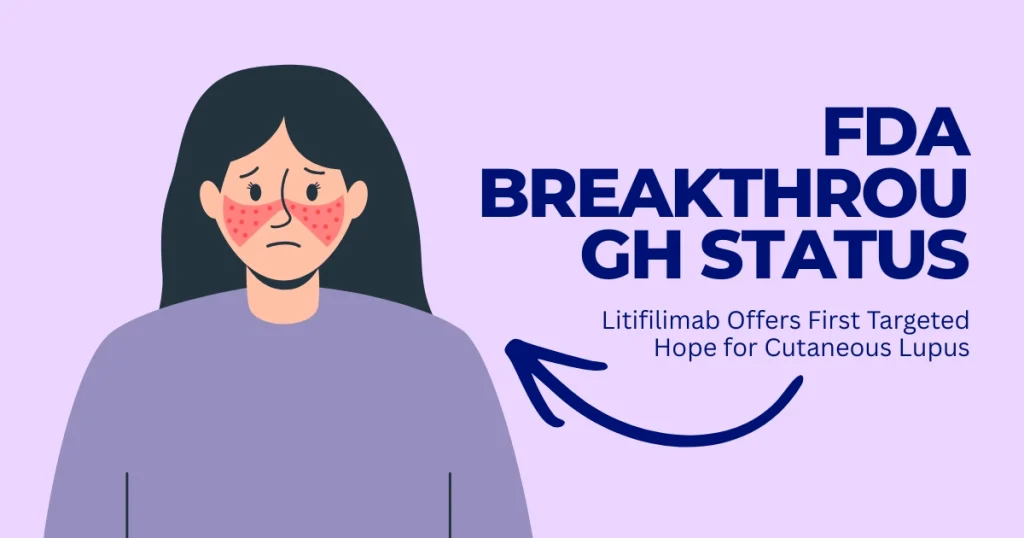
FDA Breakthrough Status | Litifilimab Offers First Targeted Hope for Cutaneous Lupus
A Historic Milestone in Autoimmune Skin Care
Today, January 28, 2026, marks a transformative day for the millions of individuals living with Cutaneous Lupus Erythematosus (CLE). The U.S. Food and Drug Administration (FDA) has officially granted Breakthrough Therapy Designation to litifilimab (BIIB059), a first-in-class monoclonal antibody developed by Biogen.
For a long time, patients with skin-based lupus have been caught in a cycle of “managing” rather than “treating.” This news signals a shift toward precision medicine that could finally end the heavy reliance on steroids and offer a future of clear skin and reduced systemic inflammation Litifilimab for Cutaneous Lupus.
What is Litifilimab? The Science of Targeted Hope
Litifilimab is not just another immunosuppressant; it is a humanized IgG1 monoclonal antibody. To put it simply, it is a highly specific “heat-seeking missile” designed to find and turn off the source of inflammation in the skin.
How It Works: Targeting the BDCA2 Receptor
In patients with lupus, certain immune cells called plasmacytoid dendritic cells (pDCs) are hyperactive. These cells pump out massive amounts of Type I interferons, proteins that cause the red, scaly, and often painful rashes associated with CLE.
Litifilimab works by binding to a specific receptor on these cells known as BDCA2. By doing this, it tells the pDCs to stop producing those inflammatory proteins. Unlike traditional steroids that suppress the entire immune system, litifilimab is targeted, meaning it goes after the specific pathway driving the disease.
Why “Breakthrough” Status Matters Litifilimab for Cutaneous Lupus
The FDA doesn’t hand out “Breakthrough Therapy” labels easily. This designation is reserved for drugs that:
- Treat a serious or life-threatening condition.
- Show preliminary clinical evidence that the drug may be a substantial improvement over existing therapies.
For CLE patients, there have been no specifically approved targeted treatments until now. Most patients are currently treated with antimalarials (like hydroxychloroquine) or corticosteroids. While these can help, they often come with a laundry list of side effects, including skin thinning, weight gain, and long-term organ damage from steroid use.
The LILAC Study: The Proof in the Numbers
The FDA’s decision was largely based on the Phase 2 LILAC study. In this trial, litifilimab significantly reduced skin disease activity compared to a placebo. It wasn’t just a minor improvement; it was enough to prove that targeting the pDC pathway actually works in the real world.
Moving Beyond the “Steroid Cycle” Litifilimab for Cutaneous Lupus
As a health professional, the most exciting part of this announcement is the potential to move away from chronic steroid use. For decades, we have used steroids as a “crutch” for lupus patients because we didn’t have anything better.
The risks of long-term steroid use are well-documented:
- Osteoporosis: Weakening of the bones.
- Glaucoma/Cataracts: Issues with vision.
- Metabolic Issues: Increased risk of diabetes and high blood pressure.
- Skin Atrophy: Permanent thinning and scarring of the skin.
Litifilimab offers a “steroid-sparing” future. By controlling the disease at its source, we hope to see patients achieve remission without the heavy burden of traditional medications.
Understanding Cutaneous Lupus (CLE) Litifilimab for Cutaneous Lupus
Lupus is often thought of as an internal disease affecting the kidneys or heart (Systemic Lupus Erythematosus or SLE). However, 70-85% of lupus patients will experience skin manifestations.
CLE can manifest in several ways:
- Malar Rash: The classic “butterfly rash” across the nose and cheeks.
- Discoid Lupus: Thick, red, scaly patches that can lead to permanent scarring and hair loss.
- Subacute Cutaneous Lupus: Ring-shaped sores that worsen with sun exposure.
For many, these aren’t “just rashes.” They are painful, disfiguring, and lead to significant psychological distress and social isolation. Having a targeted therapy like litifilimab acknowledges that the skin is a major organ that deserves its own specialized treatment.
What’s Next for Patients For Litifilimab for Cutaneous Lupus?
While the Breakthrough Designation speeds up the development and review process, the drug is not yet available at your local pharmacy.
- Phase 3 Trials (AMETHYST): Biogen is currently conducting larger trials to confirm the safety and efficacy of litifilimab in a broader population.
- Anticipated Timeline: Data readouts are expected in 2027. If successful, a full FDA approval could follow shortly thereafter.
Summary of Litifilimab Benefits
| Feature | Traditional Treatments (Steroids) | Litifilimab (BIIB059) |
|---|---|---|
| Approach | Broad immune suppression | Targeted (BDCA2/pDC) |
| Primary Goal | Symptom management | Disease pathway modification |
| Long-term Safety | High risk of organ damage | Potentially improved safety profile |
| FDA Status | Standard of Care (Off-label) | Breakthrough Therapy |
Final Thoughts
The FDA’s recognition of litifilimab is more than just a regulatory win; it’s a validation for every patient who has felt “unseen” while dealing with the visible scars of lupus. We are entering an era where we no longer have to settle for treatments that cause as many problems as they solve.
Health Disclaimer: This article is for informational purposes only and does not constitute medical advice, diagnosis, or treatment. Always seek the advice of your physician or other qualified health provider with any questions you may have regarding a medical condition. Never disregard professional medical advice or delay in seeking it because of something you have read here. DrugsArea
Sources
- Lupus Research Alliance: FDA Breakthrough Therapy Designation for Litifilimab
- Biogen Investor Relations: Litifilimab Receives FDA Breakthrough Status
- Dermatology Times: FDA Grants Breakthrough Therapy Designation to Litifilimab
- New England Journal of Medicine: Trial of Anti-BDCA2 Antibody Litifilimab
People Also Ask
1. What is the recent FDA news regarding litifilimab and cutaneous lupus?
On January 28, 2026, the FDA granted Breakthrough Therapy designation to litifilimab (BIIB059) for the treatment of cutaneous lupus erythematosus (CLE). This status is reserved for drugs that show the potential to provide a substantial improvement over existing treatments for serious conditions, allowing the FDA to expedite its development and review process.
2. How does litifilimab work differently than current lupus treatments?
Unlike broad immunosuppressants or steroids, litifilimab is a targeted monoclonal antibody. It specifically binds to BDCA2, a receptor found on certain immune cells (plasmacytoid dendritic cells). By doing this, it reduces the production of type I interferons—proteins that are major drivers of inflammation and skin damage in lupus patients.
3. Why is litifilimab considered the “first targeted hope” for cutaneous lupus?
Currently, there are no FDA-approved therapies specifically designed for cutaneous lupus (CLE). Patients typically rely on “off-label” treatments like antimalarials or topical steroids, which don’t always work and can have significant side effects. Litifilimab is the first treatment developed to specifically target the biological pathways of the skin-based form of the disease.
4. What are the symptoms of cutaneous lupus that litifilimab aims to treat?
Cutaneous lupus primarily affects the skin, causing butterfly rashes, scaly red patches, and ring-shaped sores. If left untreated, it can lead to permanent scarring, changes in skin pigment, and hair loss (alopecia). Litifilimab aims to reduce this skin-specific inflammation and prevent long-term disfigurement.
5. What did the clinical trials show about litifilimab’s effectiveness?
The FDA’s decision was based on the Phase 2 LILAC study, which demonstrated that patients receiving litifilimab had a significant reduction in skin disease activity compared to those on a placebo. The drug showed a clear “dose-response” relationship, meaning higher efficacy was generally observed with the optimized dosages.
6. Who is developing litifilimab?
Litifilimab is being developed by Biogen Inc., a biotechnology company that has partnered with organizations like the Lupus Research Alliance to accelerate the discovery and testing of new autoimmune therapies.
7. Is litifilimab only for people with “skin-only” lupus?
While the Breakthrough designation is for Cutaneous Lupus (CLE), litifilimab is also being studied for patients with Systemic Lupus Erythematosus (SLE) who have active joint and skin symptoms. Many people with SLE suffer from skin manifestations, and this drug could potentially help both groups.
8. What are the side effects of litifilimab?
In Phase 2 trials, the most common side effects included upper respiratory infections, headaches, and injection-site reactions. Because it modulates the immune system, doctors are also monitoring for viral infections like shingles or herpes simplex, though most reported cases in trials were mild to moderate.
9. When will litifilimab be available to the public?
While the “Breakthrough” status speeds up the process, the drug is currently in Phase 3 clinical trials (the AMETHYST study). Data from these final-stage trials is expected in 2027. If the results are positive, an official FDA filing for public availability would likely follow shortly after.
10. Can I join a clinical trial for litifilimab?
Yes, Biogen is currently recruiting for the Phase 3 AMETHYST trial at various locations globally. Patients with moderate-to-severe cutaneous lupus who haven’t found relief with standard treatments may be eligible. You can find more details on ClinicalTrials.gov or through the Lupus Research Alliance.