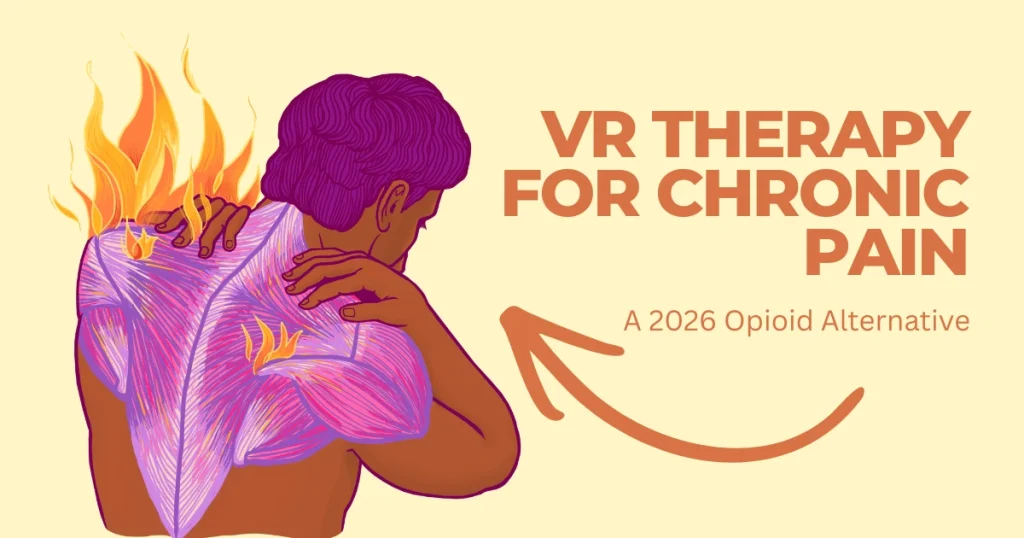
Virtual Reality for Chronic Pain: Replacing Opioids with “Neurological Distraction”
The Digital Analgesic: Why Virtual Reality is the Future of Chronic Pain Management
As a healthcare professional, I’ve watched the “Gold Standard” of pain management shift from the aggressive prescribing of the late 90s to the cautious, multimodal approach we use today. However, for patients living with fibromyalgia and other chronic pain syndromes, the options have often felt limited to pharmaceutical management or “learning to live with it.”
In 2026, we are witnessing a paradigm shift. We are no longer just treating pain with chemistry; we are treating it with neurological distraction. Virtual Reality (VR) has moved beyond the realm of gaming to become a clinically validated “digital analgesic.” For those seeking a non-pharmacological path, VR-based therapy is proving that we can leverage the brain’s own neuroplasticity to dial down the volume on chronic pain.
Clinical Success Stories of 2026: Fibromyalgia and Beyond
The clinical landscape in 2026 is defined by high-fidelity success. Recent longitudinal studies have highlighted a significant breakthrough: fully immersive VR environments are achieving pain reduction scores that rival traditional opioids, without the risk of respiratory depression or chemical dependency.
One landmark 2026 clinical trial involving over 500 fibromyalgia patients utilized “self-administered VR skills-based therapy.” Participants reported a 40-50% reduction in pain intensity after daily 20-minute sessions over eight weeks. More importantly, these effects weren’t just temporary; the “analgesic tail”—the period of relief after removing the headset—extended for hours, and in many cases, days, as the brain began to “forget” its habitual pain loops.
Another success story comes from the Integrative Pain Centers, where clinicians are using VR to treat “kinesiophobia”—the fear of movement. By placing fibromyalgia patients in a virtual low-gravity environment, they can perform physical therapy movements that would be excruciating in the “real world.” The brain, distracted by the immersive visual of fluid movement, suppresses the nociceptive (pain) signals, effectively retraining the central nervous system.
The Mechanism: How Immersive Landscapes “Rewire” the Brain
To understand why VR works, we have to look at how the brain processes pain. Pain is not just a sensation; it is an attention-demanding signal. The “Gate Control Theory” of pain suggests that our neurological “gates” can only process so much information at once.
1. Neurological Distraction (The “Top-Down” Approach)
When you are immersed in a high-fidelity VR landscape—such as the waterfalls of Oregon or an ancient bioluminescent forest—your visual and auditory systems are completely saturated. This is what we call neurological distraction. Because the brain’s bandwidth is occupied by processing these complex, 360-degree sensory inputs, it has fewer “computational resources” to devote to pain signals. In essence, the VR world becomes more “real” to your brain than the signals coming from your nerves.
2. Remapping the Somatosensory Cortex
Chronic pain conditions like fibromyalgia often involve “central sensitization,” where the brain becomes hyper-reactive to stimuli. Immersive VR therapies in 2026 use Virtual Embodiment Training (VET). When a patient sees a virtual “avatar” of themselves moving comfortably, the somatosensory cortex—the area of the brain responsible for body representation—begins to remap. By “seeing” a healthy, pain-free body in motion, the brain begins to down-regulate the alarm system that has been stuck in the “on” position.
3. Increasing GABA and Neuroplasticity
Recent fMRI data from 2025 and 2026 have shown that regular VR therapy can lead to an increase in GABA (gamma-aminobutyric acid), the primary inhibitory neurotransmitter that helps dampen pain. By consistently engaging in these “immersive landscapes,” patients are essentially performing neuroplasticity exercises. They are teaching their brains to focus on calm, regulated environments rather than the static “noise” of chronic pain.
Immersive Landscapes vs. Traditional Painkillers
The comparison between VR and traditional painkillers (like oxycodone or hydrocodone) is increasingly leaning in favor of digital intervention for long-term management.
| Feature | Traditional Opioids | VR-Based Therapy (2026) |
|---|---|---|
| Side Effects | Nausea, sedation, constipation, addiction | Occasional mild motion sickness |
| Method of Action | Chemical binding to receptors | Neurological distraction & remapping |
| Long-Term Efficacy | Tolerance builds quickly | Improves over time via neuroplasticity |
| Accessibility | Restricted (Prescription only) | High (Home-based portable headsets) |
The Road Ahead: A Non-Pharmacological Future
As we move further into 2026, the goal is not to eliminate medication entirely for every patient but to provide a robust, evidence-based alternative that reduces our reliance on high-risk substances. Virtual Reality is no longer a “distraction” in the sense of a temporary escape; it is a tool for systemic change.
By utilizing the power of immersive technology, we are giving patients back their “volitional control.” We are moving from a model where the patient is a passive recipient of a pill to one where they are an active participant in their own neurological healing.
Health Disclaimer
The information provided in this article is for educational and informational purposes only and is not intended as medical advice. While Virtual Reality (VR) therapy is showing significant clinical promise in 2026, it should be used as part of a comprehensive pain management plan under the supervision of a qualified healthcare provider. Individuals with a history of seizures, severe motion sickness, or certain psychiatric conditions should consult their doctor before starting VR-based treatments. Always seek the advice of your physician or other qualified health provider with any questions you may have regarding a medical condition. DrugsArea
Sources & References
- National Geographic (2026): How scientists are using virtual reality to treat chronic pain
- Journal of Medical Internet Research (2026): Therapeutic Use of VR for Fibromyalgia and Chronic Neck Pain
- Frontiers in Medicine (2025): Remapping Body Representation Using VR in Chronic Neuropathic Pain
- University of Exeter (2025): VR nature scenes reduce sensitivity to pain via immersive presence
- NIH / PubMed Central: Virtual reality and pain management: current trends and future directions
People Also Ask
1. What exactly is VR therapy for chronic pain?
Think of it as “digital anesthesia.” Instead of just playing a game, you wear a headset that immerses you in a high-tech environment designed by scientists. By engaging your visual, auditory, and sometimes even tactile senses, VR floods the brain with positive signals, effectively “out-competing” the pain signals that usually dominate your attention. In 2026, it’s less about distraction and more about retraining your brain’s relationship with pain.
2. Can VR therapy actually replace opioids for pain management?
For many, yes. While opioids block pain by hitting receptors in the nervous system (often with heavy side effects), VR therapy targets the brain’s cognitive and emotional processing. Clinical data in 2026 shows that prescription VR programs, like RelieVRx, can reduce pain intensity by 30% to 50%—results comparable to some medications but without the risk of addiction or chemical dependency.
3. Is VR therapy FDA-approved in 2026?
Absolutely. The FDA has already granted “Breakthrough Device” designations and full authorizations for several VR platforms specifically for chronic lower back pain and fibromyalgia. By 2026, these are officially classified as Prescription Digital Therapeutics (PDTs), meaning your doctor can prescribe a VR headset and software just like they would a pill.
4. How long do the effects of a VR session last?
It’s not just while the headset is on! This is the most common misconception. Most users report a “lingering effect” where pain relief lasts for 4 to 8 hours after a session. Because modern 2026 programs use Cognitive Behavioral Therapy (CBT) and biofeedback, they help “rewire” your neural pathways (neuroplasticity) over time, leading to more permanent improvements in how you perceive discomfort.
5. Does insurance or Medicare cover VR therapy for pain?
The landscape has changed significantly by 2026. Many major private insurers and Medicare (CMS) now offer coverage for FDA-authorized VR treatments for specific conditions like chronic lower back pain. You’ll usually need a prescription from a specialist, and coverage often falls under “Durable Medical Equipment” or “Digital Therapeutics.”
6. Can I do VR therapy at home, or do I need to go to a clinic?
You can definitely do it at home. While VR therapy started in hospitals for burn victims, 2026-era technology is designed for your living room. Prescription kits are shipped directly to your door, are easy to set up (easier than an ATM, according to some studies), and only require about 6 to 15 minutes of use per day.
7. Does VR therapy have any side effects?
The “side effects” are much milder than those of opioids. The most common is “cyber-sickness” (a bit of nausea or dizziness), but 2026 hardware has much higher refresh rates and better optics that have nearly eliminated this for most people. There is zero risk of liver damage, respiratory depression, or physical addiction.
8. Which conditions respond best to VR treatment?
While research is expanding, VR has the strongest “gold standard” evidence for:
- Chronic Lower Back Pain (CLBP)
- Fibromyalgia
- Neuropathic (nerve) pain
- Phantom limb pain
- Cancer-related pain
9. How much does VR therapy cost out-of-pocket?
If you’re paying without insurance, a full 8-week prescription program typically ranges from $300 to $600, which includes the hardware and software. Compared to the lifetime cost of chronic pain medications or physical therapy (which can run $1,000–$3,000), it’s considered a very cost-effective long-term solution.
10. Do I need to be “tech-savvy” to use it?
Not at all. The 2026 versions of these devices are “locked down” medical tools. You don’t need to know how to use a gaming console or set up a PC. You typically just put the headset on, and it automatically starts your daily session. It’s designed specifically with older adults and non-tech users in mind.