Synthetic Control Arms: How Big Health Data is Replacing Placebo Groups in 2026
The Digital Shift in Clinical Research
For decades, the Randomized Controlled Trial (RCT) has been the “gold standard” of clinical research. By splitting participants into a treatment group and a placebo group, researchers could isolate the effects of a new drug. However, as we move through 2026, a seismic shift is occurring. The traditional placebo group—often criticized for ethical concerns and high costs—is being systematically replaced by Synthetic Control Arms (SCAs).
Powered by Big Data, Artificial Intelligence (AI), and Real-World Evidence (RWE), SCAs are no longer a theoretical concept. They are a functional reality, streamlining how life-saving therapies reach the market.
What is a Synthetic Control Arm (SCA)?
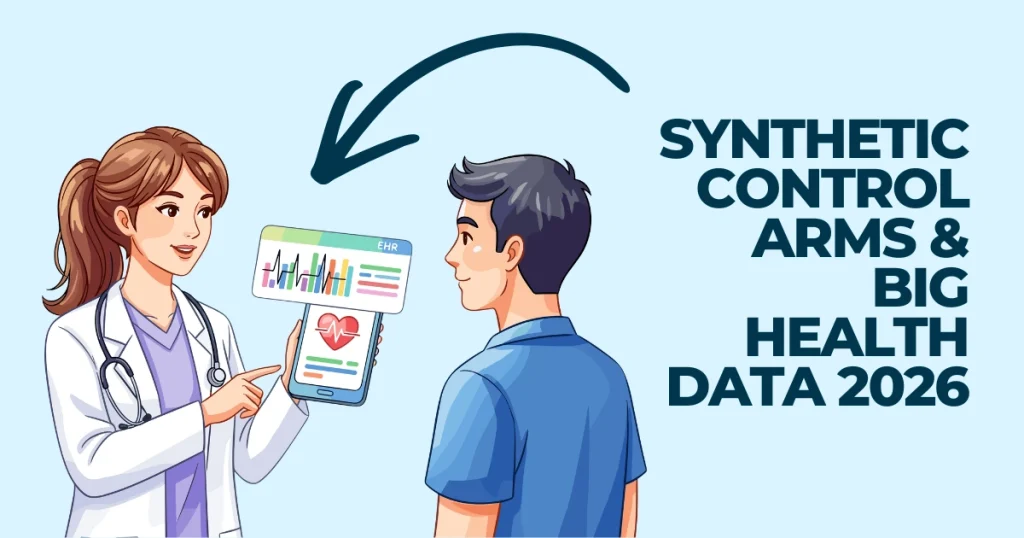
A Synthetic Control Arm is a virtual comparator group created using historical clinical trial data and Real-World Data (RWD). Instead of recruiting a new set of patients to receive a placebo, researchers use advanced statistical modeling to “synthesize” a control group from existing datasets.
Core Data Sources for SCAs in 2026:
- Electronic Health Records (EHRs): Real-time data from hospital systems and clinics.
- Historical Trial Data: De-identified data from previous Phase II and III trials.
- Wearable Device Data: Continuous physiological monitoring from patient IoT devices.
- Insurance Claims: Large-scale longitudinal data tracking patient outcomes over years.
Why Big Data is Killing the Placebo Group
The transition from physical placebo groups to synthetic ones is driven by three primary factors: Ethics, Efficiency, and Economics.
1. The Ethical Imperative
In 2026, the ethics of denying treatment to patients with terminal illnesses (such as advanced stage oncology or rare genetic disorders) is under intense scrutiny. SCAs allow every enrolled participant to receive the active investigational drug, ensuring no one is left behind in a “sugar pill” group while their condition worsens.
2. Accelerating Recruitment and Timelines
Recruiting for a placebo-controlled trial is notoriously slow. Many patients are hesitant to join a study where they have a 50% chance of not receiving the treatment. By removing the need for a physical control arm, sponsors can reduce recruitment targets by nearly half, cutting years off the development cycle.
3. Cost-Effectiveness
Maintaining a traditional control arm is expensive. Between site monitoring, patient stipends, and administrative overhead, the cost per patient can exceed $50,000. Big Data platforms now allow researchers to purchase curated, regulatory-grade datasets at a fraction of that cost.
The Role of AI and Machine Learning in 2026
In 2026, the “Synthetic” part of the SCA is more sophisticated than ever. Advanced Propensity Score Matching (PSM) and Bayesian Frameworks are used to ensure the virtual patients perfectly mirror the treatment group’s demographics, biomarkers, and disease severity.
- Digital Twins: We are seeing the rise of “Digital Twins,” where AI models predict how a specific patient would react to a placebo based on their unique genetic profile.
- Bias Mitigation: Machine Learning algorithms now identify and correct for “temporal drift”—the phenomenon where standard-of-care changes over time, making older historical data less relevant.
Regulatory Landscape: FDA and EMA in 2026
Regulatory bodies like the FDA and EMA have moved from “cautious interest” to “active implementation.” Following the FDA’s 2023 Guidance on Externally Controlled Trials, 2026 has seen a record number of drug approvals—particularly in oncology and orphan diseases—that utilized SCAs for their primary or secondary evidence.
Key Trend: “Hybrid Designs” are the current standard. These involve a small, randomized placebo group supplemented by a large synthetic arm, providing the statistical rigor of an RCT with the efficiency of Big Data.
Challenges and the Path Ahead
While the potential is massive, the industry still faces hurdles:
- Data Interoperability: Standardizing data from different hospital systems remains a challenge.
- Data Privacy: Ensuring patient anonymity in massive datasets is a top priority for 2026.
- The Gold Standard Debate: Some traditionalists still argue that only a concurrent, randomized placebo can truly eliminate unknown confounders.
Conclusion
As we look toward the future of medicine, the era of the traditional placebo is fading. In 2026, Synthetic Control Arms represent the pinnacle of data-driven medicine. By leveraging the power of Big Data, we are not just making trials faster; we are making them more ethical and accessible for patients worldwide. DrugsArea
Sources & References
- FDA Guidance on Externally Controlled Trials, https://www.fda.gov/media/164960/download
- Medidata AI: The Power of Synthetic Control Arms, https://www.medidata.com/en/clinical-trial-products/medidata-ai/real-world-data/synthetic-control-arm/
- Clinical Trials Arena: 2026 Trends Report, https://www.clinicaltrialsarena.com/features/external-control-arms/
- Nature Medicine: Big Data in Clinical Research, https://www.nature.com/nm/
- Indegene: Leveraging RWD for SCAs, https://www.indegene.com/what-we-think/blogs/leveraging-rwd-for-synthetic-control-arms
FAQs regarding Synthetic Control Arms (SCAs) and the role of Big Health Data in clinical trials, reflecting the landscape as of January 2026.
1. What exactly is a “Synthetic Control Arm” (SCA)?
An SCA is a statistical method used in clinical trials where the “control group” (the group usually receiving a placebo or standard care) is generated from historical data rather than recruiting live participants.
Instead of finding 100 new patients to take a sugar pill, researchers use Big Data—anonymized records from past trials, electronic health records (EHRs), and disease registries—to simulate how a control group would have responded. This creates a “virtual” comparison group against the actual patients receiving the new experimental drug.
2. How does Big Data make SCAs possible in 2026?
SCAs rely on the sheer volume and granularity of modern health data. By 2026, the interoperability of Electronic Health Records (EHR) and the explosion of “Real-World Data” (RWD) from wearables and genomic databases have allowed researchers to create “Digital Twins.”
Algorithms sift through millions of patient records to find historical matches that are statistically identical to the patients in the trial—matching not just age and gender, but genetic markers, disease progression rates, and comorbidities.
3. Does this mean placebo groups are completely gone?
Not completely, but they are rapidly declining in specific areas.
As of 2026, SCAs are primarily replacing placebos in oncology (cancer) and rare disease trials where recruiting a control group is difficult or ethically questionable. However, for common conditions with subjective outcomes (like depression or pain management), traditional placebo groups are still the “gold standard” to account for the psychological “placebo effect,” which historical data cannot easily simulate.
4. What is the FDA and EMA’s stance on SCAs in 2026?
Regulators have moved from “cautious observation” to “active frameworking.”
Following the FDA’s draft guidance on AI and RWD in 2024–2025, regulatory bodies now accept SCAs as primary evidence for rare diseases and life-threatening conditions where no standard of care exists. For broader indications, they often require “Hybrid Trials” (a small live control group supplemented by a large synthetic one) rather than a full replacement.
5. Are Synthetic Control Arms as safe and accurate as traditional trials?
Yes, and sometimes more accurate, provided the data quality is high.
Traditional trials often suffer from “recruitment bias” (participants are often healthier/wealthier than the average patient). SCAs, because they draw from Real-World Data (RWD), often reflect the messier, more diverse reality of actual patient populations. However, the risk lies in “data drift”—if the historical data is too old (e.g., 5+ years), it may not reflect modern supportive care, making the new drug look better than it actually is.
6. What is a “Digital Twin” in the context of clinical trials?
A “Digital Twin” is a highly advanced evolution of the synthetic control. It uses AI to model a virtual counterpart for a specific patient in the trial.
For example, if “Patient A” is enrolled to take the new drug, the AI finds a composite of historical data that perfectly matches Patient A’s biological profile to predict how Patient A would have progressed without the drug. This allows for personalized treatment effect estimation, a major trend in 2026 precision medicine.
7. How do SCAs help patients with rare diseases?
This is the single biggest impact area.
In the past, trials for rare diseases often failed because researchers couldn’t find enough patients for both a treatment and a control group. SCAs allow all recruited patients to receive the experimental therapy (open-label), while the control arm is synthesized from natural history databases. This encourages patient participation, as families no longer fear getting a placebo.
8. What are the risks of “Data Bias” in SCAs?
If the historical data used to train the SCA is biased (e.g., predominantly white, male, or from specific geographic regions), the synthetic control will be biased.
In 2026, there is intense scrutiny on “Algorithmic Justice.” If an SCA is built on data from top-tier research hospitals, it may not be a fair comparator for a general population trial. Regulators now require “Health Equity Audits” on the datasets used to generate synthetic arms.
9. Can SCAs speed up drug approval times?
Significantly.
Recruiting patients is the most time-consuming part of a clinical trial (often taking years). By eliminating the need to recruit a control arm, trials can fill up 30-50% faster. Additionally, because the control data is already available, interim analyses can be performed almost immediately, allowing failing drugs to be dropped sooner and winning drugs to reach the market faster.
10. What is a “Hybrid External Control” design?
This is the “middle ground” approach popular in 2026.
In a Hybrid design, a trial might randomize patients 3:1 (3 patients get the drug, 1 gets placebo) instead of the traditional 1:1. The small live placebo group is then mathematically “boosted” with synthetic data to achieve statistical significance. This satisfies regulatory desire for some concurrent validation while still reducing the number of patients required to take a placebo.