
The “Smart-Stent” Revolution: Real-Time Heart Monitoring from Within
The End of “Wait and See” Cardiology
For decades, the standard procedure for a blocked artery was straightforward: we inserted a mesh tube, called a stent, to prop the vessel open. We sent the patient home and told them to watch for chest pain or shortness of breath.
The problem? By the time a patient feels symptoms, the artery is often already significantly re-narrowed—a process we call restenosis.
Today, that “reactive” model of medicine has been officially challenged. The landmark breakthrough in Bio-Sensor Stents (or “Smart-Stents”) represents a shift from guessing to knowing. We are no longer just plumbing the heart; we are installing a high-tech security system inside it.
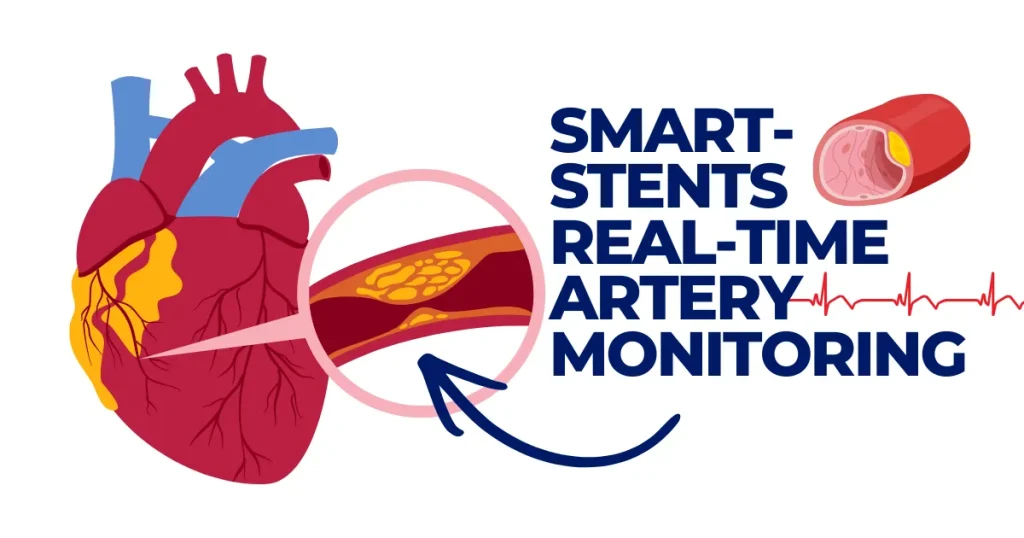
What Exactly is a Smart-Stent?
At its core, a Smart-Stent looks much like the traditional cobalt-chromium or drug-eluting stents we’ve used for years. However, the “magic” lies in microscopic, biocompatible sensors integrated into the stent’s struts.
These sensors are designed to measure:
- Blood flow velocity: How fast blood is moving through the device.
- Intraluminal pressure: Changes in pressure that indicate a blockage is forming.
- Pulse wave signals: The “rhythm” of the vessel wall.
Instead of waiting for a patient to feel a “tightness” in their chest, these sensors beam encrypted, real-time data directly to a cardiologist’s tablet or a secure hospital cloud.
Why This Changes Everything for Patients
As a healthcare professional, the most frustrating part of cardiac care is the “repeat emergency.” A patient receives a stent, feels great for six months, and then ends up back in the ER because the stent has become clogged with scar tissue or new plaque.
The Smart-Stent changes the narrative in three distinct ways:
- Early Warning System: The sensors can detect a 10% or 15% narrowing. At this stage, we can often manage the issue with medication adjustments rather than a second surgery.
- Peace of Mind: For the patient, the “ticking time bomb” feeling disappears. You know that if something is wrong, your care team will know before you even feel a flutter.
- Data-Driven Lifestyle: Seeing how your heart reacts to exercise or stress in real-time through your stent data can be a powerful motivator for heart-healthy habits.
The Technology: Micro-Electronics Meet Macro-Health
You might wonder how a device inside your chest sends data without a bulky battery. These devices utilize near-field communication (NFC) or inductive coupling—similar to how your smartphone pays for groceries at a checkout terminal.
The stent doesn’t “broadcast” constantly; rather, it can be “pinged” by a wearable patch or a handheld device held near the chest. This ensures the tech is energy-efficient and, more importantly, safe for the human body over the long term.
Moving Toward a “Preventative” Future
We are entering the era of the “Internet of Bodies” (IoB). Just as your smart home tells you if there’s a leak in the basement before the floor is ruined, your Smart-Stent tells us if there’s a “leak” in your cardiovascular health.
In the near future, this could virtually eliminate the need for repeat emergency angioplasties. We won’t be reacting to heart attacks; we will be preventing them with surgical precision based on data that is only minutes old.
Health Disclaimer
The information provided in this article is for educational and informational purposes only and is not intended as medical advice. Always seek the advice of your physician or other qualified health provider with any questions you may have regarding a medical condition or treatment. Never disregard professional medical advice or delay in seeking it because of something you have read here. DrugsArea
Sources & References
- American Heart Association – Future of Stents, Journal of the American College of Cardiology, Nature Biomedical Engineering – Implantable Sensors, Mayo Clinic Cardiology Updates
People Also Ask
1. What is a “smart-stent” and how does it differ from a regular one?
A traditional stent is a tiny mesh tube used to prop open a clogged artery. A smart-stent does the same job but is embedded with micro-sensors and a wireless antenna. While a regular stent just sits there, a smart-stent “talks” to your doctor by transmitting real-time data about blood flow, pressure, and potential re-clogging directly from inside your heart.
2. Can a smart-stent actually detect a heart attack before it happens?
It’s designed to do something very close to that. By monitoring hemodynamics (the way blood moves), the stent can detect “restenosis”—the gradual re-narrowing of the artery—long before you feel chest pain. By catching these subtle changes in real-time, doctors can intervene weeks or months before a full blockage or heart attack occurs.
3. Does a smart-stent need a battery to work inside my body?
Surprisingly, no. Most smart-stents are batteryless. They use “inductive coupling” or “radiofrequency (RF) energy,” which is the same tech used in tap-to-pay credit cards. The stent gets its power wirelessly from an external reader (like a wand or a wearable vest) held near the chest, meaning there’s no battery to run out or ever need replacing.
4. How does the doctor get the data from the stent?
The process is non-invasive. You don’t need surgery to “check” the stent. Instead, you use an external data acquisition system—which could be a device at your doctor’s office or even a specialized wearable—to “ping” the stent. The stent then beams back its readings via a wireless signal, similar to how a smartphone connects to Wi-Fi.
5. Is it safe to have electronics implanted in my heart?
Yes. Smart-stents are made from biocompatible materials like medical-grade stainless steel or nitinol, just like standard stents. The electronic components are microscopic and sealed in protective coatings to prevent them from interacting with your blood or tissue in a harmful way. They are designed to be as “invisible” to your immune system as a regular implant.
6. Will I be able to have an MRI if I have a smart-stent?
This is a common concern. Most modern stents are “MR Conditional,” meaning they are safe for MRIs under specific settings. Because smart-stents contain tiny sensors, researchers are perfecting the designs to ensure the magnetic fields don’t interfere with the electronics. You should always tell your technician, but current prototypes are being built with MRI-compatibility as a priority.
7. What is “restenosis,” and why is a smart-stent better at finding it?
Restenosis is when the body’s healing process goes into overdrive and grows too much tissue inside the stent, narrowing the artery again. Currently, doctors only find this through expensive, invasive tests like an angiogram. A smart-stent identifies this non-invasively by flagging any drop in blood velocity the moment it starts to happen.
8. Can I see my heart data on my own smartphone?
We’re heading that way! While current versions primarily send data to medical teams, the goal of the “revolution” is to integrate this with consumer health apps. In the near future, you might receive a notification on your phone if your stent detects a change in your heart’s internal pressure, allowing you to call your doctor immediately.
9. Does the smart-stent ever need to be removed or replaced?
Like standard stents, smart-stents are intended to be permanent. They become incorporated into the wall of the artery over time. Because they don’t have batteries or moving parts that wear out, the “smart” functionality is designed to last as long as the physical structure of the stent itself.
10. When will smart-stents be available for all heart patients?
While some “S.M.A.R.T.” branded stents are already used for their superior mechanical design, the fully electronic “sensor-embedded” versions are currently in advanced clinical trials and pilot phases. The technology is moving fast, and experts expect these to become a standard option in cardiology departments within the next few years.

![A medical illustration showing a human heart with a mechanical LVAD pump attached to the left ventricle, with a driveline exiting the abdomen to an external controller.[Bionic Heart]](https://drugsarea.com/wp-content/uploads/2026/01/Living-with-a-Bionic-Heart-How-LVAD-Technology-Defies-End-Stage-Heart-Failure-1024x538.webp)