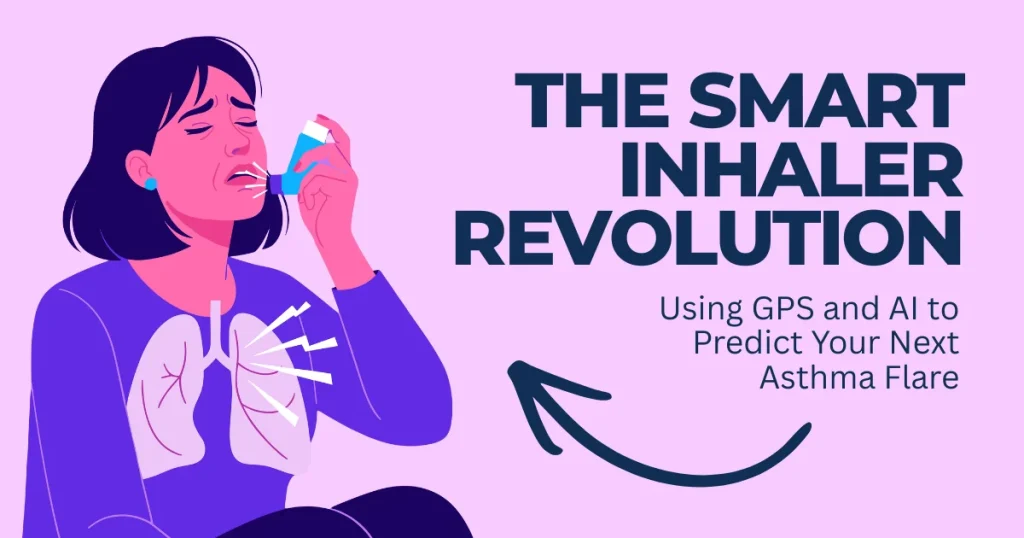
The Smart Inhaler Revolution | Using GPS and AI to Predict Your Next Asthma Flare
A New Era of Breathing | From Reacting to Predicting
As a healthcare professional, I have spent years helping patients manage the “surprise” nature of asthma. For decades, the routine was simple but stressful: carry your inhaler, avoid known triggers, and use your rescue medication when you feel that tell-tale tightness in your chest. But what if your inhaler could tell you that a flare-up was coming before you even felt a single wheeze?
Welcome to the Smart Inhaler Revolution of 2026. This isn’t just about a better way to take medicine; it’s about a complete shift from reactive care (treating symptoms) to proactive management (preventing them). With the integration of Artificial Intelligence (AI) and Global Positioning Systems (GPS), the inhalers of 2026 have become intelligent guardians of your respiratory health.
How 2026 Smart Inhalers Work: The “Digital Twin” for Your Lungs
The latest generation of smart inhalers—developed by leaders like Propeller Health, Adherium, and Teva—are now equipped with advanced sensors that go far beyond just counting puffs. These devices create what we in the medical field call a “digital health footprint.”
1. GPS Tracking & Trigger Mapping
Every time you use your inhaler, the device logs the exact GPS coordinates. Over time, AI algorithms analyze this data to identify “hotspots.” If you consistently need your rescue inhaler at a specific park or near a certain industrial zone, the app identifies this pattern. By 2026, these devices don’t just record the location; they cross-reference it with live environmental data.
2. Real-Time Weather and Pollution Syncing
The breakthrough feature of 2026 is the seamless sync with local environmental feeds. Your inhaler app is constantly “talking” to:
- Air Quality Index (AQI) Sensors: Tracking PM2.5 and ozone levels.
- Pollen Counts: Monitoring seasonal allergens in your specific neighborhood.
- Weather Stations: Detecting sudden drops in temperature or spikes in humidity—both of which are notorious asthma triggers.
3. AI-Powered Flare Prediction
Using Machine Learning (ML), the software analyzes your historical usage alongside these environmental factors. It builds a personalized risk profile. If the AI sees that a “high-pollen day” is approaching and you are scheduled to be in a high-risk GPS zone, it sends a notification to your smartphone or smartwatch.
The Proactive Alert: “Caution: High ozone levels detected in your current area. Pollen count is rising. Ensure your controller medication is taken and consider staying indoors between 2 PM and 4 PM.”
Why This Matters: The Clinical Impact
In clinical practice, the biggest hurdle to asthma control is often adherence and awareness. Many patients don’t realize their environment is becoming dangerous until the inflammation has already started.
Data from 2025 and early 2026 pilot programs (such as the AIR Louisville initiatives) have shown that when patients use integrated smart inhalers:
- Rescue inhaler use can drop by as much as 80%.
- Symptom-free days significantly increase.
- Emergency room visits are drastically reduced because the “flare” is stopped in its tracks.
By moving the “alert” from your lungs to your phone, we are giving the power back to the patient. You aren’t just waiting for an attack; you are navigating your day to avoid one.
A Professional Note on Using This Tech
While this technology is revolutionary, it is a tool, not a replacement for your doctor. As we integrate these AI insights into your care plan, we can see your data during check-ups. This allows us to adjust your dosages based on real-world evidence rather than just memory.
If your 2026 smart inhaler shows that you are frequently entering high-risk zones, we might look at strengthening your “controller” medication or working on better environmental avoidance strategies.
Medical Disclaimer
This content is for informational purposes only and does not constitute medical advice, diagnosis, or treatment. Always seek the advice of your physician or other qualified health provider with any questions you may have regarding a medical condition. Never disregard professional medical advice or delay in seeking it because of something you have read here. DrugsArea
Sources & Research
- ResearchGate: Smart Inhalers and Respiratory IoTs (2025) – Deep dive into how IoT devices monitor environmental triggers.
- NIH: AI in the Management of Asthma (2025) – Analysis of machine learning’s role in predicting exacerbations.
- DelveInsight: Smart Inhalers Transforming Care (2025) – Overview of FDA approvals and AI-powered inhaler devices.
- Respiratory Therapy: Integrating Air Quality Data – Case study on the impact of air quality syncing on rescue medication use.
- SNS Insider: Smart Inhalers Market Forecast 2026-2033 – Market trends and the adoption of connected healthcare devices.
People Also Ask
1. What is a smart inhaler and how does it actually work?
Think of a smart inhaler as your standard inhaler with a “brain” attached. It uses a small sensor—either built-in or as a clip-on—to record the exact time, date, and location of every puff you take. This data syncs via Bluetooth to an app on your phone, giving you and your doctor a digital diary of your breathing health without you having to lift a finger.
2. How can GPS help predict an asthma attack?
It sounds like sci-fi, but it’s quite practical. By using GPS tracking, the app identifies “hotspots” where you frequently use your rescue inhaler. If the system notices you’re puffing more often in a specific park or city block, it cross-references that location with real-time data on high pollen counts, smog, or humidity to warn you before you even enter a high-trigger zone.
3. Does AI really know when I’m about to have a flare-up?
Yes, and it’s getting incredibly accurate. AI algorithms analyze your historical usage patterns. If you usually use your inhaler once a week but suddenly use it three times in two days, the AI recognizes this “trend shift” as a red flag. It can often predict a significant flare-up 48 to 72 hours before you even feel chest tightness.
4. Can a smart inhaler tell if I’m using it incorrectly?
Actually, yes. Many newer models feature acoustic sensors or pressure monitors that “listen” to your inhalation. If you aren’t shaking the canister enough or if your breath isn’t deep enough to pull the medicine into your lungs, the app will send you a friendly tip on how to fix your technique.
5. Will using a smart inhaler replace my regular doctor visits?
Not at all. Think of it as a bridge, not a replacement. Instead of trying to remember how you felt three weeks ago during a check-up, you can show your doctor a graph of actual data. This allows your doctor to make much more precise adjustments to your treatment plan based on hard facts rather than memory.
6. Is my location and health data safe with these devices?
This is a common concern. Most reputable smart inhaler companies use HIPAA-compliant encryption, meaning your data is protected by the same security standards used in hospitals. You usually have full control over who sees your data, and you can choose to share it only with your specific medical team.
7. Do I need a special prescription for a smart inhaler?
It depends. Some “fully integrated” smart inhalers, like the ProAir Digihaler, are prescribed just like traditional medication. However, there are also “add-on” sensors (like those from Propeller Health or Adherium) that can be attached to the inhalers you already use. Many insurance plans are now starting to cover these to help reduce emergency room visits.
8. How much do smart inhalers typically cost?
If you’re buying an add-on sensor out-of-pocket, prices usually range from $50 to $100. However, because these devices are proven to reduce expensive hospital stays, many healthcare providers and insurance companies provide them for free or at a very low co-pay as part of an asthma management program.
9. Can smart inhalers help children manage their asthma better?
They are a game-changer for parents. Since the app tracks every dose, parents can get a notification on their own phone confirming their child took their morning “preventer” puff at school. It turns asthma management into a collaborative effort rather than a daily guessing game.
10. What are the main benefits of switching to a smart inhaler?
The “big three” benefits are adherence, awareness, and prevention. You get reminders so you never miss a dose, you learn exactly what environmental factors trigger your symptoms, and the AI-driven “early warning system” helps you take action before a minor wheeze turns into a major emergency.