
Targeted Radiation for Pancreatic Cancer: OncoSil Device Reaches New Clinical Milestones
A New Beacon of Hope in Gastrointestinal Oncology
As a healthcare professional, few diagnoses carry the clinical weight and emotional gravity of unresectable locally advanced pancreatic cancer (LAPC). For years, our toolkit has been largely limited to systemic chemotherapies that, while necessary, often struggle to achieve the localized control required to transition a patient from “inoperable” to “surgical candidate.”
Marks a pivotal moment in the landscape of oncological interventional radiology. The OncoSil™ device has officially reached new clinical milestones with its successful implementation in major European hospitals, most notably the Vivantes Neukölln Hospital in Berlin. This expansion represents more than just a commercial victory; it is the integration of a sophisticated brachytherapy platform into standard clinical pathways across Europe.
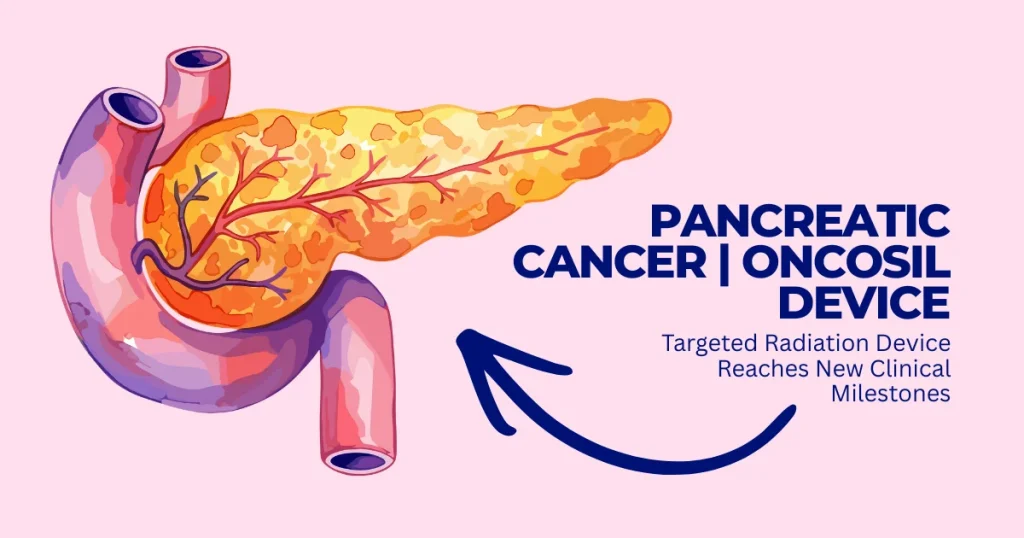
What is the OncoSil Device?
The OncoSil device is a single-use brachytherapy tool that delivers a pre-determined dose of Phosphorus-32 () microparticles directly into a pancreatic tumor. Unlike traditional external beam radiation therapy (EBRT), which must pass through healthy skin, muscle, and organs to reach the pancreas, OncoSil utilizes the precision of Endoscopic Ultrasound (EUS) or percutaneous CT guidance to place the radiation exactly where it is needed.
The Science of Localized Control
The device leverages the unique properties of beta-emitting isotopes:
- Pure Beta Radiation: Phosphorus-32 emits beta particles with a short tissue penetration range (averaging only 2.5mm).
- DNA Damage: Once implanted, the microparticles remain permanently in the tumor, delivering 98% of their radiation dose over 81 days, causing lethal double-strand DNA breaks in cancer cells.
- Sparing Healthy Tissue: Because the radiation range is so localized, the surrounding critical structures—such as the duodenum, stomach, and major blood vessels—are largely spared from the toxicities typically associated with radiation.
Clinical Breakthroughs: The 2026 Landscape
The implementation at Vivantes Neukölln Hospital follows a series of robust clinical validations. As of early 2026, the data from the PanCO and PANCOSIL studies have provided the medical community with compelling reasons to adopt this technology:
- Downstaging for Surgery: One of the most significant metrics for any LAPC treatment is the “resection rate.” Clinical studies have shown that approximately one-third of patients treated with OncoSil plus chemotherapy were either surgically resected or downstaged to the point of being candidates for surgery—a significant increase compared to chemotherapy alone.
- Extended Survival: Landmark analyses published in January 2026 indicate an estimated 6.2-month increase in restricted mean survival time for patients receiving the combination therapy versus standard-of-care chemotherapy.
- The “Percutaneous” Advantage: The PANCOSIL study recently demonstrated a 90% technical success rate using a percutaneous (through the skin) approach. This allows interventional radiologists to treat patients who might not be ideal candidates for endoscopic procedures, further broadening the patient base that can benefit from this technology.
The Multi-Disciplinary Approach
In my professional experience, the best outcomes in oncology are born from collaboration. The OncoSil device facilitates a “triple threat” approach:
- Medical Oncologists: Provide systemic chemotherapy (like FOLFIRINOX) to tackle micrometastatic disease.
- Gastroenterologists/Interventional Radiologists: Use EUS or CT guidance to deliver the OncoSil microparticles.
- Surgical Oncologists: Step in when the tumor has shrunk sufficiently to allow for a R0 (clear margin) resection.
| Feature | External Beam Radiation (EBRT) | OncoSil™ Brachytherapy |
|---|---|---|
| Delivery | External Source | Intratumoral (Direct) |
| Radiation Type | Photons/X-rays | Beta Particles () |
| Treatment Duration | Multiple weeks/Daily visits | Single Implantation |
| Tissue Sparing | Moderate (Collateral damage) | High (Localized to 2.5mm) |
| Primary Goal | Local Control | Downstaging for Resection |
Regulatory Success and Global Expansion
The momentum of early 2026 is underpinned by significant regulatory wins. Having secured the MDR certification and CE Marking, OncoSil Medical has streamlined the “onboarding” process for hospitals. This removes the bureaucratic hurdles of local ethics approvals for every case, allowing clinicians to focus on what matters most: patient care.
With treatments now active in Germany, Portugal, Spain, Italy, and the UK, the “Breakthrough Device” designation is more than just a label—it is a reflection of the urgent unmet need in pancreatic cancer care.
Professional Perspective: A Shift in the Paradigm
For too long, “unresectable” was a terminal label. With the clinical milestones reached this January, we are seeing a shift toward a more aggressive, localized intervention strategy. The ability to deliver a massive dose of radiation () directly into the heart of a tumor without destroying the patient’s quality of life is, quite frankly, a game-changer.
If you or a loved one are navigating a diagnosis of locally advanced pancreatic cancer, discussing “intratumoral brachytherapy” with your oncology team is no longer a futuristic suggestion—it is a current clinical reality.
Health Disclaimer
Disclaimer: This article is for informational purposes only and does not constitute medical advice, diagnosis, or treatment. Always seek the advice of your physician or other qualified health providers with any questions you may have regarding a medical condition. The OncoSil™ device is a regulated medical device and is only available through authorized clinical centers. DrugsArea
Sources
- OncoSil Medical: First Treatment at Vivantes Neukölln Hospital, Berlin (Jan 27, 2026), OncoSil, Pancreatic Cancer, Clinical Milestones, Germany, Vivantes Neukölln
- Comparative Analysis of OncoSil Potential Benefits (January 12, 2026), Clinical Data, Survival Rates, Downstaging, Oncology Research
- Interventional News: PANCOSIL Study Preliminary Results, PANCOSIL, Interventional Radiology, Percutaneous Delivery, LAPC
- Open MedScience: OncoSil Phosphorus-32 Microparticle Therapy Guide, Brachytherapy, Beta Radiation, Medical Device, Cancer Treatment
- Biotech Dispatch: OncoSil MDR Approval and European Expansion, MDR Certification, CE Mark, European Healthcare, Biotech News
People Also Ask
1. What is the OncoSil™ device for pancreatic cancer?
OncoSil™ is a first-in-class medical device used for brachytherapy (internal radiation). It consists of tiny microparticles containing the isotope Phosphorus-32 (P-32). Unlike traditional radiation that beams through the body, OncoSil™ is injected directly into a pancreatic tumor via an endoscopic ultrasound. It delivers high-dose, localized beta radiation to destroy cancer cells from the inside out while sparing nearby healthy organs like the stomach and liver.
2. How does the OncoSil™ device improve survival rates?
Recent clinical milestones, including the PANCOSIL study (2025), have shown a median overall survival of 20.6 months for patients with locally advanced pancreatic cancer (LAPC). This is a significant leap compared to the historical benchmark of roughly 13 months with chemotherapy alone. By shrinking the tumor, the device can also “downstage” patients, making previously inoperable tumors eligible for surgical removal.
3. Who is a candidate for OncoSil™ treatment?
The treatment is primarily designed for adults with locally advanced unresectable pancreatic cancer (LAPC). This means the cancer hasn’t spread to distant organs (like the lungs) but is wrapped around major blood vessels, making surgery too risky. Candidates must also have a stable performance status and be able to undergo standard chemotherapy, as the two treatments are usually used in tandem.
4. Is OncoSil™ FDA approved in the United States?
As of early 2026, OncoSil™ holds FDA Breakthrough Device Designation, which accelerates the review process for life-threatening conditions. While it is already CE Marked and available in several European and UK markets, the company is actively pursuing further regulatory milestones in the U.S. and looking toward expanded approvals for percutaneous (through the skin) delivery in late 2026.
5. What are the latest clinical milestones for OncoSil™ in 2026?
The most recent breakthrough is the success of the PANCOSIL Phase 1–2 study. Researchers proved that OncoSil™ can be delivered safely via CT-guided percutaneous injection while the patient is conscious. This is a massive milestone because it allows Interventional Radiologists—not just gastroenterologists—to administer the treatment, significantly widening patient access globally.
6. How long does the radiation from OncoSil™ stay active?
The Phosphorus-32 used in the device has a half-life of roughly 14 days. In clinical terms, about 98% of the therapeutic radiation dose is delivered within 81 days of the injection. After the radiation has fully decayed, the inert silicon microparticles remain permanently and safely in the tumor tissue without causing long-term harm.
7. Can OncoSil™ be used alongside chemotherapy?
Yes, it is specifically intended to be used in combination with systemic chemotherapy (such as FOLFIRINOX or Gemcitabine/Nab-paclitaxel). The device handles “local control” by attacking the primary tumor, while chemotherapy works “systemically” to prevent the spread of cancer cells throughout the body.
8. Does the OncoSil™ procedure require major surgery?
No. One of the biggest advantages for patients is that it is a minimally invasive procedure. It is typically performed via an endoscopic ultrasound (down the throat) or a percutaneous injection (through the skin). Most patients are observed for a few hours and can go home the same day or after one night in the hospital.
9. What are the side effects of targeted radiation with OncoSil™?
Clinical data suggests the device has a favorable safety profile. The most common side effects are mild and temporary, including abdominal pain, nausea, and fatigue. Because the radiation only travels about 2–3 millimeters from the injection site, it avoids the “collateral damage” often seen with external beam radiation, such as severe skin burns or damage to the intestines.
10. How does the OncoSil™ device “downstage” a tumor?
“Downstaging” refers to shrinking a tumor or pulling it away from critical blood vessels. In the PanCO study, approximately one in three patients saw enough tumor reduction to be reconsidered for surgery. This is a vital milestone because surgical resection (removal) currently offers the only potential for a long-term cure in pancreatic cancer.