The Myth of the “Equal” Eight Hours
For decades, we’ve told ourselves a comforting lie: “It doesn’t matter when you sleep, as long as you get your eight hours.” We viewed sleep like a bank account—as long as the total deposit was sufficient, the timing of the transaction was irrelevant.
However, groundbreaking research released today, January 28, 2026, has officially debunked that notion. A massive study focusing on midlife heart health has revealed a startling truth: Night owls are at a significantly higher risk for cardiovascular damage than morning larks, even when they get the exact same amount of sleep.
As a health professional, I see the “Morning Lark” advantage not as a badge of productivity, but as a fundamental pillar of biological safety. Let’s dive into why your heart cares more about the clock than you might think.
The 2026 Midlife Heart Study: What You Need to Know
The study published this morning tracked over 50,000 adults in their 40s and 50s. Researchers used advanced cardiac imaging and biomarkers to track “quiet” damage—the kind of wear and tear that doesn’t show up as a heart attack today but sets the stage for one tomorrow.
The Key Findings:
- Structural Strain: Individuals who consistently went to bed after 1:00 AM showed higher levels of arterial stiffness compared to those who slept by 10:30 PM.
- The “Sleep Debt” Fallacy: Participants who slept from 2:00 AM to 10:00 AM (a full 8 hours) still had inflammatory markers 25% higher than those on a standard “lark” schedule.
- Metabolic Mismatch: Night owls showed poorer glucose regulation, which directly impacts the lining of the blood vessels (the endothelium).
The takeaway is clear: Quality and quantity are not enough. Timing is the third, often ignored, pillar of heart health.
Circadian Alignment: A Biological Necessity
To understand why staying up late damages the heart, we have to look at our DNA. We are evolved to be diurnal creatures. Every organ in your body, especially your heart, has a “peripheral clock” that takes its cues from the master clock in your brain (the suprachiasmatic nucleus).
1. The Cortisol-Melatonin Dance
When the sun goes down, your body is hardwired to produce melatonin, which lowers your blood pressure and heart rate to give your cardiovascular system a rest. If you stay awake under artificial lights, you keep your cortisol (the stress hormone) elevated. This forces your heart to work at a “daytime” pace when it should be in “recovery” mode.
2. The Nighttime “Pressure Cooker”
During deep sleep in the early part of the night, your blood pressure undergoes a “dip.” This “nocturnal dipping” is essential for vascular health. Night owls often miss the peak window for this dip, meaning their arteries remain under higher pressure for more hours of the day. Over years, this leads to the “quiet damage” identified in the 2026 study.
Why You Can’t “Hack” Your Way Out of Night Owl Habits
Many of my patients argue that they are “naturally” night owls. While “chronotypes” (your natural sleep leaning) do exist, the modern environment has pushed us far beyond our natural limits.
We use high-intensity blue light to trick our brains into thinking it’s noon when it’s midnight. This isn’t just a lifestyle choice; it’s biological dissonance. You are essentially asking your heart to perform a marathon while your brain is trying to run a diagnostic update.
The Reality Check: Even if you feel “productive” at 2:00 AM, your mitochondria—the power plants of your heart cells—are struggling to repair themselves without the hormonal signals that only come from sleeping in total darkness during the natural night.
Shifting from Owl to Lark: A Professional Guide
If you’ve spent years as a night owl, don’t panic. The heart is remarkably resilient if you give it what it needs. Here is how to begin aligning with the sun:
- The 15-Minute Slide: Don’t try to go to bed three hours earlier tonight. You’ll just lay there frustrated. Shift your bedtime 15 minutes earlier every two nights.
- Morning Light Anchoring: The most important step is what you do when you wake up. Get 5–10 minutes of direct sunlight in your eyes (no windows, no sunglasses) as soon as possible. This “sets” your internal clock for 16 hours later.
- The “Digital Sunset”: Turn off overhead lights and switch to lamps with warm bulbs after 8:00 PM. This signals to your heart that the “workday” is ending.
- Stop Late-Night Fueling: Digestion and heart repair are competitors. Stop eating at least 3 hours before your goal bedtime to allow your blood flow to focus on cellular repair rather than processing nutrients.
Conclusion: Listen to Your Heart, Not Your Laptop
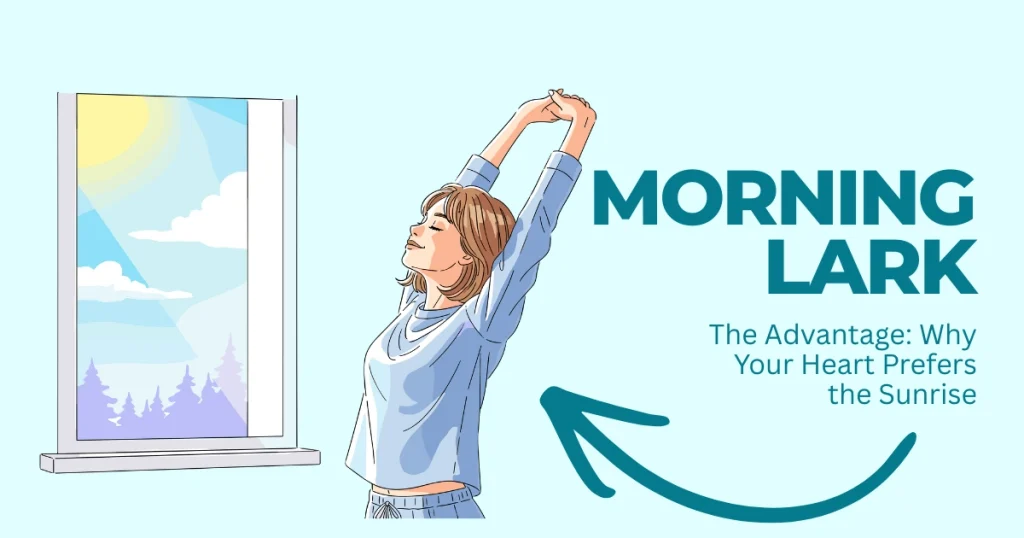
The 2026 data serves as a wake-up call. We cannot treat our bodies like machines that function regardless of the environment. The “Morning Lark” advantage isn’t about being a “go-getter”—it’s about being a “heart-protector.”
Sleeping with the sun is a biological mandate. By aligning your rest with the natural world, you aren’t just getting more sleep; you are giving your heart the specific environment it needs to beat strongly for decades to come.
Health Disclaimer
The information provided in this article is for educational and informational purposes only and is not intended as medical advice. Always seek the advice of your physician or other qualified health provider with any questions you may have regarding a medical condition or cardiovascular health. Never disregard professional medical advice or delay in seeking it because of something you have read here. DrugsArea
Sources
- The Lancet: Midlife Cardiovascular Health and Circadian Disruption (Jan 2026)
- American Heart Association: Sleep Timing and Blood Pressure Regulation
- Journal of Clinical Sleep Medicine: The Impact of Late Chronotypes on Arterial Stiffness
- Harvard Health: Why Your Heart Clock Matters
Frequently Asked Questions
1. Is being a “morning lark” actually better for heart health than being a “night owl”?
While both chronotypes have their perks, research consistently shows that morning larks often have lower risks of hypertension and cardiovascular disease. This is largely because their natural sleep-wake cycle aligns better with the planet’s light-dark cycle, leading to more stable hormonal patterns.
2. How does waking up early specifically benefit my heart?
Waking up with the sun helps regulate your circadian rhythm, which in turn manages your blood pressure and heart rate. Morning light exposure triggers a healthy release of cortisol in the morning and melatonin at night, preventing the “circadian misalignment” that can stress the cardiovascular system.
3. Can I change my biological clock if I’m naturally a night owl?
You can certainly shift it, though it takes consistency. By gradually moving your bedtime earlier and getting immediate sunlight exposure upon waking, you can train your body to adopt “morning lark” habits, potentially reducing the strain on your heart caused by late-night stress and poor sleep hygiene.
4. Does the “sunrise advantage” apply if I’m still getting 8 hours of sleep at night?
Timing matters just as much as duration. Sleeping from 2 AM to 10 AM isn’t the same as sleeping from 10 PM to 6 AM. The body’s internal repair processes, including cardiac tissue recovery, are optimized to work alongside the natural onset of darkness.
5. What is the link between morning routines and lower blood pressure?
Morning larks tend to have lower “resting” blood pressures. Because they aren’t rushing against the clock or battling the grogginess of a shifted sleep cycle (social jetlag), their sympathetic nervous system—the “fight or flight” response—stays calmer during the first few hours of the day.
6. Are morning people less likely to have a heart attack?
Some studies suggest a correlation. Night owls often face higher levels of systemic inflammation and are more prone to habits like late-night snacking or higher caffeine intake, both of which are metabolic stressors that can contribute to long-term heart issues.
7. How much morning sunlight do I need to see these benefits?
Aim for about 10 to 30 minutes of natural light shortly after sunrise. This “anchors” your biological clock, ensuring your heart rate and metabolic functions operate on a predictable, healthy schedule for the rest of the day.
8. Does being a morning lark help with cholesterol levels?
Indirectly, yes. Morning larks often have more regulated metabolic health and better insulin sensitivity. When your metabolism is in sync with your internal clock, your body processes fats and sugars more efficiently, which is great news for your arteries.
9. Is the “Morning Lark Advantage” just about sleep, or is it about exercise too?
It’s a bit of both. Morning people are statistically more likely to fit in consistent physical activity. Exercising in the morning can enhance the heart-protective benefits by jumpstarting circulation and improving vascular function early in the day.
10. What if I work night shifts? Can I still protect my heart?
It’s more challenging, but possible. You can mimic the “morning lark” effect by using light therapy during your “morning” and ensuring your sleeping environment is pitch black. The goal is to create a consistent rhythm, even if it’s inverted, to minimize cardiac stress.