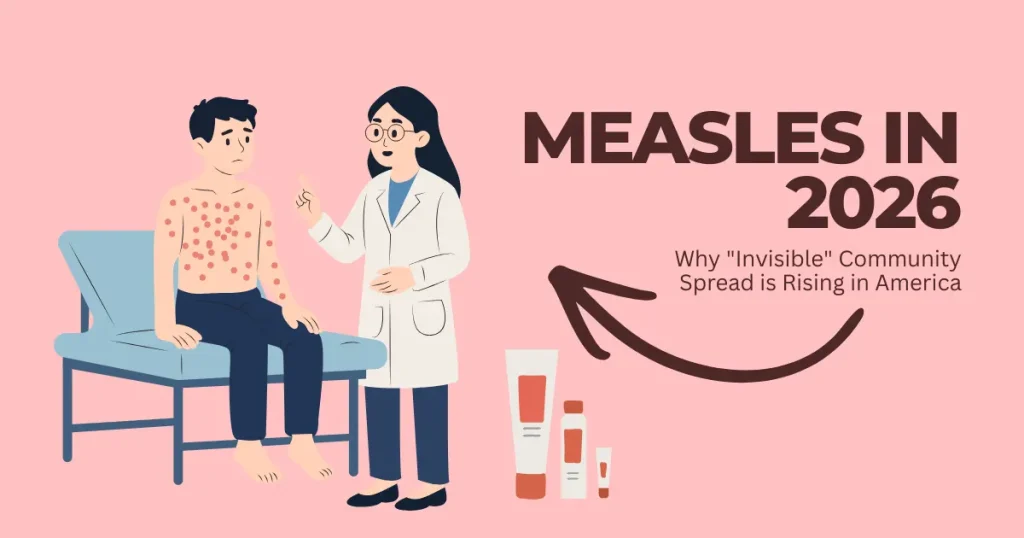
Measles in 2026: Why “Invisible” Community Spread is Rising in America
The Unseen Threat: Measles in the Modern Era
As a health professional, I’ve watched the landscape of infectious diseases shift significantly over the last decade. In 2026, we are facing a challenge many thought was a relic of the past: the resurgence of Measles.
While many view measles as “just a rash,” the reality on the ground is far more complex. We are seeing a phenomenon known as “Invisible Community Spread.” This occurs when the virus moves through populations where vaccination gaps exist—often silently—before exploding into clusters that overwhelm local clinics.
The Current Landscape: Why Now?
The surge we are witnessing in 2026 isn’t a fluke. It is the result of a “perfect storm”:
- Declining Routine Immunizations: Over the last few years, minor drops in vaccination rates have chipped away at “herd immunity.”
- Global Travel: In our hyper-connected world, a single case from overseas can land in a domestic community with low coverage.
- Misinformation: There is a lingering hesitation regarding childhood shots, leaving many little ones unprotected.
The Biological “Reset Button”: Understanding Immune Amnesia
Perhaps the most terrifying aspect of measles isn’t the high fever or the cough—it’s what the virus does to the body after the rash fades. This is a scientific concept called Immune Amnesia.
How It Works
When a child contracts measles, the virus attacks the very cells responsible for “remembering” previous infections. Think of your child’s immune system like a library. Every time they get a cold, a flu shot, or chickenpox, the library adds a book on how to fight that specific germ.
Measles acts like a fire in that library. It doesn’t just make the child sick; it burns the books.
Research shows that the measles virus can “wipe” to of a child’s existing antibodies. This means that after “recovering” from measles, a child is once again vulnerable to every other disease they had already fought off.
The Long-Term Impact
- Increased Vulnerability: For 2 to 3 years post-infection, children who survived measles are significantly more likely to die from other infectious diseases.
- Secondary Infections: We often see a spike in severe bacterial pneumonia and ear infections in the months following a measles outbreak.
Why “Invisible” Spread is So Dangerous
Measles is one of the most contagious viruses known to man. To put it in perspective, the (reproduction number) for measles is roughly to . This means one infected person can spread it to up to 18 unvaccinated people.
The “Waiting Room” Effect
The virus is airborne and can hang in the air for up to two hours after an infected person has left the room. This creates “invisible” chains of transmission. A parent might take an unvaccinated toddler to a grocery store or a doctor’s office, unaware that a person with measles walked through that same aisle an hour prior.
By the time the characteristic red spots appear, the person has already been contagious for four days. During those four days, they are the “invisible” carriers.
The Only Shield: Vaccination as an Act of Community
In 2026, the conversation around the MMR (Measles, Mumps, and Rubella) vaccine is more vital than ever. As a clinician, I hear the concerns of parents every day. It is natural to want to protect your child from everything. However, the data is clear: The vaccine is the only effective shield.
Protecting the Vulnerable
Vaccination isn’t just a personal health choice; it’s a community responsibility. There are members of our neighborhoods who cannot get vaccinated, including:
- Infants under 12 months old.
- Children undergoing chemotherapy for cancer.
- Individuals with compromised immune systems.
When you vaccinate your child, you are creating a “human shield” around these vulnerable people. This is the essence of Herd Immunity.
Comparison: Measles vs. The Vaccine
| Feature | Measles Infection | MMR Vaccine |
|---|---|---|
| Fever | High (°F+) | Low-grade (occasional) |
| Complications | Pneumonia, Encephalitis, Blindness | Soreness at injection site |
| Long-term Effect | Immune Amnesia (Wipes memory) | Builds Immune Memory |
| Contagiousness | Extremely High | Non-contagious |
Actionable Steps for Parents in 2026
If you are worried about the rising cases, here is what you can do today:
- Check Records: Ensure your family has received both doses of the MMR vaccine.
- Stay Informed: Follow updates from local health departments regarding “hot spots” in your city.
- Don’t Delay: If your child is behind on their schedule, it’s never too late to catch up. The vaccine is incredibly effective even if given later than the standard 12-month mark.
- Practice Hygiene: While measles is airborne, standard handwashing and respiratory etiquette (coughing into elbows) remain foundational for general health.
The Bottom Line
Measles is a formidable opponent, but it is a preventable one. By understanding the risk of Immune Amnesia and the reality of Invisible Spread, we can make informed decisions that protect our families and our communities. Let’s not allow 2026 to be the year we let a preventable disease rewrite our children’s health history.
Health Disclaimer
The information provided in this article is for educational purposes only and does not constitute medical advice, diagnosis, or treatment. Always seek the advice of your physician or other qualified health provider with any questions you may have regarding a medical condition or vaccination schedule. DrugsArea
Sources & Resources
- CDC (Centers for Disease Control and Prevention): Measles Cases and Outbreaks
- World Health Organization (WHO): Measles Fact Sheet
- Science Magazine: Measles and Immune Amnesia Study
- American Academy of Pediatrics (AAP): MMR Vaccine Information
People Also Ask
1. Why is measles being called an “invisible” threat in 2026?
It’s called “invisible” because the virus is highly contagious four days before the signature red rash even appears. During this window, an infected person might just feel like they have a standard cold or flu, allowing them to unknowingly spread the virus in schools, grocery stores, and offices.
2. Is the U.S. still considered “measles-free” in 2026?
As of early 2026, the U.S. is at high risk of losing its “elimination status.” While we technically eradicated endemic measles in 2000, sustained outbreaks in states like Texas, Utah, and South Carolina have lasted long enough (over 12 months) that international health organizations are currently reassessing our status.
3. How long does the measles virus stay in the air?
The virus is incredibly hardy; it can linger in the air or on surfaces for up to two hours after an infected person has left the room. This means you could catch measles simply by entering a doctor’s waiting room or a classroom that an infected individual occupied earlier that morning.
4. Why are measles cases rising if most people are vaccinated?
The rise is driven by “pockets of vulnerability.” While national averages remain high, certain communities have seen vaccination rates dip below the 95% threshold required for herd immunity. In these micro-pockets, the virus can jump from person to person with ease.
5. What are the first signs of measles before the rash starts?
Before the rash, keep an eye out for the “three Cs”: Cough, Coryza (runny nose), and Conjunctivitis (red, watery eyes), usually accompanied by a high fever. Small white spots inside the mouth, known as Koplik spots, may also appear 2-3 days after symptoms begin.
6. Can you get measles in 2026 if you were vaccinated as a child?
It is very rare. Two doses of the MMR vaccine are roughly 97% effective for life. Most cases in 2026 are occurring in unvaccinated individuals (about 92-94% of cases). If you aren’t sure of your status, a simple blood test (titer test) can confirm if you’re still protected.
7. What makes the 2026 outbreaks different from previous years?
The 2026 outbreaks are characterized by endemic transmission, meaning the virus is circulating locally rather than being brought in by international travelers. We are seeing more “chains of transmission” where health officials cannot trace the original source of the infection.
8. Who is most at risk during the current community spread?
The most vulnerable are infants under 12 months (who are too young for the vaccine), pregnant individuals, and people with compromised immune systems. In 2026, about 1 in 5 unvaccinated people who catch measles end up hospitalized.
9. Does the “immunity amnesia” from measles still happen?
Yes. One of the most dangerous aspects of measles is that it can “wipe” your immune system’s memory. Even after you recover, your body may “forget” how to fight off other illnesses you were previously immune to, leaving you vulnerable to other infections for months or years.
10. What should I do if I think I’ve been exposed to measles?
Do not go directly to a clinic or ER, as you may infect others in the waiting room. Call your healthcare provider first. They will likely give you instructions on how to be evaluated safely and may offer post-exposure prophylaxis (like the vaccine or immunoglobulin) if you act within 72 hours.