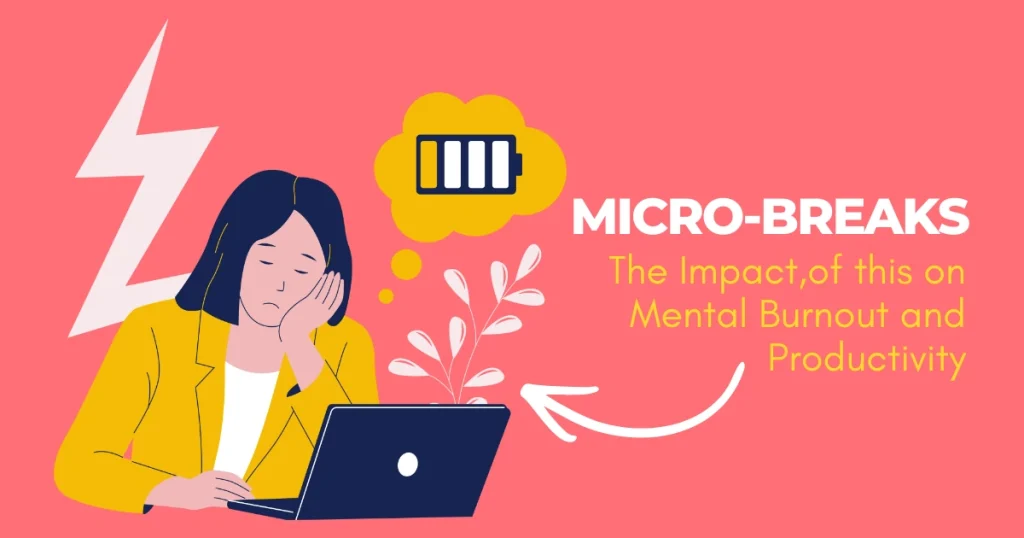
The Modern Crisis of Cognitive Fatigue
In the contemporary “always-on” work culture, we often treat our brains like high-speed processors that can run at maximum capacity for eight hours straight. However, neurobiology suggests otherwise. The human brain is a biological organ, not a silicon chip, and it is subject to the laws of directed attention fatigue.
When we push through exhaustion, our prefrontal cortex—the area responsible for executive function, decision-making, and impulse control—begins to falter. This is where micro-breaks enter the conversation as a revolutionary, low-effort strategy to maintain high performance and safeguard mental health.
What is a Micro-Break?
A micro-break is a brief, voluntary cessation of work tasks, typically lasting anywhere from 30 seconds to 5 minutes. Unlike traditional lunch breaks or hourly 15-minute intervals, micro-breaks are spontaneous and highly flexible.
The goal is not to “get things done” during these gaps, but to allow the brain’s Default Mode Network (DMN) to engage, providing a momentary “reboot” for your cognitive systems.
The Science: Why Tiny Breaks Yield Big Results
1. Combating Decision Fatigue
Every email you answer and every Slack message you parse requires a tiny “transaction fee” from your cognitive energy. Over time, these fees lead to decision fatigue. Research shows that even a 40-second micro-break—such as glancing at a green rooftop or out a window—can improve concentration levels by up to 6%.
2. The Role of the “Green Micro-break”
Environmental psychology highlights the “Attention Restoration Theory” (ART). This theory suggests that urban environments and digital screens drain our focus, while nature restores it. A micro-break spent looking at a plant or the sky helps “recharge” the neurons responsible for focus.
3. Preventing the “Vigilance Decrement”
Psychologists refer to the decline in performance over a long task as the vigilance decrement. By breaking the task for just a minute, you effectively “reset” your attention span, allowing you to return to the task with the same level of accuracy you had at the start.
Micro-Breaks vs. Mental Burnout
Mental burnout isn’t usually caused by one big event; it is the result of cumulative, unmanaged stress. Micro-breaks act as a “pressure valve.”
- Cortisol Regulation: Constant focus keeps the body in a mild state of “fight or flight.” Brief breaks help lower cortisol levels throughout the day.
- Physical Tension: Burnout is often accompanied by physical symptoms like neck pain or eye strain. A 60-second stretch breaks the feedback loop between physical discomfort and mental stress.
- Autonomy: One of the leading causes of burnout is a lack of control. Choosing to take a 2-minute break gives an employee a sense of agency over their time.
5 Practical Micro-Break Techniques
- The 20-20-20 Rule: Every 20 minutes, look at something 20 feet away for 20 seconds. This reduces digital eye strain and prevents “mental fog.”
- Box Breathing: Take 4 seconds to inhale, hold for 4, exhale for 4, and hold for 4. This resets the nervous system in under a minute.
- The Sensory Shift: If you’ve been staring at a screen, close your eyes and focus purely on the sounds in the room or the feeling of your feet on the floor.
- Hydration Sprints: Walk to the kitchen, pour a glass of water, and drink it mindfully. The movement and hydration provide a dual-benefit.
- Micro-Socializing: A quick, non-work-related chat with a colleague for 2 minutes can boost oxytocin and lower workplace isolation.
10 FAQs Micro-Breaks and Productivity
1. How often should I take a micro-break?
Ideally, every 20 to 45 minutes. The human brain struggles to maintain deep focus for longer than 90 minutes (the Ultradian Rhythm).
2. Does checking social media count as a micro-break?
No. Scrolling social media requires “active processing” and can lead to emotional triggers or “comparison trap” stress. A true micro-break should be “low-effort” for the brain.
3. Can micro-breaks actually make me more productive?
Yes. Studies from the University of Illinois show that brief diversions from a task can dramatically improve one’s ability to focus on that task for long periods.
4. How long is the “perfect” micro-break?
Research suggests the “sweet spot” is between 30 seconds and 5 minutes. Anything longer usually transitions into a standard break.
5. Are micro-breaks better than one long lunch break?
They serve different purposes. Lunch breaks are for physical nourishment and detachment, while micro-breaks are for real-time cognitive maintenance. You need both.
6. Will my boss think I’m slacking off?
Modern management is shifting toward “output-based” results. High-performing employees often use these techniques to maintain quality. If asked, explain it as a “cognitive reset strategy.”
7. What is the “Green Micro-break” study?
A famous study found that students who looked at a flowering “green roof” for 40 seconds performed significantly better on attention-based tasks than those who looked at a concrete roof.
8. Can micro-breaks help with physical pain?
Absolutely. They help prevent Repetitive Strain Injury (RSI) and “Tech Neck” by encouraging frequent posture changes.
9. Should I schedule them or take them spontaneously?
A mix of both works best. Use a timer if you tend to get “sucked in” to work, but also listen to your body’s signals of fatigue.
10. Do I have to leave my desk?
Not necessarily, though moving is better. Even just leaning back, closing your eyes, and stretching your arms for 30 seconds counts. DrugsArea
Key Sources and Further Reading
- Harvard Business Review: The Power of Small Wins and Micro-breaks
- Journal of Applied Psychology: Impact of Micro-breaks on Employee Well-being
- University of Melbourne: The 40-second Green Micro-break Study
- Psychological Science: Restorative Effects of Nature on Attention