The Future of Living with Chronic Illness: Why Holograms are More Than Sci-Fi
As a healthcare professional who has spent years navigating the limitations of traditional telehealth, I’ve seen firsthand the “digital disconnect.” You know the feeling—staring at a pixelated, 2D screen trying to explain a complex tremor or a swelling that the camera just won’t catch. But we are currently entering a transformative era. In 2026, the shift from “video calls” to holographic doctor visits is no longer just a scene from a movie; it is becoming a clinical reality that is fundamentally altering the management of chronic conditions.
Augmented Reality (AR) is bridging the gap between the physical and digital worlds, allowing us to “step into” the patient’s environment—and more importantly, allowing patients to visualize their own health in ways never before possible.
1. Beyond the Screen: What is a Holographic Visit?
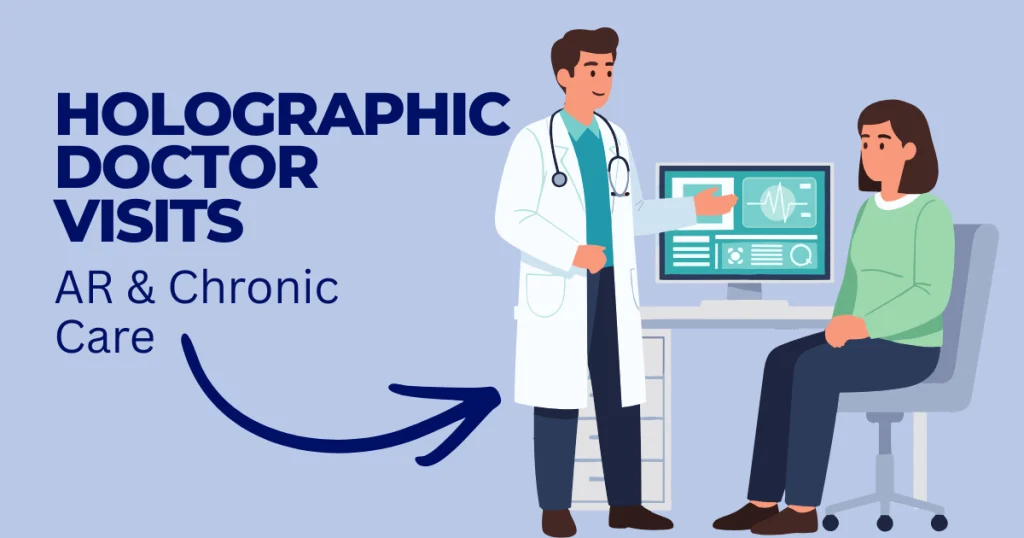
Traditional telehealth is essentially a glorified FaceTime. Holographic visits, powered by AR headsets or specialized light-field displays, project a life-sized, 3D digital representation of the clinician into the patient’s room (and vice versa).
For a patient managing a chronic condition like Multiple Sclerosis (MS) or Rheumatoid Arthritis, this depth perception is vital. As your doctor, I can see the nuances of your gait or the range of motion in your joints with spatial accuracy that a flat screen simply cannot provide. It’s about restoring the “human” element of the physical exam, even from miles away.
2. AR: The “GPS” for Chronic Disease Management
Chronic care is often synonymous with “self-management.” This is where AR truly shines as a transformative tool. We are seeing the rise of AR-guided self-care, which functions like a GPS for your health:
- Visualizing Biology: For patients with Diabetes, AR apps can overlay 3D visualizations of how insulin interacts with their specific glucose levels, making abstract data points tangible.
- Precision Physical Therapy: For stroke recovery or chronic pain, AR “ghosts” can appear in your living room, showing you the exact posture and movement required for an exercise, correcting your form in real-time.
- Wound Care: Patients with chronic ulcers can use AR scanners to map wound depth and healing progress, sending 3D telemetry directly to their wound-care specialist.
3. Impact on Patient Engagement and Literacy
The biggest hurdle in chronic care is often patient health literacy. When I explain a complex cardiac condition using a 2D diagram, much of it gets lost in translation.
In a holographic consultation, I can “pull out” a 3D model of your heart—rendered from your latest MRI—and show you exactly where the blockage is or how a valve is functioning. Research shows that this level of immersion increases treatment adherence because the patient isn’t just listening to a lecture; they are witnessing their own physiology.
4. The Challenges: Privacy and the “Digital Divide”
As much as I am an advocate for this tech, we must address the hurdles. Data security is paramount. When we project 3D medical data into a home, we are dealing with massive amounts of sensitive biometric information.
Furthermore, the cost of hardware remains a barrier. While AR glasses are becoming sleeker and more affordable in 2026, we must ensure that these life-changing tools don’t just become a luxury for the wealthy. True transformation requires equitable access.
5. A Doctor’s Perspective: The Emotional Connection
Perhaps the most surprising benefit of holographic visits is the reduction in “zoom fatigue” and clinical burnout. There is a psychological phenomenon called “presence.” When I see you as a hologram, my brain registers it as a face-to-face interaction. This reduces the cognitive load of virtual care and helps rebuild the sacred doctor-patient relationship that often feels “thinned out” by digital barriers. DrugsArea
Sources:
- How Augmented Reality in Healthcare is Revolutionizing Medical Practices – Flam
- Augmented Reality and Virtual Reality in Medical Devices – FDA
- Holography applications toward medical field: An overview – PMC – NIH
- “Your Digital Doctor Will Now See You”: A Narrative Review of VR and AI Technology in Chronic Illness Management – MDPI
- Augmented Reality in Outpatient Care: A Narrative Review – PMC
People Also Ask
1. What is a holographic doctor visit?
A holographic doctor visit is a next-generation telehealth experience where a doctor is “beamed” into a patient’s room as a live, life-sized 3D projection. Unlike a standard 2D video call (like Zoom or FaceTime), this technology uses Augmented Reality (AR) and specialized displays (such as Holobox or Proto) to create the illusion that the doctor is physically sitting in front of you. It allows for eye contact, depth perception, and a sense of “presence” that traditional screens cannot match.
2. How is holographic telemedicine different from a video call?
The main difference is spatial presence. In a standard video call, you are looking at a screen. In a holographic visit, you are looking through a display at a person who appears to be in the room with you. For chronic care patients, this reduces the “digital fatigue” of constant video calls and builds a stronger emotional connection and trust between the patient and the provider, which is crucial for long-term treatment adherence.
3. Can hologram doctors actually examine patients?
Currently, holographic doctors cannot physically touch a patient. However, they can perform highly detailed visual assessments. The high-definition, life-sized resolution allows doctors to observe physical symptoms (like skin color, gait, swelling, or range of motion) much more accurately than on a small laptop webcam. For physical examinations requiring touch, a nurse or medical assistant is usually present in the room to act as the doctor’s “hands.”
4. How does AR help in managing chronic diseases?
Augmented Reality (AR) transforms patient education. Instead of just telling a patient “you have high blood pressure,” a holographic doctor can project a floating 3D model of the patient’s heart into the room to visually show the blockage or strain. This visual learning is a game-changer for chronic conditions like diabetes or heart disease, as it helps patients truly understand their condition and why their medication is necessary.
5. Is holographic healthcare available to the public yet?
Yes, but it is still in the early adoption phase. Select forward-thinking hospitals and clinics (such as Crescent Regional Hospital in Texas and West Cancer Center) are already using units like the Proto M or Holoconnects for patient consults, especially for connecting rural patients with specialists in major cities. It is not yet a standard household technology, but it is rapidly moving from “sci-fi” to “specialized care.”
6. Do I need special glasses or headsets for a holographic visit?
Generally, no. The most promising holographic technologies for patient care (like the “Holobox”) are autostereoscopic, meaning they are naked-eye 3D displays. You do not need to wear clumsy VR headsets or AR glasses. You simply sit in front of the display unit, and the doctor appears naturally, making it accessible even for elderly patients who might struggle with wearable tech.
7. Is holographic telemedicine covered by insurance?
In most cases, these visits are billed similarly to standard telehealth consultations. Since the medical service provided (consultation, visual assessment, therapy) is the same as a video call, many insurers cover it under existing telemedicine codes. However, policies vary by provider and region, so patients should always verify if “telehealth services” are fully covered under their specific plan.
8. What are the benefits of holograms for rural or immobile patients?
For patients with chronic mobility issues or those living in “medical deserts,” holographic visits offer the closest alternative to an in-person visit without the travel. It eliminates the physical pain and logistical cost of transporting a chronically ill patient to a city center while providing a level of social interaction and “bedside manner” that phone calls lack.
9. Are holographic doctor visits private and secure?
Yes. Reputable holographic health providers must comply with the same HIPAA (Health Insurance Portability and Accountability Act) and GDPR regulations as any other medical software. The data transmission is encrypted end-to-end to ensure that the live stream and any patient data discussed remain confidential.
10. How much does a holographic medical system cost?
Currently, the technology is an enterprise investment for hospitals rather than a consumer purchase. Commercial units can range from $20,000 to $65,000+ depending on the size and fidelity. However, for the patient, there is typically no extra “equipment cost”—the hospital provides the unit in a satellite clinic, or the cost is absorbed into the facility fees, similar to using an MRI or X-ray machine.