Muscle as a Vital Sign: Why Grip Strength Matters More Than BMI
For decades, the medical community leaned heavily on the Body Mass Index (BMI). It was the “gold standard” because it was easy: height versus weight. But as we step further into 2026, the clinical focus has shifted. We’ve realized that a number on a scale doesn’t tell us how well you’ll age, how quickly you’ll recover from surgery, or how likely you are to remain independent in your 80s.
Today, we look at Muscle as a Vital Sign. Specifically, we look at Grip Strength.
If BMI is a snapshot of your size, grip strength is a high-definition video of your internal health. In this new era of “Metabolic Resilience,” your muscle isn’t just about aesthetics; it is your longevity insurance policy.
The Shift to Metabolic Resilience
In 2026, “fitness” isn’t about being thin. It’s about Metabolic Resilience—the body’s ability to withstand stress, clear glucose efficiently, and recover from injury.
Muscle is the primary organ of metabolism. It is the “sink” where your body stores and uses blood sugar. When you lose muscle mass—a process known as sarcopenia—you don’t just get weaker; your metabolic health takes a dive.
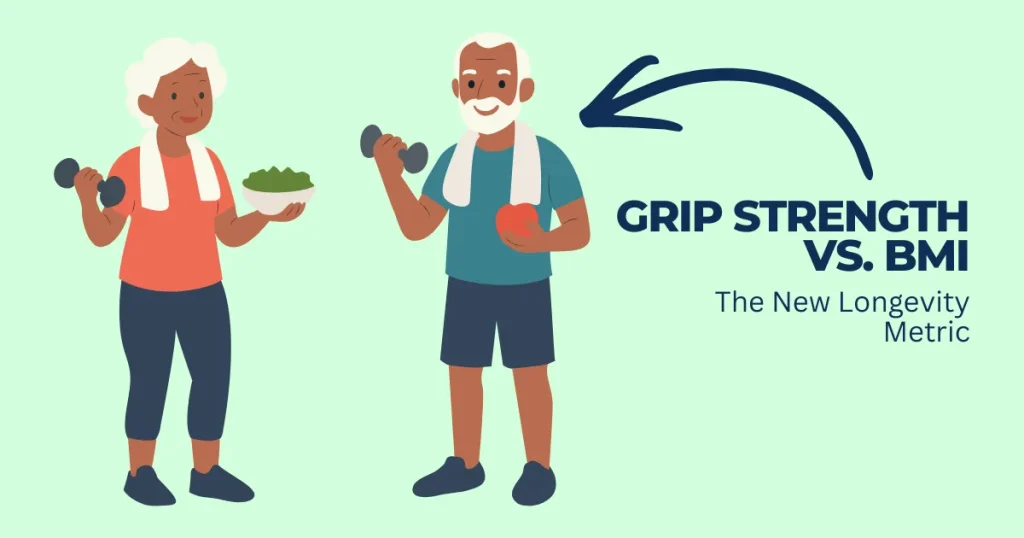
Why BMI Fails the Longevity Test
BMI cannot distinguish between 200 lbs of sedentary fat and 200 lbs of functional muscle. This creates the “Skinny Fat” paradox: individuals with a “normal” BMI who possess dangerously low muscle mass and high visceral fat. These individuals are often at higher risk for metabolic disease than “overweight” individuals with high muscle density. BMI CALCULATOR
Grip Strength: The “Crystal Ball” of Health
Why is a simple squeeze of a hand dynamometer so predictive? Research has consistently shown that grip strength correlates with:
- Cardiovascular Health: Low grip strength is a stronger predictor of cardiovascular mortality than systolic blood pressure.
- Cognitive Function: There is a direct link between muscular power and brain volume/white matter integrity as we age.
- Biological Age: Grip strength is one of the most reliable biomarkers of functional aging.
If you have a strong grip, it usually implies you have a functional, well-integrated nervous system and enough total-body lean mass to support your frame.
The Silent Enemy: Sarcopenia
Starting in our 30s, we begin to lose 3% to 8% of our muscle mass per decade. This rate accelerates significantly after age 60. Sarcopenia is the leading cause of falls, fractures, and loss of independence.
The good news? Muscle is a “use it or lose it” tissue. You can build it at any age. To combat sarcopenia, we need to move away from “cardio-only” mindsets and embrace Functional Strength.
The 5-Minute “Functional Strength” Routine
You don’t need a gym membership to build metabolic resilience. This routine focuses on the “Big Three” of functional aging: Grip, Legs, and Core.
| Exercise | Duration | Why It Works |
|---|---|---|
| The Farmer’s Carry | 1 Minute | Directly builds grip strength and stabilizes the spine. |
| Sit-to-Stand (Squats) | 2 Minutes | Targets the largest muscle groups to boost metabolism. |
| Dead Hang or Wall Push | 1 Minute | Decompresses the spine and builds upper body tension. |
| Plank / Core Hold | 1 Minute | Protects the lower back and improves posture. |
How to do it:
- Farmer’s Carry: Grab two heavy grocery bags or jugs of water. Walk around your room for 60 seconds. Do not let the weights touch your legs. Squeeze the handles hard.
- Sit-to-Stand: Use a sturdy chair. Sit down and stand up without using your hands. Move with control. This is the ultimate “longevity move.”
- Wall Push-Ups: Stand a few feet from a wall. Place your hands on it and perform slow, controlled push-ups. This maintains bone density in the wrists and strength in the chest.
Nutrition: Feeding the Machine
You cannot exercise your way out of a protein-deficient diet. To maintain muscle mass, especially post-2026 guidelines, aim for:
- Protein Threshold: Aim for 1.2 to 1.6 grams of protein per kilogram of body weight.
- Leucine: This amino acid (found in eggs, whey, and beef) is the “light switch” that turns on muscle protein synthesis.
- Hydration: Muscle is roughly 75% water. Dehydrated muscle is weak muscle.
The Bottom Line
In 2026, we are retiring the scale as the primary judge of health. Your ability to carry your own groceries, get up off the floor, and maintain a firm handshake are the real metrics of a long, vibrant life.
Stop worrying about being “thin” and start focusing on being strong. Your future self will thank you.
Health Disclaimer
The information provided in this article is for educational and informational purposes only and is not intended as medical advice. Always consult with a qualified healthcare professional or physician before starting a new exercise program or making significant changes to your health regimen, especially if you have pre-existing conditions. DrugsArea
Sources & References
- The Lancet: Grip strength as a predictor of muscular strength and health
- Journal of Cachexia, Sarcopenia and Muscle: Sarcopenia and Longevity
- Mayo Clinic: Why Muscle Mass is the New Vital Sign
- Frontiers in Medicine: Metabolic Resilience and Aging
People Also Ask
1. Why is grip strength considered a “vital sign” for health?
Think of grip strength as a proxy for your total body muscle mass and nervous system health. Just like blood pressure or heart rate, it provides a snapshot of your biological age. Research shows that a weak grip is a powerful predictor of underlying issues like chronic inflammation, heart disease, and cognitive decline.
2. Is grip strength more accurate than BMI for predicting longevity?
In many ways, yes. BMI (Body Mass Index) is a simple math equation that doesn’t distinguish between fat and muscle. You could be “normal” weight but “skinny fat” with very little muscle, which is a high-risk state. Grip strength measures muscle quality, which is more closely linked to how long (and how well) you’ll live.
3. What is the average grip strength for my age and gender?
While it varies, the general “red zone” for health risks is usually below 26 kg (57 lbs) for men and 16 kg (35 lbs) for women. Peak strength usually occurs in your 30s; if your numbers drop significantly faster than the standard aging curve, it’s a signal to check your metabolic health.
4. How does grip strength relate to heart health?
It sounds strange that your hands relate to your heart, but the link is strong. A large study (the PURE study) found that for every 11-pound decrease in grip strength, there was a 17% increase in cardiovascular death. Essentially, if your muscles are wasting away, your heart—which is also a muscle—is likely under stress too.
5. Can I improve my longevity just by using a hand gripper?
Not exactly. While hand grippers improve forearm strength, the “vital sign” concept refers to systemic strength. To actually move the needle on your health, you need full-body resistance training (squats, deadlifts, presses). The grip is just the “check engine light” for the rest of the machine.
6. Why does muscle mass matter more as we age?
Muscle is more than just “meat”; it’s a metabolic organ. It helps regulate blood sugar, soaks up glucose, and secretes “myokines” (hormones that fight inflammation). Starting around age 30, we lose about 3–8% of muscle mass per decade (sarcopenia). Maintaining grip strength is the best way to fight this decline.
7. Does a weak grip strength mean I have a higher risk of dementia?
There is a fascinating correlation here. Studies have shown that lower grip strength is associated with smaller hippocampal volume and slower processing speeds. Because the brain controls the complex motor neurons required for a strong grip, a decline in power often signals a decline in neuro-signaling.
8. How is grip strength measured?
It’s measured using a tool called a handheld dynamometer. You squeeze the device as hard as possible three times with each hand, and the highest score is recorded. It’s a 30-second test that provides more data than a standard physical exam often does.
9. Can you have a high BMI and still be healthy if your grip strength is high?
Absolutely. This is the “Fit but Fat” or “Muscular Overweight” paradox. If you have a high BMI but high grip strength, you likely have significant muscle mass, which protects you against the metabolic issues (like Type 2 Diabetes) that usually accompany a high BMI.
10. What are the best exercises to improve grip strength and overall muscle health?
If you want to improve the “vital sign” of grip, focus on:
- Farmer’s Carries: Walking while holding heavy weights.
- Dead Hangs: Hanging from a pull-up bar for time.
- Compound Movements: Deadlifts and rows require your grip to work in tandem with your entire posterior chain.