
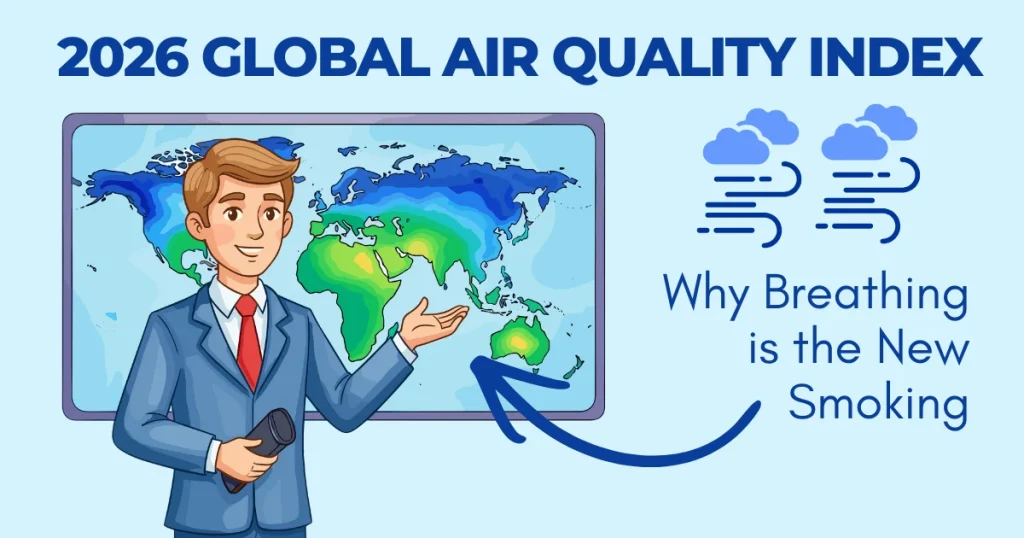
The 2026 Global Air Quality Index: Why Breathing is the New Smoking
For decades, the leading voluntary threat to human longevity was the cigarette. However, the release of the 2026 Global Air Quality Index (GAQI) has confirmed a terrifying shift in public health: the simple act of breathing has become an involuntary health hazard that rivals, and in some regions exceeds, the physiological damage of a pack-a-day smoking habit.
As we navigate 2026, the data shows that “Air Quality” is no longer just an environmental metric—it is the most significant determinant of global life expectancy.
1. The Invisible Killer: Decoding the 2026 GAQI Data
The 2026 Index highlights that 99% of the global population now breathes air that exceeds the World Health Organization’s (WHO) tightened safety limits. The primary culprit is PM2.5—fine particulate matter less than 2.5 micrometers in diameter. These particles are so small they bypass the lung’s natural filters, entering the bloodstream and triggering systemic inflammation.
The “Cigarette Equivalent” Metric
Researchers in 2026 have popularized the “Cigarette Equivalent” (CEQ) to help the public visualize risk.
- The Conversion: In cities with an average AQI of 150, the 24-hour inhalation of ambient air is roughly equivalent to smoking seven cigarettes per day.
- The Extreme: In hotspots like New Delhi or Lahore, the annual average PM2.5 levels mean residents “smoke” the equivalent of nearly 1,800 cigarettes a year just by existing.
2. Why Breathing is Morphing Into “The New Smoking”
The analogy isn’t just a marketing slogan; it is grounded in clinical pathology. The 2026 medical consensus confirms that the pathways of damage for air pollution and tobacco smoke are nearly identical.
Shared Pathological Outcomes:
- Systemic Inflammation: Both smoke and PM2.5 trigger an immune response that leads to chronic oxidative stress.
- Genotoxicity: 2026 studies show that prolonged exposure to toxic air causes DNA mutations in lung tissue, leading to early-onset lung cancer in non-smokers.
- Cardiovascular Decay: Just as nicotine constricts vessels, air pollutants cause arterial plaque buildup, leading to the “pollution-induced” strokes and heart attacks that dominated 2025-2026 hospital admissions.
3. Global Hotspots: The 2026 Toxicity Map
The 2026 GAQI reveals a deepening “Air Inequality” gap. While North America and parts of Western Europe have seen a 5% improvement due to aggressive EV transitions and industrial carbon scrubbing, the Global South is in a state of respiratory emergency.
| Region | Primary Pollutant Source | Average AQI (2026) | Life Expectancy Loss |
|---|---|---|---|
| South Asia | Crop burning & Fossil Fuels | 190+ | 5.2 Years |
| Sub-Saharan Africa | Domestic Biomass Burning | 140 | 3.1 Years |
| Southeast Asia | Industrial Emissions | 115 | 2.4 Years |
| Eastern Europe | Coal-fired Heating | 90 | 1.2 Years |
4. The Economic Toll of Every Breath
The World Bank’s 2026 update on environmental economics estimates that air pollution-related illnesses cost the global economy $9.1 trillion annually. This includes:
- Labor Productivity: Loss of workdays due to asthma and COPD.
- Healthcare Burdens: The skyrocketing cost of treating “non-smoker lung cancer.”
- Cognitive Decline: New 2026 research links high AQI exposure to accelerated Alzheimer’s and Parkinson’s, further straining elderly care systems.
5. Is Transitioning to “Clean Air” Possible?
The 2026 report isn’t entirely bleak. It highlights “Success Corridors” where policy has triumphed over smog.
- The China Model: Continuing its “War on Pollution,” China has successfully added 2.1 years back to the life expectancy of Beijing residents since 2014.
- Urban Green Zones: Cities like Singapore and Copenhagen have utilized “living walls” and “mega-purifiers” to create localized micro-climates where the AQI is consistently 40% lower than the surrounding suburbs.
6. How to Protect Yourself in 2026
Until systemic change occurs, individual mitigation is essential. Professional health experts now recommend:
- Real-time Monitoring: Using hyper-local AQI sensors rather than regional averages.
- HEPA Ubiquity: 2026 home standards now treat HEPA air filtration as a necessity, much like clean water.
- N95/FFP3 Masking: During “Severe” AQI days, masking is no longer about viruses—it’s about filtering the “atmospheric cigarettes.”
Conclusion: The Right to Breathe
The 2026 Global Air Quality Index serves as a final warning. We can choose to quit smoking, but we cannot choose to stop breathing. The shift from “Smoking” to “Breathing” as the primary threat to human health requires a global policy shift that treats air quality as a fundamental human right. DrugsArea
Sources & References
- World Health Organization (WHO), Air Pollution Overview & Guidelines 2026
- State of Global Air, 2025-2026 Health Impact Report
- Energy Policy Institute at the University of Chicago (EPIC), Air Quality Life Index (AQLI) 2026 Update
- The Lancet Planetary Health, Comparative Risks of Ambient Pollution vs. Tobacco
- IQAir, World Air Quality Report: 2026 Rankings
FAQ “2026 Global Air Quality Index: Why Breathing is the New Smoking.”
1. What does the “2026 Global Air Quality Index” actually measure?
The index is not a single static report but a real-time aggregate of data from ground stations and satellites (like those from IQAir, WAQI, and government bodies). In 2026, it specifically tracks PM2.5 (fine particulate matter), PM10, Nitrogen Dioxide (NO2), and Ozone. The “2026” focus highlights the current year’s severe spikes, particularly in South Asia (where AQI hit 400+ in January) and parts of the Western Hemisphere affected by wildfire smoke.
2. Why is breathing polluted air compared to smoking?
The phrase “Breathing is the New Smoking” is used because PM2.5 particles act similarly to cigarette smoke in the body.
- Size: They are small enough (1/30th the width of a hair) to bypass the body’s defenses.
- Path: They enter the bloodstream through the lungs, causing systemic inflammation, heart disease, stroke, and lung cancer—diseases traditionally associated with tobacco use.
- Impact: Research (such as the Air Quality Life Index) suggests that in the most polluted regions, breathing the air cuts life expectancy by as much as 4–8 years, comparable to the loss suffered by long-term smokers.
3. If I live in a city with an AQI of 150, how many “cigarettes” have I smoked?
A popular conversion rule of thumb (popularized by Berkeley Earth) is: 22 µg/m³ of PM2.5 over 24 hours ≈ 1 cigarette.
- AQI 150 (Unhealthy): Roughly equivalent to smoking 2–3 cigarettes that day.
- AQI 300+ (Hazardous): In cities like Delhi or parts of China during peak smog, residents may effectively inhale the equivalent of 10–15 cigarettes a day just by breathing.
4. Which regions are the “chain smokers” of 2026?
As of January 2026, the data points to specific “hotspots” with chronic hazardous levels:
- South Asia: Cities like New Delhi, Lahore, and Dhaka have recorded “Severe” AQI levels (400+) due to winter inversion, vehicular emissions, and biomass burning.
- East Asia: Certain industrial zones in China remain high but show improvement trends.
- Wildfire Zones: Parts of North America and Australia see sporadic “hazardous” spikes due to climate-driven wildfires, even if their annual average is lower.
5. Who is most vulnerable to “passive smoking” from the air?
While everyone is affected, the 2026 Index highlights three critical groups:
- Children: Their lungs are still developing, and they breathe faster, taking in more pollutants per pound of body weight.
- The Elderly: Higher risk of stroke and heart attack triggered by inflammation.
- Pre-existing Conditions: Those with asthma, COPD, or heart disease face immediate risks even at “Moderate” (AQI 50–100) levels.
6. Is indoor air safer than outdoor air in 2026?
Not necessarily. The EPA and WHO warn that indoor air can be 2 to 5 times more polluted than outdoor air. Without proper filtration (HEPA purifiers) or ventilation, outdoor PM2.5 seeps inside and gets trapped, mixing with indoor pollutants like cooking fumes (gas stoves), volatile organic compounds (VOCs), and dust.
7. Do standard face masks protect against this “smoke”?
No. Standard cloth or surgical masks are designed to catch droplets (like viruses) but are too porous to stop PM2.5 particles.
- Effective: N95, KN95, or FFP2 masks form a tight seal and filter out at least 95% of non-oil-based airborne particles.
- Ineffective: Scarves, bandanas, and loose-fitting surgical masks offer negligible protection against fine particulate matter.
8. What is the economic cost of this “new smoking”?
The global economy loses trillions annually due to air pollution. Costs include:
- Healthcare: Treatment for chronic respiratory and cardiovascular diseases.
- Productivity: Lost workdays due to illness and fatigue (pollution lowers cognitive function).
- Premature Death: The workforce shrinks as life expectancy drops in highly productive industrial regions.
9. How does the 2026 Index differ from previous years?
The 2026 data reflects tighter integration of satellite monitoring to fill gaps in ground data (especially in Africa and South America). It also accounts for the increasing role of climate change—specifically how shifting wind patterns (like La Niña/El Niño) trap pollutants longer in stagnant air, creating “airpocalypse” events even with the same level of emissions.
10. What can I do to “quit” this involuntary habit?
Since you cannot stop breathing, “quitting” involves mitigation:
- Monitor: Check the AQI daily (using apps like IQAir or local government sites).
- Filter: Run HEPA air purifiers in your bedroom and workspace.
- Seal: Use weather stripping to prevent outdoor air leakage during high AQI days.
- Mask: Wear an N95 mask when outdoors if the AQI exceeds 150.