Eccentric Loading: The 2026 Secret to Strengthening Tendons and Preventing Injury
The Paradigm Shift: From “Lifting” to “Lengthening”
For decades, the “clank and bang” of the gym was focused almost entirely on the concentric phase of movement—the glamorous part where we curl the weight up or push the bar off our chest. But as we move through 2026, the longevity community and sports medicine professionals have pivoted toward a “lengthening-first” philosophy.
We are no longer just asking how much you can lift; we are asking how well you can lower. This is the science of eccentric loading, and it is the single most important factor in building a body that doesn’t just look strong, but stays resilient well into your 80s and 90s.
What is Eccentric Loading?
Every strength exercise consists of three phases:
- Concentric: The muscle shortens under tension (e.g., pulling up in a chin-up).
- Isometric: The muscle stays the same length under tension (e.g., holding the top of a chin-up).
- Eccentric: The muscle lengthens under tension (e.g., slowly lowering yourself down from the chin-up bar).
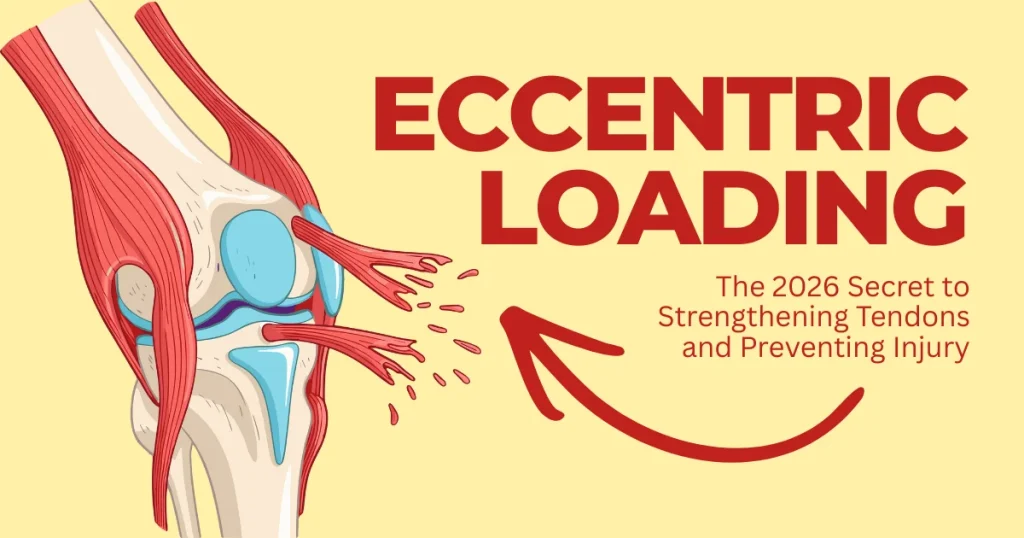
In 2026, we’ve realized that the eccentric phase is where the magic happens for connective tissue. While muscles are highly vascular and heal quickly, tendons are the “stubborn” cousins. They have less blood flow and require a specific type of mechanical “insult” to trigger remodeling. That insult is eccentric tension.
The Science: Why Your Tendons Crave the “Slow Lower”
Tendons are primarily composed of collagen fibers arranged in parallel. When a tendon becomes pathological (tendinopathy), those fibers become disorganized, much like a tangled ball of yarn.
1. Mechanotransduction
Eccentric loading utilizes mechanotransduction, a process where physical forces are converted into cellular signals. When you slowly lengthen a muscle-tendon unit under load, you create a “shearing” force that signals the tenocytes (tendon cells) to produce new Type I collagen.
2. Greater Force Production
Physiologically, humans are roughly 20–40% stronger during the eccentric phase than the concentric phase. This means we can apply a higher magnitude of force to the tendon during the lowering phase than we ever could while “lifting,” providing a more potent stimulus for structural change.
3. Sarcomere Genesis
Eccentric training has been shown to add sarcomeres in series, effectively making the muscle-tendon unit longer and more compliant. This is a massive win for injury prevention, as a “stiff” but brittle system is much more likely to tear than a “supple” and strong one.
The 2026 Longevity Priority: Joint Integrity
In current longevity programs, we prioritize “Biological Durability.” We’ve seen a shift away from high-intensity interval training (HIIT) that hammers the joints, toward Tempo Training.
By focusing on a 4-to-6 second eccentric phase, we reduce the shear force on the internal joint capsule while maximizing the tension on the stabilizing structures. This is why eccentric loading is now the frontline defense against:
- Achilles Tendinopathy
- Patellar Tendonitis (Jumper’s Knee)
- Rotator Cuff Tears
- Lateral Epicondylitis (Tennis Elbow)
Practical Application: How to Program for Resilience
If you want to integrate these 2026 standards into your routine, you don’t need a new gym. You need a new tempo.
The 4-2-1 Rule
A standard “Eccentric-Focused” rep should look like this:
- 4 Seconds: The lowering phase (Eccentric).
- 2 Seconds: A pause at the bottom (Isometric) to eliminate momentum.
- 1 Second: The lifting phase (Concentric).
Top 3 Exercises for Tendon Health
| Exercise | Primary Target | Why it Works |
|---|---|---|
| Nordic Hamstring Curls | Hamstring Tendon | Unmatched eccentric load for ACL protection. |
| Slant Board Squats | Patellar Tendon | Places direct, controlled tension on the knee stabilizers. |
| Slow-Lower Calf Raises | Achilles Tendon | Reorganizes collagen fibers in the thickest tendon in the body. |
Injury Prevention vs. Rehabilitation
In the past, eccentric loading was something you did after you got hurt. In 2026, it is what we do so we don’t get hurt.
By exposing our tissues to controlled eccentric stress, we increase the “Load Tolerance” of the tissue. Think of it like upgrading the suspension on a car. If you have a Ferrari engine (strong muscles) but the suspension of a bicycle (weak tendons), you’re going to crash when you hit a bump. Eccentric loading builds the suspension.
Common Mistakes to Avoid
- Going Too Heavy Too Soon: Tendons take weeks, sometimes months, to adapt. Muscles adapt in days. Don’t let your ego dictate the weight.
- Rushing the Eccentric: If you “drop” the weight, you lose 80% of the benefit. Use a stopwatch or a partner to keep your count honest.
- Ignoring Pain: While some “discomfort” (2/10 on a pain scale) is often acceptable in tendon rehab, sharp pain is a signal to back off.
The Future of Strength
The “Secret of 2026” isn’t a new supplement or a high-tech machine; it’s a return to the fundamentals of physics. By slowing down and respecting the lengthening phase of movement, we can build bodies that are not only powerful but virtually “bulletproof” against the wear and tear of aging.
Stop lifting. Start lowering. Your future self will thank you.
Sources & References
- Journal of Orthopaedic & Sports Physical Therapy: Eccentric Exercise for Tendinopathy
- British Journal of Sports Medicine: Mechanotransduction and Tendon Health
- National Library of Medicine: Physiological Basis of Eccentric Training
- The Lancet: Longevity and Musculoskeletal Health 2025-2026 Review
Health Disclaimer: The information provided in this article is for educational and informational purposes only and is not intended as medical advice. Always consult with a qualified healthcare professional or physical therapist before starting a new exercise regimen, especially if you are recovering from an injury. DrugsArea
People Also Ask
1. What is eccentric loading and why is it trending in 2026?
Eccentric loading refers to the phase of an exercise where the muscle lengthens under tension (like lowering the weight during a bicep curl). In 2026, it’s trending because sports science has moved toward “longevity training,” prioritizing tendon health and connective tissue density over simple muscle hypertrophy.
2. How does eccentric training actually strengthen tendons?
Unlike muscles, tendons have low blood flow and respond better to slow, heavy mechanical tension. Eccentric loads stimulate collagen synthesis and help realign collagen fibers that have become disorganized due to overuse or age, essentially “remodeling” the tendon from the inside out.
3. Can eccentric exercises help with chronic Achilles or Patellar tendonitis?
Yes, it is often considered the gold standard for recovery. By focusing on the “down” phase of a movement—such as a slow heel drop for the Achilles—you apply controlled stress that promotes healing without the high-impact “snap” that usually aggravates tendonitis.
4. How many times a week should I perform eccentric loading?
For tendon adaptation, 2 to 3 times per week is the sweet spot. Tendons take longer to recover than muscles (roughly 48–72 hours). Overdoing it can lead to “creep,” where the tendon becomes too compliant and loses its ability to store and release energy.
5. Is eccentric loading better for injury prevention than stretching?
In 2026, the consensus is yes. While stretching improves temporary range of motion, eccentric loading builds “strength at length.” This prepares your joints to handle sudden, awkward forces, which is where most sports injuries actually happen.
6. What is the ideal “tempo” for an eccentric movement?
To maximize tendon benefits, aim for a 3 to 5-second eccentric phase. For example, if you are doing a squat, take a full 4 seconds to lower yourself to the bottom, then explode up or use assistance to return to the start.
7. Do I need special equipment for eccentric training?
Not necessarily, but flywheel training and isokinetic machines have become huge in 2026. However, you can do this with standard weights by using the “2-up, 1-down” method: lift the weight with two limbs and lower it slowly with only one.
8. Will eccentric loading make me extremely sore?
Initially, yes. Eccentric tension causes more micro-tears in the muscle fibers, leading to Delayed Onset Muscle Soreness (DOMS). The key is to start with body weight and gradually increase the load as your nervous system and tendons adapt.
9. Is there an age limit for starting eccentric tendon training?
Actually, it’s highly recommended for older adults. As we age, tendons naturally become stiffer and more brittle. Controlled eccentric loading is one of the most effective ways to maintain “springiness” and prevent the tendon ruptures common in “weekend warriors” over 40.
10. Can I combine eccentric loading with my regular gym routine?
Absolutely. Most athletes use it as a “finisher” or a dedicated block at the start of their workout. By integrating slow descents into your existing lifts, you’re hitting both the metabolic engine (muscle) and the structural support (tendon) simultaneously.