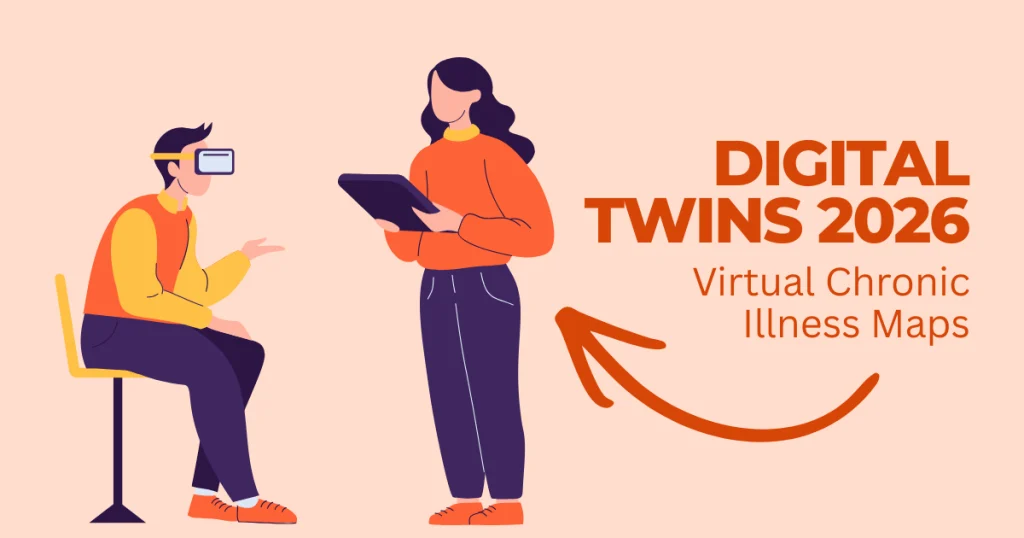
Digital Twins in 2026: Creating a “Virtual Map” of Your Chronic Illness
As a healthcare professional who has spent years navigating the trial-and-error nature of chronic disease management, I’ve often wished for a “crystal ball.” In the past, when we prescribed a new ACE inhibitor for a patient with hypertension or a specific biologic for an autoimmune condition, we were essentially playing a game of biological probability. We knew what worked for the average patient, but we never truly knew what would work for you—until now.
By 2026, that “crystal ball” has arrived in the form of the Digital Twin. This technology is no longer a futuristic concept found only in high-end research labs; it is becoming a cornerstone of personalized medicine. We are now moving away from treating “the disease” and moving toward treating “the patient’s unique physiology” through high-fidelity, AI-driven virtual mapping.
What is a Digital Twin in Healthcare?
In its simplest form, a Digital Twin is a dynamic, virtual replica of a physical asset. In our world, that asset is you. By 2026, we are using a convergence of high-performance computing, real-time data from wearables, and advanced imaging (like 3D MRIs and CT scans) to create an “Avatar” of your internal systems.
Imagine a 3D, AI-modeled version of your own heart or kidneys sitting on your physician’s tablet. This isn’t just a static picture; it’s a living, breathing computational model that mimics your specific vascular resistance, your filtration rates, and your unique genetic markers.
The End of “Trial and Error” Prescribing
The most transformative application of Digital Twins in 2026 is in silico medication testing. For patients with complex, multi-system chronic illnesses, the risk of adverse drug reactions or “drug-drug interactions” is a constant anxiety.
Traditionally, if a patient with Stage 3 Chronic Kidney Disease (CKD) also had heart failure, balancing their medications was a delicate tightrope walk. A drug that helped the heart might inadvertently strain the kidneys.
Today, we use AI-modeled organ simulations to run “what-if” scenarios:
- Heart Simulations: We can introduce a virtual version of a new medication to your Digital Twin’s heart and observe how it affects your specific arrhythmia or ejection fraction before a single pill is swallowed.
- Kidney Function Mapping: For patients with diabetes and kidney concerns, we can simulate the metabolic flux of a drug to see if it causes interstitial stress or if your specific filtration rate can handle the clearance.
This allows us to achieve what we call “97% predictive accuracy” in certain neurodegenerative and cardiac outcomes, significantly reducing the recurrence of complications like arrhythmias.
Why 2026 is the Turning Point
While the concept of the Digital Twin originated in engineering (think NASA or Formula 1), 2026 marks the year it moved from “pilot to practice.” Several factors have aligned to make this a reality for chronic disease patients:
- The Rise of Generative AI: Unlike older models, today’s AI can interpret massive datasets—genomics, proteomics, and real-time biometric data from your smartwatch—to update your “Virtual Map” instantly.
- Organ-on-Chip Integration: We are seeing the marriage of biological “organoids” with digital models. By using a patient’s own cells to create a micro-organ, we can feed that real-world biological data into the Digital Twin to make the simulation even more accurate.
- Regulatory Shifts: The FDA and other global bodies have expanded frameworks to include computational modeling as an acceptable tool for clinical decision-making.
A Professional Perspective: The Human Element
As a clinician, I see the Digital Twin not as a replacement for the “doctor-patient” relationship, but as a bridge. When I can show you a visual representation of how a lifestyle change or a specific medication is preserving your kidney function, it transforms your role from a passive patient to an active partner in your care.
We are entering an era where your “Virtual Map” tells the story of your future health, allowing us to intervene before a flare-up occurs or a complication arises. This is the promise of 2026: a healthcare system that is predictive, preventive, and, above all, personal.
Sources & References
- Digital twins in healthcare: a comprehensive review and future directions – Frontiers ,
- Healthcare Digital Twins Market Size 2025 to 2034 – Precedence Research ,
- Digital Twins’ Advancements and Applications in Healthcare – PMC ,
- 2026: The year AI stops being optional in drug discovery – Drug Target Review ,
- Digital Twin of the Heart in Cardiac Care – Open MedScience ,
- GenAI-Powered Digital Twins for Chronic Disease Management – IJFMR
Health Disclaimer: This article is for informational purposes only and does not constitute medical advice. Digital Twin technology is an emerging tool and should only be used under the supervision of qualified medical professionals. Always consult with your physician before making any changes to your medication or treatment plan. DrugsArea
People Also Ask
1. What is a “Digital Twin” in the context of chronic illness?
In 2026, a digital twin is more than just a chart; it’s a dynamic, virtual 3D replica of your biological systems. It stays synced with your body using real-time data from wearables and medical sensors. For chronic illness, it acts as a “flight simulator” for your health, allowing doctors to test treatments on your virtual self before applying them to your real body.
2. How do “Virtual Chronic Illness Maps” differ from traditional medical records?
Traditional records are like a static photo of your past; Virtual Chronic Illness Maps are a live-stream of your future. These maps visualize the progression of a disease (like diabetes or heart disease) across your specific anatomy, highlighting “hot zones” where complications are likely to occur based on your unique genetic and lifestyle data.
3. Can a digital twin predict a flare-up before it happens?
Yes. By 2026, predictive algorithms integrated into your digital twin can analyze subtle shifts in biomarkers—like heart rate variability or glucose fluctuations—to alert you and your doctor days before a chronic flare-up occurs. This allows for “preventative adjustments” rather than reactive ER visits.
4. Which chronic diseases are best managed with this technology?
Currently, the most effective maps exist for Type 1 and 2 Diabetes, Cardiovascular Disease, and COPD. Because these conditions rely heavily on continuous data (glucose, blood pressure, lung capacity), the digital twin can provide highly accurate simulations of how different medications or lifestyle changes will impact the disease’s path.
5. How does AI improve these virtual health maps?
AI serves as the engine. It processes the massive “data exhaust” from your life—everything from sleep patterns to local air quality—and compares it against millions of other patient maps. This helps the AI identify patterns unique to you, making your virtual map increasingly accurate at simulating “what-if” scenarios.
6. Is my data safe in a virtual illness map?
Privacy is the biggest conversation of 2026. These maps use Zero-Trust Architectures and often Blockchain-based identity management to ensure you own your biological data. While the risk of cyberattacks exists, the industry has moved toward decentralized storage where your “twin” is encrypted and accessible only via your explicit digital consent.
7. Do I need special equipment to start a digital twin?
Most users start with standard 2026-grade wearables (smartwatches or continuous glucose monitors). However, for a high-fidelity “Virtual Map,” your doctor might integrate data from a one-time genomic sequence and high-resolution imaging (like a 3D MRI) to “seed” the initial virtual model.
8. Will health insurance cover the cost of a digital twin?
Increasingly, yes. Insurers in 2026 are realizing that maintaining a digital twin is significantly cheaper than treating a localized crisis. Many “Value-Based Care” plans now subsidize the creation of these maps because they demonstrably reduce hospital readmission rates and long-term complications.
9. Can I share my virtual map with different specialists?
That is one of the primary benefits. Instead of carrying physical files, you grant “viewing keys” to your specialists. Whether you’re seeing a cardiologist or a nutritionist, they all look at the same living model of your health, ensuring that a treatment for one issue doesn’t accidentally worsen another.
10. What is the “Digital Twin ROI” for a typical patient?
For the average patient with a chronic condition, the “Return on Health” includes a 30-50% reduction in emergency visits and the elimination of “trial-and-error” prescribing. By seeing the map of where your health is headed, you gain the agency to change the route before you arrive at a complication.