The Ultimate 2026 Home Wellness Upgrade: Circadian Lighting for Deep Sleep
Introduction: Why Light is Your Most Powerful “Drug”
As a health professional, I often see patients struggling with “tired but wired” syndrome. They eat well, they exercise, and they take magnesium, yet deep, restorative sleep remains elusive. In 2026, we’ve realized that the missing piece of the puzzle isn’t in a pill bottle—it’s on your ceiling.Deep Sleep
Welcome to the era of Human-Centric Lighting (HCL). This isn’t just about “smart bulbs”; it’s about aligning your indoor environment with the biological clock that has governed human life for millions of years. By mimicking the sun’s natural progression, you can effectively “biohack” your hormones to ensure you feel energized at 8:00 AM and naturally drowsy by 10:00 PM.
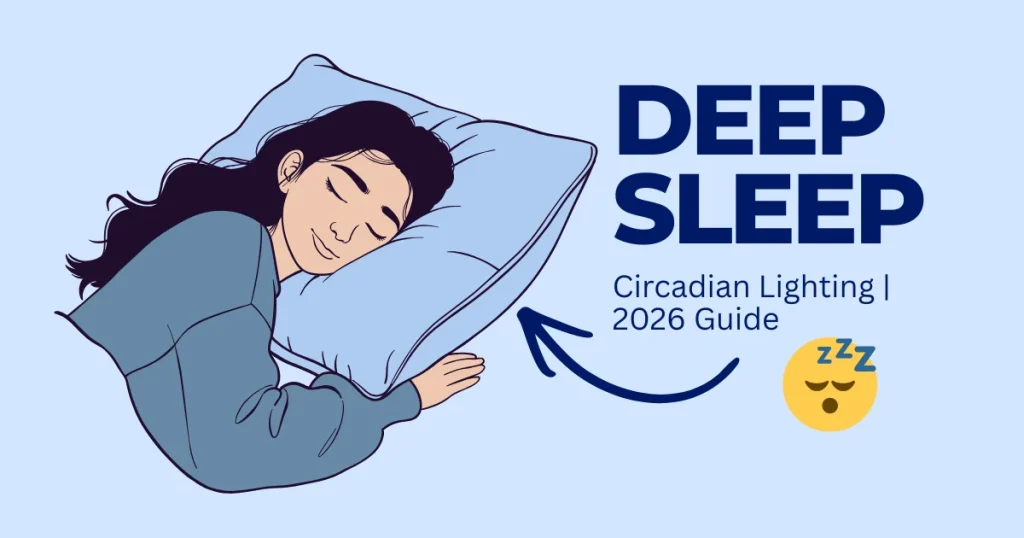
The Science: What is Circadian Lighting Deep Sleep ?
Our bodies operate on a Circadian Rhythm, an internal 24-hour clock located in the hypothalamus of the brain. This clock is primarily regulated by light.
When specific wavelengths of light hit the photoreceptors in your eyes, your brain sends signals to produce either Cortisol (the alertness hormone) or Melatonin (the sleep hormone).
- Blue Light (Short Wavelength): Found in morning sunlight and LED screens. It suppresses melatonin and spikes cortisol. Great for productivity; terrible for bedtime.
- Amber/Red Light (Long Wavelength): Mimics the sunset. It tells the brain that the day is ending, allowing melatonin levels to rise naturally.
“Human-Centric Lighting” is simply the practice of using artificial light to support this natural biological process rather than fighting against it.
The 2026 Daily Guide: Shifting Your Spectrum
Upgrading your home doesn’t require a total rewiring. You can achieve a circadian-friendly home using smart bulbs, smart switches, or even just strategically placed lamps.
Morning (7:00 AM – 11:00 AM): The “Blue” Boost
- Goal: Immediate cortisol release and suppression of “sleep fog.”
- The Light: High-intensity, “Cool White” or blue-enriched light (5000K–6500K).
- The Action: Open your curtains immediately. If it’s dark outside, turn on bright overhead lights. This sets your “internal timer,” ensuring you’ll be tired 14–16 hours later.
Afternoon (11:00 AM – 4:00 PM): High Noon Stability
- Goal: Maintain focus and avoid the “afternoon slump.”
- The Light: Neutral white light (approx. 4000K).
- The Action: Keep your workspace well-lit. If you work near a window, let the natural daylight do the heavy lifting.
Evening (4:00 PM – Sunset): The Transition
- Goal: Begin the gradual descent into relaxation.
- The Light: Warm White (2700K–3000K).
- The Action: Switch off harsh overhead “can” lights. Switch to floor lamps or table lamps. The light should be physically lower in the room (mimicking the low sun).
Night (2 Hours Before Bed): The Amber Zone
- Goal: Maximum melatonin spike.
- The Light: Amber or Sunset Orange (1800K–2200K).
- The Action: Eliminate all blue light. Use “warmth” filters on your phone and switch your smart bulbs to a deep amber hue. This is the most critical window for deep sleep.
Practical Tips for a “Low-Tech” Upgrade
You don’t need a $10,000 lighting system to see results. Here are the easiest ways to start tonight:
- The “Lamp-Only” Rule: After 7:00 PM, no overhead lights allowed. Use only lamps with warm-toned bulbs.
- Smart Bulb Automation: Brands like Philips Hue or Nanoleaf have “Circadian” settings that automatically change the color temperature based on the time of day.
- Motion-Sensed Nightlights: For bathroom trips at night, use red-tinted motion lights. This prevents “circadian shock” that wakes your brain up if you turn on the main bathroom light.
The Benefits: More Than Just Sleep
By adopting circadian lighting, you aren’t just sleeping better; you’re improving your overall health:
- Mood Regulation: Proper light exposure is linked to lower rates of seasonal depression.
- Metabolic Health: Sleep deprivation messes with hunger hormones; better sleep leads to better weight management.
- Cognitive Function: Deep sleep is when your brain “washes” itself of toxins, improving memory and focus the next day.
Conclusion: Let Nature Lead the Way
In our modern world, we’ve built “caves” (houses) and filled them with “fake suns” (LEDs). By returning to a natural light cycle through Human-Centric Lighting, you are giving your body the permission it needs to heal and rest. It is the easiest, most passive wellness upgrade you can make in 2026.
Health Disclaimer
This article is for informational purposes only and does not constitute medical advice. DrugsArea
Sources & Scientific References
- Harvard Health: Blue light has a dark side
- National Institute of General Medical Sciences: Circadian Rhythms
- Nature Journal: Impact of Light on Human Health
- Sleep Foundation: How Blue Light Affects Sleep
People Also Ask
1. What is circadian lighting and how does it actually work?
Think of circadian lighting as a “sun simulator” for your home. It uses smart LED technology to mimic the natural progression of sunlight throughout the day. In the morning, it pumps out crisp, blue-toned light to wake your brain up; by evening, it automatically shifts to a warm, amber glow. This helps keep your internal 24-hour clock (your circadian rhythm) in sync, even if you spend most of your day indoors.
2. Can circadian lighting really help me fall asleep faster?
Absolutely. The biggest sleep-killer in modern homes is “blue light” from standard LEDs and screens late at night, which tricks your brain into thinking it’s still noon. Circadian systems strip away those blue wavelengths as bedtime approaches, allowing your body to produce melatonin naturally. Most users find they start feeling “naturally sleepy” much earlier once they make the switch.
3. What is the best color temperature for sleep in 2026?
For deep sleep prep, you want to stay below 2700 Kelvin (K) in the evening. As you get closer to your actual bedtime, shifting even lower to an “amber” or “candlelight” setting around 1800K to 2200K is ideal. These ultra-warm tones have the least impact on melatonin production, effectively telling your brain the day is over.
4. How much does a full home circadian lighting upgrade cost?
The price range is wider than ever in 2026. You can start small with a few smart bulbs for $30–$100, or go for a high-end, professionally integrated system like Lutron Ketra or Savant, which can range from $3,000 to $10,000+ depending on the size of your home. The “sweet spot” for most homeowners is a DIY-friendly mesh system (like Philips Hue) which costs about $500–$1,500 for a main living area and bedroom.
5. Do I need to replace all my light fixtures to get circadian benefits?
Not at all! Most people start by simply swapping out their existing bulbs for “Tunable White” or “Full Spectrum” smart bulbs. As long as your fixture has a standard socket, you can usually upgrade it. However, for a truly seamless experience, “Dim-to-Warm” recessed fixtures are a popular 2026 choice for new builds and renovations.
6. Is “blue light” always bad for you?
Not at all—it’s actually essential! In the morning, blue-rich light (around 5000K–6500K) is exactly what you need to stop melatonin production and boost cortisol, which helps you feel alert and focused. The “bad” reputation only applies when you’re exposed to it after the sun goes down.
7. How is circadian lighting different from regular “smart bulbs”?
While many smart bulbs change color, true circadian lighting focuses on the spectrum and timing. In 2026, top-tier systems use “dynamic spectral tuning” to change the actual light recipe throughout the day automatically. Regular smart bulbs often require you to change the colors manually, which most people forget to do.
8. Can circadian lighting help with Seasonal Affective Disorder (SAD)?
Yes, it’s one of the best tools for it. By simulating a bright, sunny morning indoors—even on a gray, rainy Tuesday—circadian lighting can help regulate your mood and energy levels during the darker months. It provides that vital “anchor” for your internal clock that natural winter light often lacks.
9. Does circadian lighting save energy?
Surprisingly, yes. Because these systems are typically LED-based and use automated dimming, they often consume less power than traditional “always-on” lighting. Many 2026 systems also feature “daylight harvesting,” which dims your indoor lights automatically when there’s enough natural sun coming through the windows.
10. What are the best brands for circadian lighting in 2026?
For a DIY-friendly setup, Philips Hue and Nanoleaf remain the leaders in ease of use. If you’re looking for professional-grade wellness, Lutron (Ketra), Crestron, and Savant offer the most sophisticated “human-centric” lighting on the market. For budget-conscious upgrades, Wyze and Govee offer solid tunable white options.