CRISPR-Cas13: A Visionary Leap in RNA Editing for Blindness
A New Dawn for Genetic Medicine
As a healthcare professional, I have spent years witnessing the profound impact of inherited retinal diseases (IRDs) on patients and their families. For a long time, the promise of “fixing” these genetic blueprints felt like a distant horizon—fraught with the ethical and biological risks of permanent DNA alteration.
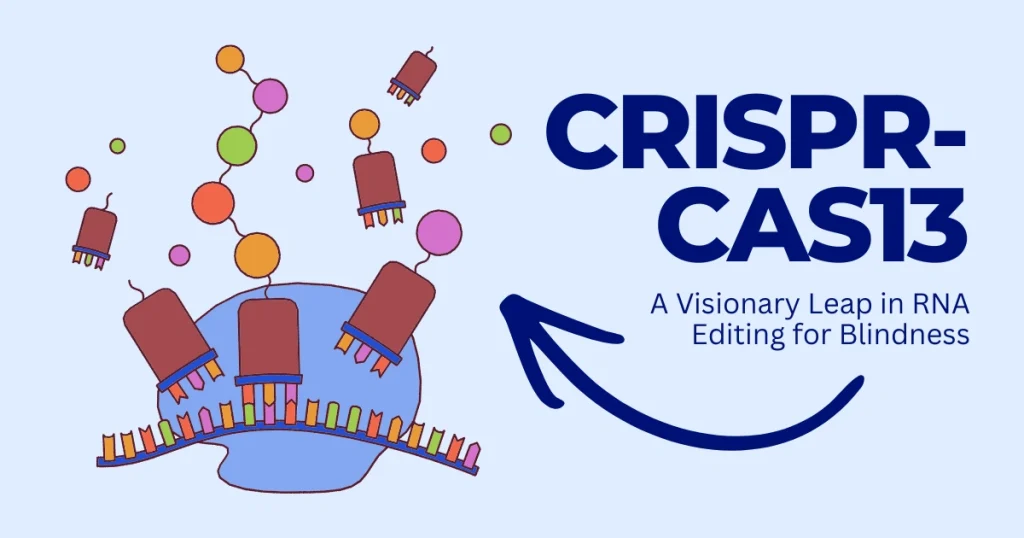
However, January 2026 has marked a historic pivot in genomic medicine. Researchers have successfully utilized the CRISPR-Cas13 system to perform the first successful RNA edit to reverse inherited blindness. Unlike its predecessor, Cas9, which targets the “master blueprint” of DNA, Cas13 targets the “messenger”—the RNA.
This distinction isn’t just technical; it is a paradigm shift in patient safety and therapeutic flexibility.
Understanding the Mechanism: Why RNA Matters
To appreciate this breakthrough, we must look at the central dogma of biology: DNA makes RNA, and RNA makes protein.
In many forms of inherited blindness, a mutation in the DNA leads to “broken” RNA, which in turn produces a non-functional or toxic protein in the photoreceptor cells of the eye. Traditional CRISPR-Cas13 interventions act like a molecular eraser and pencil for that RNA.
The CRISPR-Cas13 Advantage
- Site-Specific Precision: Cas13 is guided by a small sequence to find the exact “typo” in the RNA strand.
- The Correction: Once bound, the enzyme (often fused with a protein called ADAR) converts the faulty nucleotide into the correct one.
- Protein Restoration: The corrected RNA then proceeds to the cell’s “factory” to create the functional proteins necessary for vision.
The Safety Profile: Temporary vs. Permanent
The most frequent question I receive from patients regarding gene therapy is: “What if something goes wrong?”
With DNA editing (Cas9), an “off-target” effect—where the enzyme cuts the wrong part of the genome—is permanent. It becomes a part of the patient’s genetic legacy. This is where RNA editing shines as a safer, more clinical-friendly approach.
Reversibility and Control
RNA is naturally transient. Cells constantly produce and degrade RNA molecules. Therefore, an RNA edit is temporary. If a treatment causes an adverse reaction, the clinician can simply stop the administration of the CRISPR components. As the edited RNA degrades and is replaced by the cell’s natural (albeit mutated) production, the treatment’s effects wear off.
Avoiding “Off-Target” Anxiety
Because we are not breaking the double-helix of the DNA, we eliminate the risk of large-scale genomic deletions or rearrangements. This significantly lowers the barrier for regulatory approval and patient trust.
From Clinical Trial to Visual Reality
The January 2026 study focused on a specific cohort of patients with Leber Congenital Amaurosis (LCA). Before the treatment, these individuals lived in a world of shadows. Post-intervention, clinical markers showed a significant restoration of light sensitivity and visual acuity.
From a clinical perspective, the delivery method—typically a subretinal injection—allows the CRISPR-Cas13 machinery to reach the retinal cells directly, minimizing systemic exposure and further enhancing the safety profile.
Protecting the Healer: A Note on Burnout and Cortisol
In the fast-paced world of medical innovation, it is easy for healthcare providers and researchers to succumb to “information overload.” The pressure to stay at the cutting edge can lead to chronic cortisol spikes, which impair our own cognitive function and empathy.
I encourage my colleagues to view these breakthroughs not as more “work to track,” but as the fulfillment of our collective mission. To prevent burnout:
- Segment your learning: Focus on deep dives into one breakthrough (like Cas13) rather than skimming fifty abstracts.
- Practice “Restorative Vision”: Just as we seek to restore sight to our patients, we must protect our own physiological health by balancing high-stakes clinical work with periods of neurological rest.
The Path Ahead
While this is a monumental first step, we must remain grounded. Scaling RNA therapeutics requires overcoming delivery challenges and ensuring the longevity of the treatment effect. However, the door is now open for treating a vast array of neurological and metabolic disorders beyond the eye.
Sources & References
- Nature Biomedical Engineering: RNA Editing Technologies for Genetic Disease
- The Lancet: Clinical Progress in Retinal Gene Therapy
- ScienceDirect: CRISPR-Cas13: Mechanisms and Applications
- NIH / National Eye Institute: Understanding Inherited Retinal Diseases
Health Disclaimer
This content is for informational and educational purposes only and does not constitute professional medical advice, diagnosis, or treatment. Always seek the advice of your physician or other qualified health provider with any questions you may have regarding a medical condition. Never disregard professional medical advice or delay in seeking it because of something you have read on this website. DrugsArea
People Also Ask
1. What is TCRISPR-Cas13 and how does it differ from Cas9?
While Cas9 is famous for “cutting” DNA, TCRISPR-Cas13 targets and edits RNA. Think of DNA as the master blueprint and RNA as the temporary copy used to build proteins. By editing the RNA, we can fix genetic errors without making permanent, irreversible changes to a person’s genome, which significantly lowers the risk of long-term side effects.
2. How can RNA editing actually “cure” blindness?
Many forms of blindness, like Retinitis Pigmentosa or Macular Degeneration, are caused by genetic mutations that produce “broken” proteins in the eye. Cas13 acts like a pair of molecular scissors for RNA; it can “silence” the bad instructions or, when fused with other enzymes, “rewrite” the code so the eye starts producing healthy proteins again, potentially restoring vision.
3. Why is Cas13 better for eye diseases than traditional gene therapy?
Traditional gene therapy often struggles with large genes (like USH2A or ABCA4) because they are too big to fit inside the delivery vehicles (AAVs) used to reach the retina. Because Cas13 is much more compact, it fits easily into these delivery systems, allowing scientists to treat a much wider range of inherited retinal diseases that were previously “untreatable.”
4. Is the effect of TCRISPR-Cas13 permanent?
Technically, no—and that is actually a safety feature. Because RNA is naturally recycled by your cells, the “edit” isn’t permanent like a DNA change. However, when delivered via a viral vector (a harmless shell) into the eye, the therapy can continue producing the “editor” for a long time, providing a sustained therapeutic effect from a single injection.
5. What specific eye conditions is Cas13 currently being tested for?
The most advanced clinical work is currently focused on neovascular (wet) Age-Related Macular Degeneration (nAMD). By using Cas13 to knockdown VEGF-A (a protein that causes leaky blood vessels in the eye), patients may eventually be able to skip the monthly injections that are currently the standard of care.
6. Are there any human clinical trials currently underway?
Yes! In a historic milestone, the HG202 trial (the BRIGHT study) is the first-ever clinical-stage CRISPR-Cas13 therapy for humans. It was cleared by the FDA to evaluate safety and efficacy in patients with Macular Degeneration. This marks the transition of Cas13 from a “visionary leap” to a real-world medical treatment.
7. What are the main risks or side effects of RNA editing in the eye?
The primary concern is “collateral activity”—where the enzyme might accidentally snip RNA it wasn’t supposed to. However, new “high-fidelity” versions of Cas13 (like hfCas13y) have been engineered to be extremely precise, drastically reducing these off-target effects and making the treatment much safer for the delicate tissues of the retina.
8. Does the procedure involve surgery?
No major surgery is required. The treatment is typically delivered via a subretinal or intravitreal injection—a common procedure in ophthalmology. The Cas13 “machinery” is packaged into a microscopic delivery vehicle that travels directly to the light-sensing cells of the eye.
9. Can Cas13 help people with total blindness?
It depends on the cause. Cas13 is most effective at halting progression or restoring function in cells that are still alive but malfunctioning. If the retinal cells (photoreceptors) have completely died off, RNA editing alone may not be enough, though it is often being researched in combination with regenerative medicine.
10. How soon will TCRISPR-Cas13 treatments be available to the public?
While the first clinical trials are active as of 2024–2026, it usually takes several years of testing to ensure a drug is safe and effective for everyone. If the current Phase 1 trials continue to show success, we could see these therapies moving toward general approval within the next 3 to 5 years.