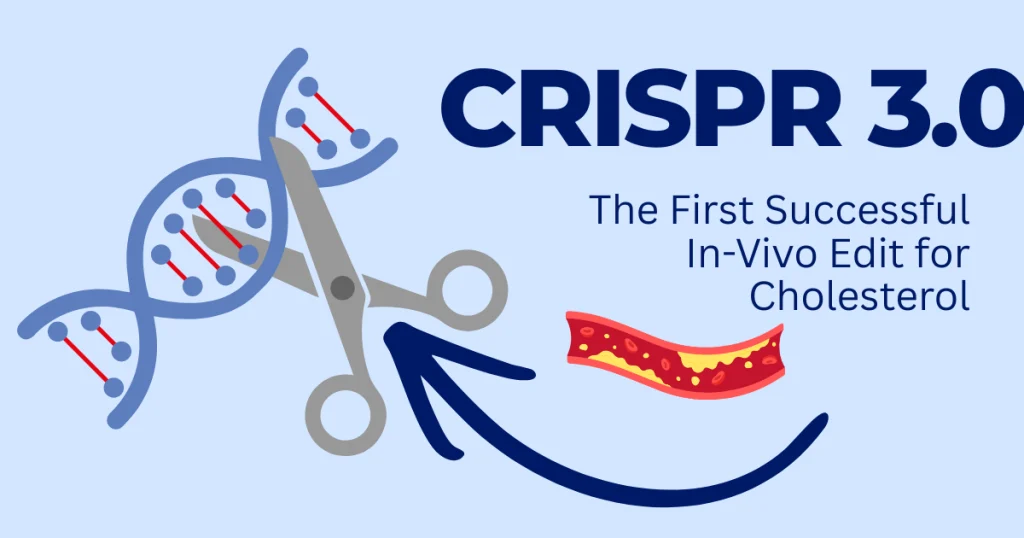
CRISPR 3.0: The One-Dose Cure for High Cholesterol?
As a healthcare professional who has spent years counseling patients on the daily “statin struggle”—the forgotten pills, the muscle aches, and the frustration of stubborn LDL numbers—the news of CRISPR 3.0 feels like the dawn of a new era. We aren’t just talking about a better drug; we are talking about a fundamental shift from managing disease to coding it out of existence.
The recent success of the first-in-human in-vivo gene editing trial for high cholesterol is not just a win for laboratory scientists; it is a beacon of hope for millions living with the shadow of cardiovascular disease.
What is CRISPR 3.0? The Next Evolution of Precision Medicine
To understand the significance of this breakthrough, we have to look at how far we’ve come. If CRISPR-Cas9 (the original “genetic scissors”) was a blunt cutting tool, CRISPR 3.0—encompassing advanced techniques like Base Editing and more refined delivery systems—is a surgical laser.
Unlike traditional gene therapy, which often adds a new gene into the body, this “3.0” approach uses in-vivo (inside the body) editing to precisely disable or “silence” a specific target. In the case of high cholesterol, the target is the ANGPTL3 gene or the PCSK9 gene in the liver.
The Mechanism: How It Works
- The Delivery Vehicle: Scientists use Lipid Nanoparticles (LNPs)—the same technology that powered COVID-19 vaccines—to ferry the CRISPR tools directly to the liver.
- The Target: Once in the liver, the CRISPR machinery locates the gene responsible for elevated cholesterol.
- The “One-and-Done” Edit: Instead of cutting the DNA and leaving it to chance, modern base editors chemically change a single “letter” of the genetic code (e.g., changing an Adenine to a Guanine). This effectively “turns off” the gene, permanently lowering the production of LDL-C and triglycerides.
The Breakthrough Trial: CTX310 and the End of Daily Statins?
In a landmark Phase 1 trial presented recently at the American Heart Association (AHA) 2025 Scientific Sessions, researchers showcased the power of CTX310. This investigational therapy targets the ANGPTL3 gene, which naturally regulates lipid metabolism.
The Results at a Glance:
| Metric | Achievement |
|---|---|
| LDL Cholesterol Reduction | ~50% drop (at highest dose) |
| Triglyceride Reduction | ~55% drop (at highest dose) |
| Durability | Effects remained stable for the duration of follow-up |
| Patient Profile | Individuals with refractory dyslipidemia (unresponsive to standard meds) |
The most staggering part? This was achieved with a single intravenous infusion. For a patient with Familial Hypercholesterolemia (HeFH) who faces a lifetime of injections or pills, this is the equivalent of a medical “cure.”
Why “In-Vivo” Changes Everything
Historically, gene editing was ex-vivo—we had to take cells out of the patient, edit them in a lab, and put them back (common in sickle cell treatments). The success of in-vivo editing means we can now treat the organ directly inside the patient.
For the liver—our body’s primary cholesterol factory—this is a game-changer. By editing the hepatocytes (liver cells) directly, we ensure the treatment is localized, systemic, and permanent.
Safety and Ethics: The Professional Perspective
As a health professional, my enthusiasm is tempered by a commitment to safety. The Phase 1 results for therapies like CTX310 and Verve Therapeutics’ VERVE-102 have shown a promising safety profile, with side effects generally limited to temporary infusion reactions or mild, transient liver enzyme elevations.
However, “permanent” is a heavy word in medicine. Because these edits cannot be easily undone, long-term monitoring (up to 15 years, as mandated by the FDA) is essential to ensure no “off-target” effects emerge as patients age.
The Future of Heart Health: A World Without ASCVD?
We are moving toward a future where “high cholesterol” is a childhood vaccination rather than a mid-life crisis. Imagine a world where:
- Adherence is 100%: Because the medicine is in your DNA, you can’t “forget” to take it.
- Preventative Care is Permanent: We stop the buildup of plaque before it ever starts, potentially making heart attacks a rarity.
- Health Equity Improves: A one-time treatment could eventually be more cost-effective for global health systems than decades of chronic medication.
Final Thoughts
CRISPR 3.0 represents more than just a technological milestone; it represents a promise to our patients that their genetic “fate” is no longer set in stone. While we are still in the early innings of clinical trials, the first successful in-vivo edit for cholesterol has proven that the “one-dose future” is no longer science fiction—it is science fact.
Sources:
- American Heart Association – CRISPR Trial Results,
- New England Journal of Medicine – CTX310 Study,
- Cleveland Clinic – CRISPR for Dyslipidemia,
- Verve Therapeutics – VERVE-102 Clinical Update,
- NIH – Gene Editing for Hypercholesterolemia
Health Disclaimer: This article is for informational purposes only and does not constitute medical advice. Gene editing therapies mentioned (such as CTX310 and VERVE-102) are currently in investigational clinical trial stages and are not yet FDA-approved for general use. Always consult with your physician or a qualified cardiovascular specialist regarding the management of high cholesterol and your heart health. DrugsArea
People Also Ask
1. What is CRISPR 3.0 and how does it treat high cholesterol?
CRISPR 3.0 refers to the latest generation of gene-editing technology, specifically the use of lipid nanoparticles (LNPs) to deliver CRISPR-Cas9 or base editors directly into the liver. Unlike earlier versions that required removing cells from the body, this treatment is a simple intravenous infusion. Once inside, it “switches off” specific genes (like PCSK9 or ANGPTL3) that regulate cholesterol, effectively acting as a permanent, internal thermostat for your blood fats.
2. Which gene was targeted in the first successful in-vivo edit?
The most recent success involves targeting the ANGPTL3 gene (using a therapy called CTX310). This gene produces a protein that normally keeps cholesterol and triglyceride levels high. By “breaking” this gene in liver cells, the body naturally maintains much lower levels of these harmful fats. Earlier trials, such as those by Verve Therapeutics, have also successfully targeted the PCSK9 gene.
3. How much did cholesterol levels drop in the human trials?
The results have been described as “unprecedented.” In Phase 1 clinical trials presented in late 2025, patients receiving the highest dose saw their LDL (bad) cholesterol drop by nearly 50% and their triglycerides drop by about 55%. These reductions were visible within just two weeks and remained stable throughout the follow-up period.
4. Is this a “one-and-done” treatment for life?
That is the goal. Because CRISPR permanently alters the DNA of the liver cells, the “off switch” is inherited by new liver cells as they regenerate. While long-term monitoring is required (the FDA recommends 15 years), data from non-human primates show the effects lasting for years, suggesting a single infusion could replace a lifetime of daily pills or monthly injections.
5. Who is the ideal candidate for this CRISPR cholesterol therapy?
Initially, the therapy is being tested on people with Familial Hypercholesterolemia (FH)—a genetic condition where cholesterol is dangerously high from birth—and those with “refractory dyslipidemia” (cholesterol that doesn’t respond to standard statins). However, experts believe it could eventually be used for the millions of people who struggle with medication adherence.
6. What are the side effects of in-vivo CRISPR editing?
In the 2025 CTX310 trial, the treatment was generally well-tolerated. Some participants experienced minor infusion reactions like back pain, nausea, or a temporary rise in liver enzymes, which resolved quickly. However, because it’s a permanent change, doctors are moving cautiously to ensure there are no “off-target” edits where the wrong part of the DNA is accidentally changed.
7. How is the CRISPR treatment delivered to the body?
It is delivered via Lipid Nanoparticles (LNPs), the same technology used in COVID-19 mRNA vaccines. These tiny fat bubbles act like a GPS, specifically seeking out the liver. Once the infusion enters the bloodstream, the LNPs are swallowed by liver cells, releasing the CRISPR “machinery” to perform the genetic edit.
8. How does CRISPR 3.0 differ from traditional statins?
Statins are daily pills that block a specific enzyme ( reductase) to slow down cholesterol production. They only work as long as you keep taking them. CRISPR 3.0, on the other hand, reprograms the body’s genetic code. It removes the “blueprint” for cholesterol-raising proteins, meaning the body simply stops making them at high levels.
9. When will this treatment be available to the general public?
We are currently in the early stages. Phase 1 trials (safety) are finishing, and Phase 2 trials (efficacy) are slated to begin in 2026. If these and subsequent Phase 3 trials are successful, it could take another 3 to 5 years before the treatment receives full regulatory approval for widespread use.
10. Will CRISPR cholesterol editing be expensive?
While specialized gene therapies for rare diseases can cost millions, the CEO of CRISPR Therapeutics has suggested that because cholesterol is so common, the goal is to make this treatment much more affordable—potentially under $100,000. While that sounds high, it is being compared to the total cost of 40+ years of daily medications, doctor visits, and the price of treating a heart attack or stroke.