
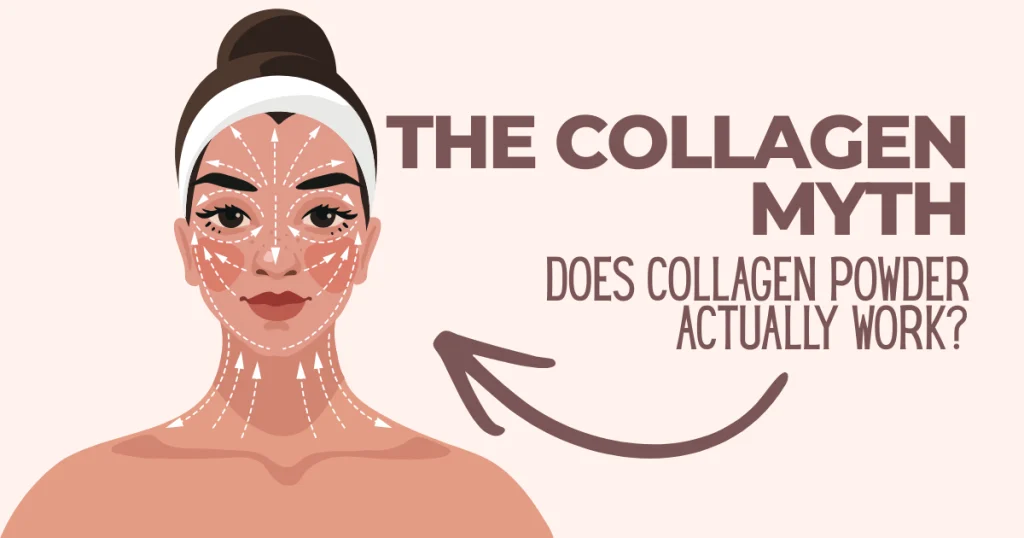
The Collagen Myth: Why Your Expensive Powder Might Not Be Reaching Your Skin
In the shimmering world of “wellness,” few products have ascended to the throne of holy-grail status quite like collagen powder. Walk into any high-end health store or scroll through a lifestyle influencer’s feed, and you’ll find it: a sleek tub promising the fountain of youth in a single daily scoop. The marketing is seductive, claiming that by simply stirring this powder into your morning latte, you can “refill” the collagen levels in your skin, smoothing out fine lines and restoring that elusive twenty-something glow.
But as the global collagen market swells into a multi-billion dollar behemoth, a nagging question persists among dermatologists and biochemists: Is it actually working, or are we just flushing expensive protein down the drain?
To understand why your expensive powder might not be reaching your skin, we have to look past the branding and dive into the complex, often unglamorous world of human digestion and molecular biology.
The Biological Barrier: The Journey of a Supplement
The central promise of collagen supplements is “ingestible beauty.” The idea is linear: you eat collagen, it goes to your skin, and your skin becomes firmer. Unfortunately, the human body doesn’t function like a direct-delivery courier service.
1. The Great Digestive Breakdown
Collagen is a complex, long-chain protein. When you consume it—whether it’s in a pill, a powder, or a gummy—your gastrointestinal tract treats it like any other protein, such as a piece of chicken or a bowl of lentils. Your stomach acid and digestive enzymes immediately begin breaking those long protein chains down into their smallest components: amino acids and peptides.
Once broken down, these components enter the bloodstream to be used wherever the body needs them most. Your body does not recognize these amino acids as “skin-exclusive.” It might send them to repair a damaged tendon, support your gut lining, or simply use them for general cellular energy. Your body is a survival machine, not a beauty pageant contestant; it prioritizes internal structural integrity over forehead wrinkles every single time.
2. The Bioavailability Problem
Many brands boast about “hydrolyzed” collagen or “collagen peptides.” This means the protein has already been broken down into smaller pieces to aid absorption. While this does make the collagen easier for your gut to take in, it still doesn’t guarantee a “GPS lock” on your dermis. There is no biological mechanism that forces an ingested amino acid to reassemble itself specifically as collagen in the facial tissue.
The “Expensive Urine” Argument: Is It Just Hype?
Critics of the supplement industry often use the phrase “expensive urine” to describe the result of taking high-dose vitamins and proteins that the body can’t immediately use. With collagen, the reality is slightly more nuanced, but the skepticism is well-founded.
The Lack of Independent Regulation
Because collagen is sold as a supplement rather than a drug, it doesn’t face the same rigorous FDA (or equivalent international body) scrutiny. Many of the “clinical trials” cited on product packaging are small-scale, short-term, and—most importantly—funded by the companies selling the product. When a study is paid for by the brand, the “significant improvement in skin elasticity” reported should be taken with a grain of salt.
The Protein Displacement
For a healthy individual eating a balanced diet rich in protein, the extra 10 grams of collagen in a supplement might be entirely redundant. If your body already has the “bricks” (amino acids) it needs from eggs, meat, beans, and dairy, it will simply discard the excess. In this scenario, you aren’t buying better skin; you’re just buying a very expensive way to meet your daily protein quota.
What Actually Happens to Your Skin as You Age?
To understand why a powder might not be the fix, we have to understand the problem. Collagen is the “scaffolding” of the skin. Starting in our mid-20s, we begin to lose about 1% of our collagen every year.
- Intrinsic Aging: The natural, genetically programmed decline in collagen production.
- Extrinsic Aging: Damage caused by external factors like UV radiation (sun), pollution, and smoking.
Sun exposure is responsible for up to 80% of visible skin aging. UV rays trigger an enzyme called collagenase, which literally eats away at your existing collagen fibers. No amount of powder can outrun the damage of a daily commute without SPF.
If Not Powder, Then What? The Science-Backed Alternatives
If you want to support your skin’s collagen levels, the most effective methods are those that protect your existing collagen and stimulate your body to produce its own naturally.
1. The Power of Retinoids (Vitamin A)
In the world of dermatology, Retinol and prescription-strength Tretinoin are the gold standards. Unlike supplements, topical retinoids have decades of peer-reviewed evidence proving they can increase collagen production within the skin cells (fibroblasts) themselves.
2. Vitamin C: The Essential Co-Factor
Your body cannot physically synthesize collagen without Vitamin C. It acts as the “glue” that holds the collagen fibers together. Using a stabilized Vitamin C serum and eating a diet high in citrus and leafy greens is far more effective for collagen synthesis than eating the collagen itself.
3. Sun Protection (The Non-Negotiable)
If you are spending $50 a month on collagen powder but not wearing sunscreen, you are essentially trying to fill a bucket that has a giant hole in the bottom. Protecting your skin from UV rays is the single most effective “anti-aging” step you can take.
4. Amino Acid-Rich Whole Foods
Instead of processed powders, focus on a diet that provides the precursors to collagen:
- Proline: Found in egg whites, dairy, and mushrooms.
- Glycine: Found in pork skin, chicken skin, and gelatin.
- Copper: Found in organ meats, sesame seeds, and cashews.
Is There Any Benefit to Collagen Supplements?
It’s not all bad news. While the “skin-direct” miracle is largely a myth, some studies suggest that collagen peptides can signal the body to ramp up its own production through a feedback loop. There is also promising evidence regarding:
- Joint Health: Reducing pain in athletes and those with osteoarthritis.
- Muscle Mass: Supporting protein synthesis when combined with resistance training.
- Nail Strength: Reducing brittleness in some users.
However, these benefits are systemic—meaning they affect the whole body—and are rarely as dramatic as the “before and after” photos on Instagram suggest.
The Verdict: Save Your Money or Spend Wisely?
The “Collagen Myth” isn’t that collagen is useless; it’s the idea that it acts as a shortcut to youthful skin.
If you have the disposable income and enjoy the routine of a collagen-boosted smoothie, there’s likely no harm in it. However, if you are looking for the most “bang for your buck” in skin health, your hierarchy of investment should look like this:
- Sunscreen (Daily)
- Retinoids/Tretinoin
- Vitamin C Serum
- A balanced, high-protein diet
- …and then, maybe, a collagen supplement.
Real beauty isn’t built in a scoop; it’s built through consistent protection, internal nutrition, and a healthy dose of skepticism toward wellness industry claims. DrugsArea
Sources & References
- Harvard Health Publishing: Considering Collagen Supplements, https://www.health.harvard.edu/blog/considering-collagen-supplements-202303062895
- Journal of Drugs in Dermatology: A Review of Oral Collagen Supplementation for Skin Health, https://jddonline.com/articles/oral-collagen-supplementation-a-systematic-review-of-dermatological-applications-S1545961619P0009X/
- Dermatology Practical & Conceptual: The Impact of Oral Collagen Peptides, https://www.ncbi.nlm.nih.gov/pmc/articles/PMC6835901/
- The Lancet: Skin Aging and Oxidative Stress, https://www.thelancet.com/
- Cleveland Clinic: The Truth About Collagen, https://health.clevelandclinic.org/the-best-way-to-get-more-collagen/
People Also Ask
1. Does collagen powder actually tighten skin and reduce wrinkles?
The Short Answer: Yes, but it’s not a magic eraser.
The Nuance: Research shows that taking 2.5g to 10g of hydrolyzed collagen daily can improve skin elasticity and hydration after 8–12 weeks. However, it doesn’t “add” collagen directly to your face. Instead, the broken-down peptides signal your body’s fibroblasts (skin cells) to wake up and produce more of their own collagen. Think of it as a pep talk for your skin cells, not a filler.
2. Is taking collagen powder a waste of money?
The Short Answer: Not if you have realistic expectations, but it depends on your diet.
The Nuance: If you are already eating a high-protein diet with plenty of Vitamin C, your body might already have the building blocks it needs. However, collagen powder is rich in specific amino acids (glycine, proline, hydroxyproline) that are hard to get from standard muscle meats like chicken breast. If you barely eat connective tissues (like bone broth or skin), a supplement is a valid, functional tool—not just hype.
3. How long does it take to see results from collagen?
The Short Answer: Patience is key—usually 8 to 12 weeks.
The Nuance:
- Skin hydration: 4–6 weeks.
- Wrinkle reduction & elasticity: 8–12 weeks.
- Joint pain relief: 3–6 months.
- Expert Tip: If you stop taking it, the benefits typically fade, as your body returns to its natural (slower) production rate.
4. Can I just eat protein powder instead of collagen?
The Short Answer: No, they do different jobs.
The Nuance: Whey or plant protein is great for muscle building (BCAAs), but they lack the high concentration of glycine and proline found in collagen.
- Use Whey: To build biceps and recover from lifting.
- Use Collagen: To support skin structure, joints, and tendons.
- The “Myth” Buster: Collagen is a terrible post-workout protein for muscle growth because it’s incomplete. Don’t swap your whey for collagen; stack them or use them for their specific purposes.
5. What are the negative side effects of taking collagen?
The Short Answer: It is generally very safe, but “digestive surprise” is the most common issue.
The Nuance: Some people experience bloating, heartburn, or a feeling of “fullness” because collagen is a dense protein.
- Allergy Warning: If you are allergic to fish or shellfish, check your labels religiously. Many “Marine Collagen” powders are made from fish scales.
- Contamination: Since supplements aren’t strictly FDA-regulated, look for third-party testing (like NSF or USP) to avoid heavy metals.
6. Is there such a thing as vegan collagen?
The Short Answer: No. True collagen only comes from animals.
The Nuance: Products labeled “Vegan Collagen” are usually collagen boosters. They contain vitamins (C, Zinc) and plant extracts that encourage your body to make its own collagen. Recently, scientists have started bio-engineering vegan collagen from genetically modified bacteria/yeast, but these are rare and expensive. If you see a cheap “vegan collagen” powder, check the label—it’s likely just vitamins.
7. Does stomach acid destroy collagen before it works?
The Short Answer: This is the biggest myth! It does break it down, but that’s the point.
The Nuance: Skeptics argue that digestion destroys collagen. The reality is that your stomach acid breaks the collagen down into peptides and amino acids. These peptides are then absorbed into the bloodstream. You want digestion to happen; you can’t absorb a whole collagen molecule anyway. The key is using hydrolyzed collagen (peptides), which is pre-broken down for easier absorption.
8. Which type of collagen is best: pills, liquid, or powder?
The Short Answer: Powder is usually the best bang for your buck.
The Nuance:
- Powder: Easy to get the effective dose (10g–20g). Versatile.
- Pills: You often need to swallow 4–6 huge pills just to get a tiny 2g dose. Inefficient.
- Liquid: Convenient but often overpriced and loaded with artificial sweeteners.
- SEO Pro Tip: The form doesn’t matter as much as the dosage. If the liquid shot only has 1g of collagen, it’s useless compared to a 10g scoop of powder.
9. Does collagen actually help with weight loss?
The Short Answer: Indirectly, yes, but it’s not a fat burner.
The Nuance: Collagen is a protein, and protein is the most satiating macronutrient. Taking a scoop in the morning can keep you fuller longer, preventing snacking. However, there is no chemical mechanism in collagen that melts fat. It’s a tool for appetite control, not a metabolic miracle.
10. Can I get enough collagen from bone broth instead?
The Short Answer: Absolutely, if you are consistent.
The Nuance: Homemade, gelatinous bone broth is the “OG” collagen supplement. It is bioavailable and full of minerals. The problem? Consistency. It’s hard to drink a cup of bone broth every single day, whereas dumping a scoop of tasteless powder into coffee is easy. Supplements are essentially paying for the convenience of not simmering bones for 24 hours.

