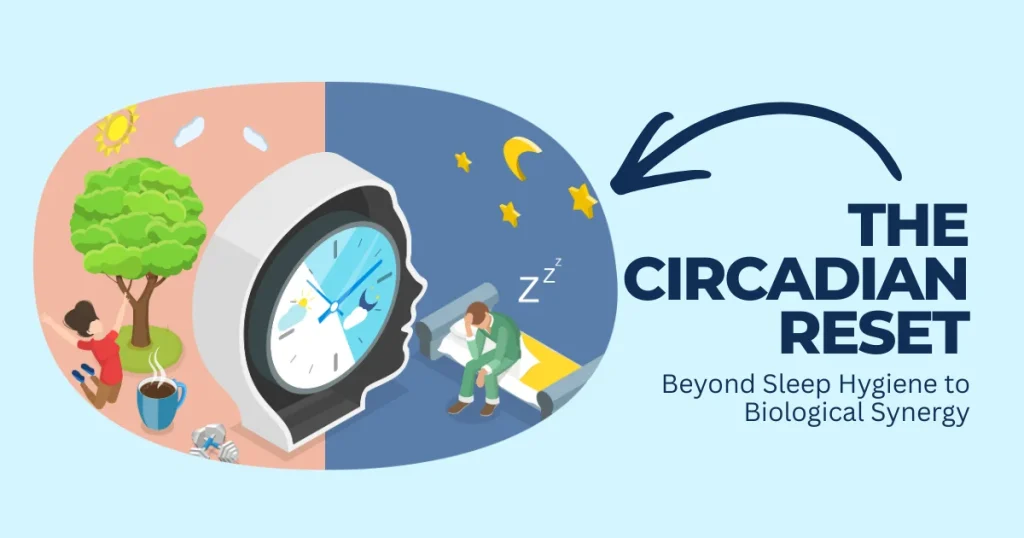
The Circadian Reset| Beyond Sleep Hygiene to Biological Synergy
Moving Beyond “Sleep Hygiene”
For years, we’ve been told to buy blackout curtains, avoid caffeine after noon, and keep our bedrooms cool. While this “sleep hygiene” is helpful, it’s often a band-aid solution for a much deeper issue: biological desynchrony.
Your body isn’t just a machine that turns off at night; it’s a complex orchestra governed by a master clock called the Suprachiasmatic Nucleus (SCN). This clock doesn’t just care about when you close your eyes; it cares about when you eat, when you see the sun, and when you move.
Welcome to The Circadian Reset. This is the shift from “trying to sleep better” to “living in sync with your biology.”
1. Light Therapy: Your Primary “Zeitgeber”
The word Zeitgeber is German for “time-giver.” Light is the most powerful signal your brain uses to tell what time it is.
Morning: The Blue Light Anchor
To reset your clock, you must view sunlight within 30 to 60 minutes of waking.
- The Science: Sunlight triggers a timed release of cortisol (the “wake-up” hormone) and sets a countdown timer for melatonin production 14–16 hours later.
- The Action: Step outside for 10–20 minutes. Even on a cloudy day, the lux (light intensity) outside is significantly higher than your brightest indoor office lights.
Evening: The Twilight Transition
As the sun goes down, your brain needs “optical silence.”
- The Problem: Overhead LED lights and blue-light-emitting screens trick the brain into thinking it’s mid-day, suppressing melatonin by up to 50%.
- The Action: After 8:00 PM, switch to floor lamps with warm (amber) bulbs. Use blue-light-blocking software, but remember: dimming the lights is more effective than just filtering the color.
2. Chrono-Nutrition: Timing Your Fuel
We used to think “a calorie is a calorie,” regardless of when it was eaten. We now know that the gut has its own circadian clocks.
The Insulin Connection
Our bodies are more insulin-sensitive in the morning. As the day progresses, our ability to process glucose diminishes. Eating a heavy meal at 9:00 PM forces your body to deal with an energy influx when it should be focused on cellular repair.
The 10-Hour Window
A “Circadian Reset” often involves Time-Restricted Feeding (TRF).
- The Strategy: Try to consume all calories within a 10-to-12-hour window (e.g., 8:00 AM to 6:00 PM).
- The Benefit: This gives your digestive system a consistent “down period,” allowing the liver to focus on detoxification and the brain to perform “glymphatic clearing” (washing out metabolic waste).
3. Temperature and Movement
Your body temperature naturally fluctuates throughout the 24-hour cycle, peaking in the late afternoon and hitting its lowest point around 4:00 AM.
- Exercise Timing: Physical activity increases core body temperature. To support the reset, aim for vigorous movement in the morning or afternoon. Exercise late at night can delay the drop in core temperature needed for deep sleep.
- The Hot Shower Hack: Taking a warm bath or shower 90 minutes before bed sounds counterintuitive, but it works. It brings blood to the surface of the skin, which then radiates heat away, causing your core temperature to drop—the biological signal for sleep.
4. Why This Matters: Immunity and Energy
When you are “in sync,” your hormones act like a well-timed relay race.
- Energy: You stop relying on caffeine for “fake energy” because your natural cortisol spike handles the heavy lifting.
- Immunity: Many of our immune cells are circadian-gated. They are more active during our rest phase to repair tissues. Chronic “social jetlag” (living out of sync) is linked to higher inflammation and reduced vaccine efficacy.
Summary of The Circadian Reset Protocol
| Time of Day | Action | Goal |
|---|---|---|
| Waking | 10 mins of direct sunlight | Set the cortisol/melatonin timer |
| Mid-Day | High-protein meal | Support metabolic rate |
| Sunset | View low-angle sun | Signal the brain that day is ending |
| Evening | Dim overhead lights | Allow melatonin to rise naturally |
| Night | 10–12 hours of fasting | Cellular cleanup and repair |
Medical Disclaimer:
The information provided in this article is for educational purposes only and does not constitute medical advice. Always consult with a healthcare professional before making significant changes to your diet, light exposure, or exercise routine, especially if you have underlying health conditions or are taking medication. DrugsArea
Sources & References
- Salk Institute – Satchin Panda on Circadian Biology
- Harvard Health – Why Blue Light is Bad for Sleep
- Nature Communications – Meal Timing and Metabolic Health
- Journal of Clinical Sleep Medicine – Light Exposure and Health
People Also Ask
Circadian Reset & Biological Synergy FAQs
1. What is the difference between sleep hygiene and a circadian reset?
Sleep hygiene focuses on your immediate environment and habits before bed, like keeping the room cool or dark. A circadian reset is much broader; it involves synchronizing your body’s internal 24-hour clock (the Suprachiasmatic Nucleus) with natural light cycles, meal timing, and physical activity to ensure your biological systems are working in harmony, not just helping you fall asleep.
2. How long does it actually take to reset your circadian rhythm?
For most people, a significant shift takes about 2 to 7 days. While you can see minor improvements in alertness within 24 hours of consistent light exposure, your peripheral clocks (like those in your gut and liver) may take a full week of consistent meal timing to fully catch up with your brain’s master clock.
3. Can I reset my biological clock without using supplements like melatonin?
Absolutely. In fact, natural light is a more powerful “Zeitgeber” (time-giver) than supplements. By viewing 10–30 minutes of sunlight shortly after waking and dimming lights after sunset, you naturally stimulate your body’s own production of cortisol in the morning and melatonin in the evening.
4. What is “Biological Synergy” in the context of health?
Biological synergy is the state where your various internal systems—metabolism, immune response, and hormone production—are all “singing from the same sheet music.” When your master clock is aligned, your digestive system is ready for food when you eat, and your repair systems are ready to work when you sleep, leading to higher energy and better long-term health.
5. How does meal timing affect my circadian rhythm?
Your gut has its own internal clock. Eating late at night sends a “daytime” signal to your digestive organs while your brain is sending a “nighttime” signal. This conflict causes metabolic “friction,” which can lead to weight gain and poor sleep. For a true reset, try to finish your last meal at least 3 hours before bed.
6. Does exercise timing play a role in a circadian reset?
Yes. Early morning or afternoon exercise can help “anchor” your rhythm by raising your core body temperature at the right time. However, very intense training late at night can delay your clock by keeping your temperature and cortisol levels too high, making it harder for the body to transition into a recovery state.
7. Why is morning sunlight considered the “Master Switch” for the brain?
When blue-wavelength light from the sun hits the melanopsin receptors in your eyes, it shuts off melatonin production and triggers a timed release of cortisol. This sets a “timer” in your brain that determines exactly when melatonin will start to rise again roughly 12–14 hours later.
8. Can “Social Jetlag” ruin a circadian reset?
“Social Jetlag” occurs when your sleep schedule on the weekends differs significantly from your weekday routine. This constant shifting keeps your body in a state of perpetual recovery, similar to flying across time zones every week. Consistency—even on Saturdays—is the secret to biological synergy.
9. How does temperature regulation factor into a biological reset?
Your body temperature naturally drops in the evening to facilitate sleep and rises just before you wake up. You can “hack” this by taking a warm bath or shower before bed; the subsequent rapid cooling of your core temperature as you exit signals to your brain that it’s time to sleep.
10. What are the signs that my circadian rhythm is successfully reset?
You’ll know you’ve hit the “sweet spot” when you start waking up naturally around the same time without an alarm, feel a peak of mental clarity in the mid-morning, and experience a natural “wave” of tiredness in the evening rather than a sudden crash or “tired but wired” feeling.