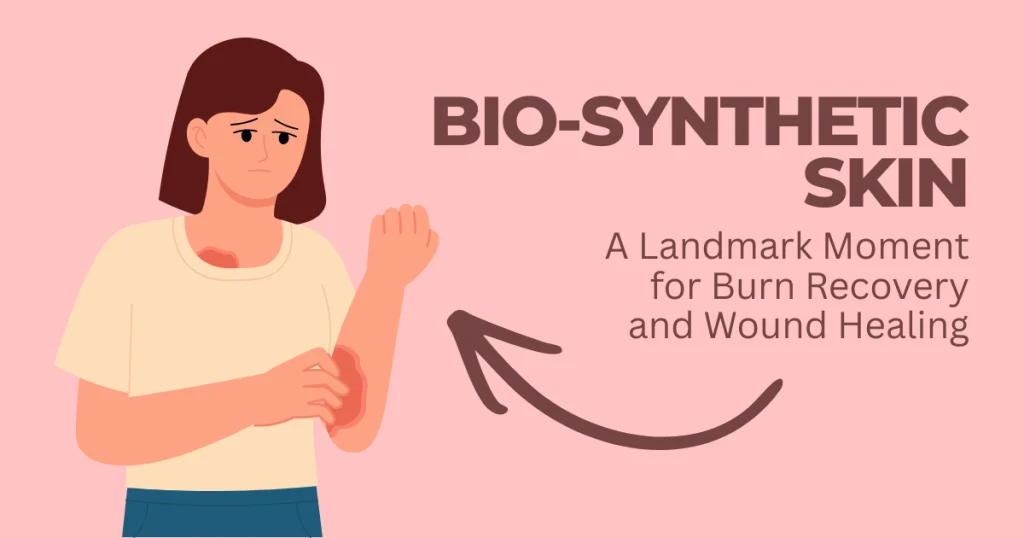
Bio-Synthetic Skin: A Landmark Moment for Burn Recovery and Wound Healing
A New Era of Sensory Restoration
As a healthcare professional, I have witnessed the grueling journey of burn recovery. For decades, our “gold standard” was the autograft—harvesting healthy skin from one part of a patient’s body to cover another. While life-saving, it often felt like a compromise. Patients were left with permanent scarring, a lifelong inability to regulate body temperature through sweat, and, perhaps most heartbreakingly, a total loss of sensation in the affected areas.
The year 2026 has officially changed that narrative. We are no longer just “covering” wounds; we are regenerating human experience. The successful clinical integration of 3D-printed bio-synthetic skin featuring functional sweat glands and nerve endings marks the most significant leap in restorative medicine this century.
The Technology: More Than Just a Surface
The breakthrough lies in advanced 3D bioprinting. Unlike traditional synthetic covers, these new grafts are “bio-inked” using a patient’s own cellular blueprint.
1. Functional Sweat Glands (Thermoregulation)
One of the most dangerous long-term complications for severe burn survivors is the loss of sweat glands. Without them, the body cannot cool itself, leading to heat exhaustion and restricted physical activity. The 2026 bio-synthetic grafts utilize epithelial stem cells programmed to self-organize into coiled tubular structures—functional sweat glands that integrate with the patient’s existing lymphatic and circulatory systems.
2. Nerve Endings (The Return of Touch)
For many survivors, the “phantom” feeling or total numbness of a graft is a constant reminder of their trauma. This new technology incorporates nerve growth factors (NGFs) and a scaffold that encourages the patient’s own peripheral nerves to grow into the graft.
- Result: Patients are reporting the return of pressure sensitivity, temperature detection, and the “fine touch” required for daily tasks.
Why This is a “Landmark Moment”
The medical community is calling this a “Landmark Moment” because it addresses the holistic recovery of the patient. In the past, success was measured by “wound closure.” Today, we measure it by “quality of life.”
| Feature | Traditional Autografts | 2026 Bio-Synthetic Skin |
|---|---|---|
| Donor Site | Requires a new wound | Minimal 4mm biopsy |
| Texture | Often rigid/scarred | Elastic and “natural” |
| Sensation | Permanent numbness | Functional nerve integration |
| Temperature | Risk of overheating | Active sweat production |
From the Clinic: A Professional Perspective
From a clinical standpoint, the precision of these grafts is staggering. Using 3D laser scans of the wound site, we can now print “biological clothing”—custom-shaped skin that fits a hand or a face perfectly, minimizing the need for complex suturing and reducing the risk of infection.
However, as we embrace this innovation, we must maintain a grounded perspective. While 2026 has shown us the “possible,” these treatments are currently specialized and require specific infrastructure found in advanced burn centers.
The Path Ahead
The integration of the dermis (the deeper, complex layer) with the epidermis (the protective outer layer) in a single bioprinting session is what makes this truly “bio-synthetic.” It is a hybrid of engineering and biology that mimics the functionality of native human tissue.
Health Disclaimer
This article is for informational purposes only and does not constitute medical advice, diagnosis, or treatment. Always seek the advice of your physician or other qualified health providers with any questions you may have regarding a medical condition. The technologies described (3D-printed skin with sensory organs) are part of evolving clinical landscapes as of 2026 and may not be available in all regions or for all burn types. DrugsArea
Sources & References
- Columbia University: Bioengineered Skin Grafts that Fit Like a Glove
- Linköping University: “Skin in a Syringe” for Faster Burn Recovery
- University of Zurich: New Elastic Skin for Burn Victims (2026)
- National Institutes of Health (PMC): 3D Bioprinting for Skin Tissue Engineering
People Also Ask
1. What exactly is bio-synthetic skin?
Bio-synthetic skin is a lab-engineered medical material that mimics the structure and function of human skin. It typically consists of a bilayer system: a synthetic outer layer (often silicone) that acts as a protective barrier, and an inner biological matrix (often collagen-based) that encourages your own skin cells to grow and repair the wound.
2. How does bio-synthetic skin differ from a traditional skin graft?
A traditional graft involves “harvesting” healthy skin from one part of your body to cover a wound elsewhere. Bio-synthetic skin is an “off-the-shelf” alternative. It eliminates the need for a second surgical site (the donor site), which reduces overall pain, lowers the risk of infection, and is especially critical when a patient has suffered extensive burns and has little healthy skin left to spare.
3. Is bio-synthetic skin a permanent replacement for human skin?
It depends on the type. Some bio-synthetic skins are temporary, serving as a “biological scaffold” that protects the wound while the body regenerates its own tissue. Others are permanent or “semi-permanent,” where the biological components eventually integrate into the patient’s body, while the synthetic top layer is removed once the new dermis has matured.
4. Why is this considered a “landmark moment” for burn recovery?
For decades, surgeons faced a “supply and demand” crisis: severe burn victims often didn’t have enough healthy skin for grafts. Bio-synthetic skin solves this by providing an immediate, unlimited supply of tissue-mimicking material. This allows for early wound closure, which is the single most important factor in preventing sepsis and improving survival rates in trauma cases.
5. Does bio-synthetic skin help reduce scarring?
Yes. Because these materials provide a highly organized “scaffold,” they guide the body to rebuild tissue in a more natural, linear pattern. This prevents the chaotic “cobblestone” collagen growth that causes thick, restrictive hypertrophic scars, leading to better cosmetic results and more flexible skin after healing.
6. Can bio-synthetic skin be used for chronic wounds like diabetic ulcers?
Absolutely. Beyond burns, bio-synthetic skin is a breakthrough for chronic, non-healing wounds. It introduces growth factors and a moist environment that “restarts” the healing process in wounds that have been stagnant for months or even years.
7. How long does it take for bio-synthetic skin to heal a wound?
While every case is unique, many bio-synthetic applications show significant integration within 2 to 3 weeks. The synthetic outer layer is usually removed or peels off naturally after the underlying “neodermis” (new skin) has stabilized, which typically happens around the 14-to-21-day mark.
8. Is there a risk of the body rejecting bio-synthetic skin?
The risk is significantly lower than with “allografts” (skin from a donor). Most bio-synthetic skins are designed to be non-immunogenic, meaning they don’t contain the specific proteins that trigger an immune system “attack.” This allows the material to stay in place long enough to facilitate healing without the need for anti-rejection drugs.
9. What are the main benefits for pediatric burn patients?
Children benefit immensely because their bodies are still growing. Traditional grafts often don’t grow at the same rate as the child, requiring multiple “release” surgeries. Bio-synthetic skin promotes more elastic tissue regeneration, which can reduce the number of future surgeries a child might need as they grow.
10. Is bio-synthetic skin widely available in hospitals today?
While “advanced” versions involving 3D-bioprinting or live stem cells are still in clinical trials or specialized centers, products like Integra and Biobrane are already standard-of-care in major burn units worldwide. The field is moving rapidly toward “personalized” skin grown from a patient’s own cells in just a few days.