
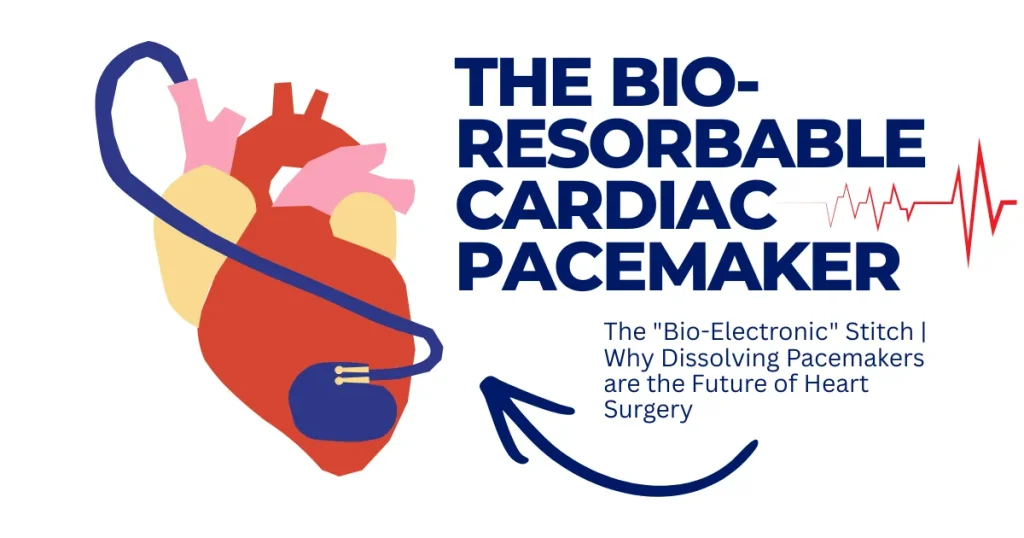
The “Bio-Electronic” Stitch | Why Dissolving Pacemakers are the Future of Heart Surgery
Introduction: A New Era of “Vanishing” Medicine
As a healthcare professional, I’ve seen firsthand the anxiety that follows a successful heart surgery. The procedure itself is a marathon, but the “recovery lap” often involves temporary wires snaking out of the chest to regulate the heart rhythm. These wires are essential, but they carry risks: infection, scarring, and the dreaded second procedure to pull them out.
Imagine a world where the medical device doesn’t need to be removed because it simply disappears.
We are currently witnessing a landmark shift in medical technology with the first human trials of bio-resorbable cardiac pacemakers. Often called “Bio-Electronic Stitches,” these devices are thinner than a human hair and made of materials that the body naturally absorbs once the heart is back to its steady beat. Bio-Resorbable
What is a Bio-Resorbable Pacemaker?
Traditionally, if a patient needs heart rhythm support after surgery, doctors use temporary external pacemakers. These involve wires that pass through the skin.
The bio-resorbable pacemaker is a game-changer. It is a wireless, battery-free device that is applied directly to the surface of the heart during surgery. It looks less like a machine and more like a high-tech sticker or a “stitch.”
How It Works Bio-Resorbable Cardiac Pacemaker
The device operates using a principle called near-field communication (NFC)—the same technology you use when you tap your phone to pay for groceries. An external wearable patch sends power wirelessly to the internal “stitch,” which then delivers gentle electrical pulses to keep the heart in rhythm.
Once the heart is healed—usually within five to seven weeks—the device begins to break down. Through a process called hydrolysis, the body’s natural fluids dissolve the device into harmless components that are excreted or metabolized. No surgery, no needles, no trauma.
The Daily Impact Bio-Resorbable Cardiac Pacemaker : Safer Recovery for Patients
For a patient, the impact of “Temporary Implants” is profound. In the medical world, we call this “minimizing the surgical footprint.”
1. Eliminating the “Extraction” Risk
Current temporary pacing wires are physically pulled out of the chest once the patient is stable. While usually safe, this can occasionally cause bleeding or damage to the delicate heart tissue. A dissolving device removes this risk entirely.
2. Reducing Infection Rates
Any time a wire exits the skin (a “percutaneous” lead), it acts as a highway for bacteria. By keeping the entire system wireless and internal, we significantly lower the chance of post-operative infections.
3. Comfort and Mobility
Patients with traditional wires are often restricted in their movement to prevent the leads from dislodging. Because the bio-electronic stitch is lightweight and wireless, patients can move more freely, which we know speeds up the overall recovery process.
The Science Behind the “Stitch”Bio-Resorbable Cardiac Pacemaker
The materials used are what make this a “Bio-Electronic” marvel. Engineers use ultra-thin membranes of:
- Silicon: To create the electronic pathways.
- Magnesium or Tungsten: To act as the electrodes.
- PLGA (a biodegradable polymer): To provide the structure.
These materials are already used in dissolving sutures (stitches), but the magic here is getting them to conduct electricity reliably before they fade away. Bio-Resorbable Cardiac Pacemaker
A Professional’s Perspective: Why Now ?
The move toward bio-integrated electronics is the next frontier of personalized medicine. We are moving away from “one-size-fits-all” hardware that stays in the body forever, toward “smart medicine” that stays only as long as it’s needed.
As a clinician, I see this as the ultimate form of “patient-centric” design. It respects the body’s natural healing timeline while providing a high-tech safety net.
Summary of Benefits Of Bio-Resorbable Cardiac Pacemaker
| Feature | Traditional Temporary Pacemaker | Bio-Resorbable “Stitch” |
|---|---|---|
| Power Source | External Battery Pack | Wireless Power Transfer |
| Removal | Physical Extraction (Manual Pull) | Natural Absorption (Dissolves) |
| Infection Risk | Moderate (Skin Penetration) | Very Low (Fully Internal) |
| Patient Comfort | Restricted Movement | High Mobility |
Health Disclaimer
The information provided in this article is for educational and informational purposes only and is not intended as medical advice. While bio-resorbable technology is currently in clinical trial phases, it may not be available for all patients or conditions. Always seek the advice of your physician or other qualified health provider with any questions you may have regarding a medical condition or heart surgery recovery. Never disregard professional medical advice because of something you have read on the internet. DrugsArea
Sources & Research
- Nature Communications: Wireless, bioresorbable cardiac pacemakers
- Northwestern University: First temporary, dissolving pacemaker
- Science: Bioresorbable materials for medical implants
People Also Ask
1. What exactly is a “dissolving” pacemaker?
A dissolving (or transient) pacemaker is a thin, flexible, wireless device made of biocompatible materials designed to regulate the heart’s rhythm temporarily. Unlike traditional pacemakers, it doesn’t require a permanent battery or metal casing. Instead, it is absorbed by the body’s natural fluids once its job is done—much like dissolvable stitches.
2. Why is it being called a “Bio-Electronic” stitch?
The term “bio-electronic stitch” highlights its dual nature: it’s an electronic device that functions with the seamlessness of a surgical suture. It “stitches” together the gap in care for patients who only need heart rhythm support for a few days or weeks (like after open-heart surgery), disappearing once the tissue has healed.
3. How does the device dissolve without harming the body?
The device is crafted from materials like magnesium, tungsten, and silicon polymers. These elements are already present in the human body in small amounts. Through a process called hydrolysis, the device breaks down into non-toxic byproducts that are safely excreted or metabolized, leaving no trace behind.
4. How long does a dissolving pacemaker last?
Typically, these devices are engineered to stay active for 5 to 7 weeks. However, the “dissolve rate” can be customized during manufacturing based on the patient’s specific recovery timeline. Once the heart regains its natural rhythm, the device loses its structural integrity and begins to be absorbed.
5. What are the main benefits over traditional temporary pacemakers?
Traditional temporary pacemakers usually involve external wires that poke through the skin, which carry a high risk of infection and limited mobility. The dissolving version is fully internal and wireless, which:
- Reduces the risk of post-surgical complications.
- Eliminates the need for a second “extraction” surgery.
- Allows the patient to move more freely during recovery.
6. How is the device powered if it doesn’t have a battery?
It uses a technology called inductive coupling, similar to how a smartphone charges wirelessly on a pad. An external wearable patch sends high-frequency energy to the internal device, powering the electrical pulses needed to pace the heart without the need for bulky, lead-based batteries.
7. Who is the ideal candidate for this technology?
It is primarily designed for patients recovering from cardiac surgery or those suffering from a temporary heart block (perhaps due to a drug overdose or a heart attack). It is not currently a replacement for permanent pacemakers used to treat chronic, lifelong conditions like persistent bradycardia.
8. Is there a risk of the device dissolving too early?
Engineers use precise “bio-resorbable” layers to control the timing. While every body reacts differently, the device is designed with a safety buffer. Even after it stops “pacing,” the physical material takes longer to fully disappear, ensuring the heart has ample time to stabilize before the support vanishes.
9. Does the procedure to implant it require major surgery?
Currently, it is often applied directly to the surface of the heart during an existing open-heart procedure. However, researchers are developing catheter-based versions that could be inserted through a small incision in the leg (the femoral vein), making it a minimally invasive “plug-and-play” solution.
10. When will dissolving pacemakers be available for general use?
While the technology has seen incredible success in lab settings and early trials, it is still moving through the FDA approval process and large-scale human clinical trials. It is expected to become a standard tool in advanced cardiac centers within the next few years.