The “Neuro-Patch” Breakthrough: How 2026 is Giving the Gift of Touch Back to Patients
A Revolution in Sensory Restoration
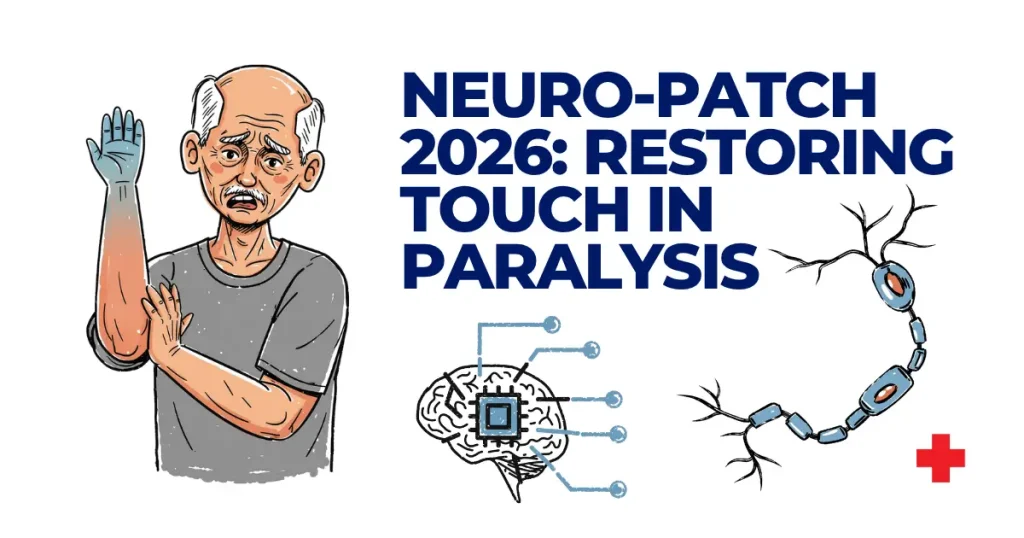
As a pharmacist, I see a lot of people who are paralyzed and how it affects their bodies and minds. For a long time, the main goal of medical technology has been to help people move, like by using an exoskeleton to help them walk or a robotic hand to help them hold something. But there has always been one thing missing: feeling. That “missing piece” was finally found at the Neural Engineering Summit on April 10, 2026. Researchers have officially announced that the “Neuro-Patch” works. It is a non-invasive device that lets the brain “feel” what a prosthetic limb touches.
This isn’t just a step forward; it’s a jump into a future where the line between biology and technology disappears.
Closing the Loop: From Movement to Feeling
Up until now, using a prosthetic was only a matter of seeing it. Patients had to be very careful when they used their robotic hands to pick up a glass of water so that they didn’t crush the cup or let it slip. There was no feedback, like a “sense” of pressure or temperature.
The Neuro-Patch makes a Bi-Directional system, which changes the game.
- The Movement: The brain tells the prosthetic to move.
- The Sensation: The sensors on the prosthetic fingers can feel the texture, temperature, and pressure of an object.
- The Neuro-Patch, which is worn on the skin, turns that information into neural impulses that the brain’s sensory cortex interprets as “touch.”
How the Neuro-Patch Works Without Surgery
From a clinical point of view, this breakthrough is especially exciting because it doesn’t involve surgery. The Neuro-Patch sits on the skin’s surface, unlike older brain-computer interfaces (BCIs) that needed risky neurosurgery to put chips directly into the brain.
It uses high-density transcutaneous electrical nerve stimulation (TENS) that has been changed by AI algorithms. These algorithms turn the digital signals from the prosthetic into a language that your nerves can understand. The patch sends signals to your brain that say, “This is warm” when the prosthetic hand touches a warm coffee cup. More Than Just a Medical Feat: The Daily Impact
As healthcare providers, we look at the clinical data, but as humans, we look at the quality of life. The daily impact of the Neuro-Patch is profound:
- Safety: Patients can tell if something is too hot or sharp, which keeps them from hurting their other tissue or damaging the expensive prosthetic.
- Fine Motor Skills: With tactile feedback, tasks like buttoning a shirt or typing on a keyboard become second nature instead of something you have to work hard to focus on.
- Emotional Connection: This technology may be most important because it lets you feel the texture of a loved one’s hand or the softness of a pet’s fur. For people with paralysis, this emotional “reconnection” is an important part of getting better mentally.
The Pharmacist’s Perspective on Neuro-Regeneration
From the pharmacy bench, we can see how this technology works with traditional medicine. We use drugs to treat neuropathic pain and muscle spasticity, but the Neuro-Patch works by changing the way the brain works. We are “retraining” the brain to recognize and process signals that were once thought to be lost forever by giving it consistent sensory input. It is a perfect combination of hardware and human biology.
What’s Next for the Neuro-Patch?
The results of the April 2026 summit are very important, but the next step is to make this technology bigger. The patch is currently being used in specialized rehabilitation centers. The next step is to make these patches as cheap and easy to get as a regular glucose monitor.
Researchers at the summit said that the main focus is on limb paralysis right now, but this “sensory skin” technology could also help people with severe peripheral neuropathy, which is a common problem I see in my diabetic patients.
Health Disclaimer:
This news article is for informational purposes only and is based on recent developments in medical technology. It does not replace professional medical advice, diagnosis, or treatment. Always seek the advice of your physician or other qualified health providers with any questions you may have regarding a medical condition or the use of prosthetic devices. Do not disregard professional medical advice because of something you have read here. DrugsArea
Sources & References
- Neural Engineering Summit 2026 Official Proceedings,
- Journal of NeuroEngineering and Rehabilitation,
- World Health Organization: Disability and Rehabilitation,
- IEEE Xplore: Biorobotics Research