Safety Alert: FDA’s 2026 Cybersecurity Mandate for Your Medical Devices
An Important Note from Your Pharmacist
Hi there. I’m accustomed to discussing side effects, expiration dates, and insulin storage as a pharmacist. However, the “medication” we oversee has evolved in 2026. These days, a lot of your life-sustaining medical devices, such as insulin pumps, pacemakers, and continuous glucose monitors (CGMs), rely as much on software as they do on chemistry.
The FDA released a crucial new safety rule on March 17, 2026. There has been a change in our understanding of “medical safety.” All “cyber-devices” must now adhere to far more stringent security guidelines, according to the agency. For engineers, this may seem like a technical problem, but for you and me, it’s a patient safety issue.
What You Should Know About the 2026 FDA Guidance Cybersecurity
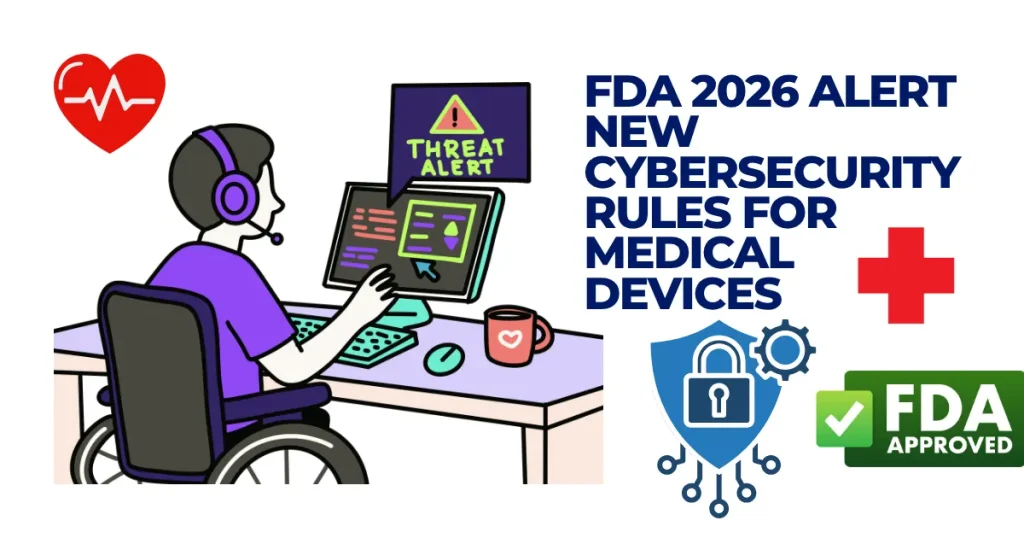
A software bug or security flaw is formally considered a physical danger under the FDA’s revised regulations under Section 524B of the FD&C Act. A gadget is currently categorized as a “cyber-device” if it can link to the internet, Bluetooth, or even a hospital network.
The Two Main Modifications: Patching and Encryption
Mandatory Encryption: In order to prevent anybody from intercepting or altering your dose settings remotely, manufacturers must now demonstrate that the data going from your pump to your phone is “locked” (encrypted). Cybersecurity
Active Patch Management: Updates to software were once thought of as optional “feature boosts.” As of right now, the FDA requires businesses to have a strategy in place for quickly identifying and addressing security flaws. We refer to this as patch management.
Why “Updating” Has Become the New “Sterilizing”
In the past, medical professionals concentrated on maintaining sterility to avoid infection. In order to avoid “digital infections” or unwanted access, we will concentrate on updating software in 2026.
The “Software Update Available” signal on your smartphone or medical device receiver should be handled as urgently as a “Low Battery” alert. In 2026, a security patch is more than just a digital task—it protects your heart and blood sugar levels. Ignoring an update might make your device susceptible to mistakes that could impact the way your therapy is administered.
Today’s 3-Step Safety Checklist Cybersecurity
In my capacity as your healthcare partner, I advise all patients who use linked devices to perform the following right now:
Look for alerts: Look for any outstanding updates by opening the companion app on your device, such as MiniMed Go or your CGM monitor.
Verify Your Connection: Make sure that only reliable, password-protected telephones are associated with your device. Steer clear of “jailbreaking” or altering the phone’s software to use your medical device.
Ask Your Provider: “Is my device currently supported with the latest 2026 FDA security patches?” should be your next question at the pharmacy or clinic.
The Viewpoint of the Pharmacist
A Software Bill of Materials (SBOM) is part of your “prescription” in the modern era. This is simply a fancy way of saying that in order to make software safe, the FDA requires producers to identify every “ingredient” in their program. We’ve always had this level of openness for medications, and now we have it for the technology that keeps us alive.
keep safe, keep informed, and stay connected. Cybersecurity
Health Disclaimer:
This news article is for informational purposes and does not replace professional medical advice. Always follow the specific instructions provided by your medical device manufacturer and consult your doctor before making changes to your device settings. If you suspect your device is malfunctioning or has been compromised, contact the manufacturer’s high-priority safety line immediately. DrugsArea
Sources & References
- FDA – Cybersecurity in Medical Devices: Quality Management System Considerations,
- Section 524B of the FD&C Act – Cybersecurity Requirements,
- Health-ISAC: 2026 Medical Device Security Trends,
- CISA: Protecting Connected Medical Devices