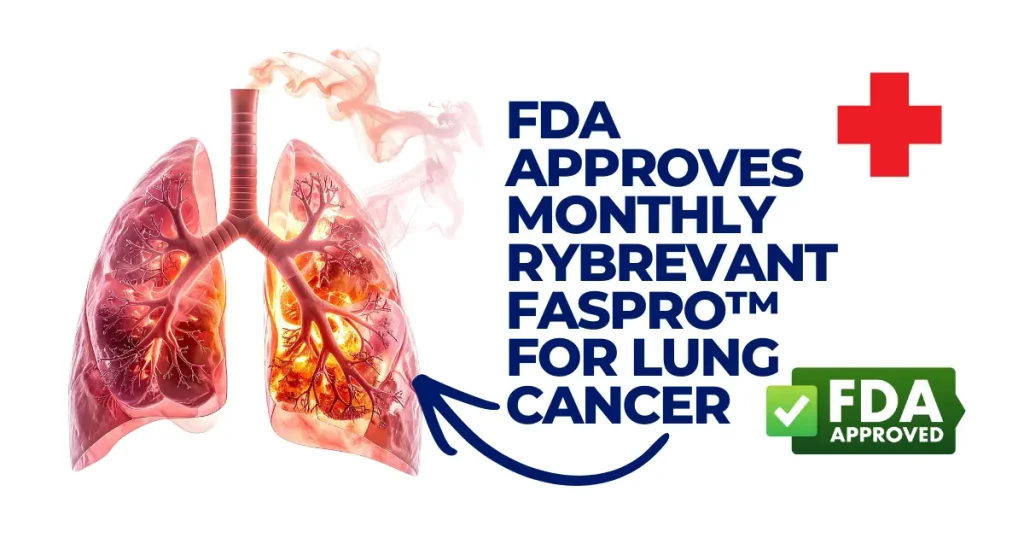
FDA Update: RYBREVANT FASPRO™ Now Approved for Monthly Dosing
A Breakthrough for Lung Cancer Families: More Time at Home, Less in the Clinic
As a healthcare professional, I’ve sat with many patients who say the hardest part of fighting lung cancer isn’t just the diagnosis—it’s the “hospital-centered” life that follows. The constant commutes, the long hours in infusion chairs, and the “treatment fatigue” that sets in when your calendar is dominated by appointments.
Today, February 17, 2026, the landscape for EGFR-mutated non-small cell lung cancer (NSCLC) has shifted dramatically. The FDA has officially approved a simplified monthly dosing schedule for RYBREVANT FASPRO™ (amivantamab and hyaluronidase-lpuj). This is more than just a paperwork update; it is a fundamental win for patient quality of life. Lung Cancer
What is the New RYBREVANT FASPRO™ Monthly Regimen?
Previously, patients on this specific therapy often faced bi-weekly subcutaneous (under-the-skin) injections. While this was already an improvement over traditional IV infusions that took hours, the new approval allows eligible patients to transition to a once-monthly schedule as early as Week 5 of their treatment. Lung Cancer
When used in combination with the oral medication LAZCLUZE®, this monthly injection provides the same level of efficacy as the more frequent dosing but with half the clinic visits.
From Hours to Minutes: The Power of Subcutaneous Tech Lung Cancer
The “Faspro” in Rybrevant Faspro refers to the integration of hyaluronidase, an enzyme that allows the medication to be absorbed quickly under the skin.
- Old Way (IV): Could take 4 to 6 hours per session.
- New Way (Faspro): Administered in roughly 5 to 10 minutes.
By moving to a monthly schedule, we are essentially giving patients back dozens of hours every year. In the world of oncology, time isn’t just a luxury—it’s a vital part of healing.
Why “Treatment Optimization” is the Theme of 2026 Lung Cancer
In 2026, the medical community has moved beyond simply asking “Does the drug work?” to asking “How does the drug fit into the patient’s life?” Monthly dosing helps solve three major hurdles:
- Treatment Fatigue: Frequent hospital visits can be psychologically draining. Fewer visits mean less “cancer-center-anxiety.”
- Clinic Accessibility: For patients living in rural areas, a monthly trip is much more sustainable than a bi-weekly one.
- Consistency: When a regimen is easier to follow, patients are more likely to stay on track, which leads to better long-term outcomes.
Is the New Schedule Safe? For Lung Cancer
The FDA’s decision was backed by the PALOMA-2 and PALOMA-3 clinical trials. The data showed that the monthly dosing delivered consistent outcomes and safety profiles compared to the bi-weekly schedule.
Notably, the subcutaneous delivery method has already shown a fivefold reduction in administration-related reactions compared to the old IV versions. No new safety concerns were identified with the move to the monthly frequency, making it a “green light” for doctors looking to optimize care.
Who Qualifies for the Monthly Dosing? Lung Cancer
This approval specifically targets patients with EGFR-mutated advanced non-small cell lung cancer. Usually, your medical team will start you on a weekly or bi-weekly induction phase to ensure your body tolerates the medicine well. If everything looks good, you can typically switch to the once-a-month schedule starting at Week 5.
The Professional Perspective: Reclaiming the “Moments That Matter”
As doctors, we often talk about “progression-free survival” (how long the cancer stays at bay). But for the person sitting in the exam room, they are thinking about their daughter’s wedding, a weekend trip, or simply an afternoon spent in the garden rather than a waiting room.
This FDA approval is a testament to the power of patient-centric innovation. By 2026 standards, we are no longer just fighting a disease; we are preserving a lifestyle. Lung Cancer
Health Disclaimer
This content is for educational purposes and reflects the FDA approval status as of February 2026. It is not a substitute for professional medical advice. Patients should discuss all treatment options, including dosing schedules and potential side effects (such as rash or infusion reactions), with their oncologist. DrugsArea
Sources & References
- Primary Source (Manufacturer): Johnson & Johnson – FDA Approves RYBREVANT FASPRO™ as the Only EGFR-Targeted Therapy for Monthly Dosing (Published Feb 17, 2026).
- Clinical News Coverage: Pharmacy Times – FDA Approves Once-Monthly Dosing Schedule for Amivantamab and Hyaluronidase-lpuj
- Oncology Professional Resource: Targeted Oncology – In a First, FDA Approves Monthly Subcutaneous Amivantamab for EGFR+ NSCLC
- Official Prescribing Information: J&J Labels – RYBREVANT FASPRO™ Prescribing Information
People Also Ask
1. What is the new FDA-approved dosing schedule for RYBREVANT FASPRO™?
The FDA has approved a once-monthly (every 4 weeks) dosing schedule for RYBREVANT FASPRO™ when used as a first-line treatment for certain types of advanced lung cancer. Previously, patients typically received injections every two weeks. This new update allows patients to transition to the monthly schedule starting as early as Week 5 of their treatment.
2. Is the monthly injection just as effective as the weekly or bi-weekly versions?
Yes. Clinical data (specifically from the PALOMA studies) showed that the monthly subcutaneous injection maintains the same level of medicine in the bloodstream as the more frequent doses. It provides consistent efficacy in fighting EGFR-mutated non-small cell lung cancer (NSCLC) while significantly reducing the number of clinic visits.
3. How is RYBREVANT FASPRO™ administered compared to the original RYBREVANT®?
While the original RYBREVANT® is given as an intravenous (IV) infusion that can take several hours, RYBREVANT FASPRO™ is a subcutaneous injection (a shot under the skin). The injection itself takes only about 5 to 11 minutes, making it much faster and more convenient for patients and healthcare providers.
4. Can I switch to monthly dosing if I’m already on the bi-weekly schedule?
Most likely, yes. The approval allows adult patients currently receiving the medication every two weeks to switch to the monthly (every 4 weeks) regimen. However, you must finish the initial “loading phase” (usually the first four weeks of treatment) before moving to the extended monthly schedule. Always consult your oncologist to see if this switch fits your specific plan.
5. What are the main benefits of the once-a-month approval?
The primary benefit is quality of life. By cutting clinic visits in half, patients spend less time in waiting rooms and more time at home. It also reduces the “treatment burden” on the healthcare system and decreases the physical stress associated with frequent injections.
6. Does monthly dosing change the side effects of the medication?
The safety profile for monthly dosing is comparable to the every-two-week schedule. Common side effects—such as skin rash, nail infections, and muscle pain—remain the same. Interestingly, the subcutaneous version (Faspro) generally has fewer “infusion-related reactions” (like chills or fever) than the older IV version.
7. Is RYBREVANT FASPRO™ used alone or with other drugs?
For first-line treatment, it is typically used in combination with LAZCLUZE® (lazertinib), an oral pill taken daily. It can also be used with chemotherapy (carboplatin and pemetrexed) depending on the specific type of EGFR mutation (such as Exon 19 deletions or Exon 21 L858R mutations).
8. Who is eligible for this once-monthly lung cancer treatment?
This approval is specifically for adults with locally advanced or metastatic non-small cell lung cancer (NSCLC) that has specific EGFR mutations. Your doctor will use an FDA-approved biomarker test to confirm your mutation type before prescribing this regimen.
9. Will my insurance cover the new monthly dosing?
Because this is an FDA-approved indication, most insurance providers and Medicare typically update their coverage to include the new dosing schedule. Many patients also utilize the “RYBREVANT withMe” program, which offers cost support and care navigators to help manage the financial side of treatment.
10. What should I do if I miss a monthly dose?
If you miss an appointment, contact your oncology team immediately. Because the drug is designed to stay in your system for a full month, keeping the levels consistent is important. Your doctor will help you get back on track without compromising the effectiveness of the treatment.