The “Needle-Free” Future: Epinephrine Films and Oral GLP-1 Pills
The End of the “Ouch”: Why Medicine is Going Needle-Free
For decades, some of our most life-saving and life-changing medications have come with a “pointy” caveat. Whether it’s the sudden emergency of an allergic reaction or the daily management of metabolic health, needles have been the gold standard for delivery.
But as we move into 2026, the medical landscape is shifting. We are entering the era of The Pharmacology of Convenience. Two major breakthroughs are leading this charge: the transition of weight-loss drugs (GLP-1s) from weekly injections to daily pills, and the evolution of the bulky EpiPen into a slim, sublingual film.GLP-1 Pills
As a healthcare professional, I see the same barrier every day: compliance. Patients are more likely to stick to a treatment plan when it fits easily into their lives. Let’s dive into how these “needle-free” innovations are set to change everything. GLP-1 Pills
1. The Weight-Loss Revolution: Enter Orforglipron By GLP-1 Pills
For the past few years, names like Ozempic and Mounjaro have dominated the headlines. While incredibly effective, they require a subcutaneous injection once a week. For many, this is a hurdle—either due to needle phobia, the logistics of cold storage, or the “medicalized” feeling of self-injecting.
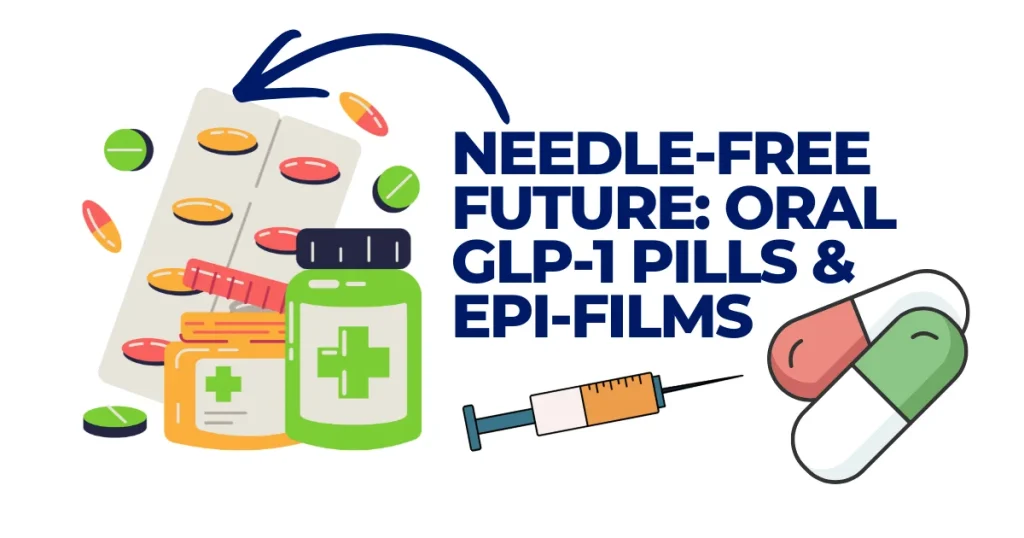
What is Orforglipron?
With FDA approval anticipated by March 2026, Orforglipron represents the first “true” weight-loss pill designed to match the efficacy of its injectable cousins. Unlike current oral options (like Rybelsus) that have strict fasting requirements and lower absorption rates, Orforglipron is a non-peptide GLP-1 receptor agonist.
Why It’s a Game Changer:
- No Cold Chain: Unlike injections, these pills don’t need to stay refrigerated.
- Easier Dosing: A simple daily pill taken with or without food.
- Massive Accessibility: Pills are significantly cheaper to manufacture and ship than glass pens and needles, which could eventually lower costs for patients.
Comparison: Injectables vs. Orforglipron GLP-1 Pills
| Feature | Injectable GLP-1s | Orforglipron (Oral) |
|---|---|---|
| Delivery | Weekly Needle | Daily Pill |
| Storage | Refrigeration Required | Room Temperature |
| Ease of Use | Moderate (Training needed) | High (Simple swallow) |
| Effectiveness | High (15-20% weight loss) | Comparable (Per clinical trials) |
2. Emergency Care in Your Wallet: Anaphylm
If you or your child lives with a severe food allergy, you know the “EpiPen Anxiety.” Is it in the bag? Is it expired? Is it too hot in the car? The bulkiness of traditional autoinjectors means many people leave them at home, risking their lives during an accidental exposure.
The Innovation: Epinephrine Sublingual Film
The solution is Anaphylm—a postage-stamp-sized film that dissolves under the tongue. It delivers a dose of epinephrine directly into the bloodstream through the mucosal tissue.
Why It Matters for Families:
- Portability: It fits in a standard wallet or a small pocket.
- No Needle Phobia: Children (and many adults) are terrified of the “thump” of an autoinjector. A film removes the trauma from an already stressful emergency.
- Temperature Stability: While still sensitive, films are generally less prone to the mechanical failures that can plague spring-loaded pens.
Health Professional Tip: If you currently carry an EpiPen, do not discard it yet. However, talk to your allergist about Anaphylm as it becomes available. Having a backup that fits in a wallet ensures you are never without protection. GLP-1 Pills
3. The Psychology of “Pill vs. Poke” GLP-1 Pills
Why does this shift matter so much? In medicine, we talk about “patient burden.” When a treatment is burdensome, people stop doing it.
- Reduced Stigma: Taking a pill at a restaurant is discreet; using an injection pen often feels like a “procedure.”
- Increased Adherence: People are conditioned to take daily vitamins or pills. Integrating GLP-1s into a morning routine is more natural than a weekly “injection day.”
- Better Outcomes: Especially in the case of epinephrine, the “best” medicine is the one you actually have with you when an emergency strikes.
Medical Disclaimer
The information provided in this article is for educational and informational purposes only and is not intended as medical advice. Always seek the advice of your physician or other qualified health provider with any questions you may have regarding a medical condition or treatment. Never disregard professional medical advice or delay in seeking it because of something you have read here. DrugsArea
Sources & Further Reading
- FDA Guidance on GLP-1 Medications
- Clinical Trials for Orforglipron (Eli Lilly)
- Anaphylm Development Updates (Aquestive Therapeutics)
- The Lancet: Oral vs. Injectable Efficacy Studies
People Also Ask
1. What is an epinephrine film, and how does it work without a needle?
Think of it like those breath strips that dissolve on your tongue. An epinephrine film (like the newly developed sublingual films) is placed under the tongue during an allergic reaction. It dissolves instantly, and the medication is absorbed directly into the bloodstream through the rich network of veins in the mouth, bypassing the need for a thigh injection.
2. Are oral GLP-1 pills as effective as the weight-loss injections?
They are remarkably close. While the “gold standard” injections (like Wegovy or Zepbound) typically offer slightly higher bioavailability, the latest clinical data shows that high-dose oral versions can achieve 13–15% weight loss. The trade-off is often worth it for those who can’t stomach the idea of a weekly needle.
3. How fast does an epinephrine film work compared to an EpiPen?
In an emergency, every second counts. Clinical trials show that sublingual epinephrine films reach peak concentration in the blood in about 15 minutes. While an EpiPen is slightly faster (around 10 minutes), the film is significantly faster than a manual syringe injection, making it a viable life-saving alternative for many.
4. Why do I have to take my GLP-1 pill on a completely empty stomach?
This is the “SEO secret” to making these pills work. Oral GLP-1s (like Rybelsus or the new oral Wegovy) are very fragile; if there is any food or even too much water in your stomach, the medication won’t be absorbed. You must take it first thing in the morning with no more than 4 ounces of water and wait 30 minutes before eating.
5. Can an epinephrine film survive in a hot car like an EpiPen can’t?
Actually, the films are much more “shelf-stable.” Because they don’t rely on a complex mechanical spring or a liquid solution that degrades rapidly in heat, they are easier to carry in a pocket or purse. However, you should still avoid extreme temperatures to ensure the chemical potency remains 100% effective.
6. Do needle-free pills have more side effects than the shots?
Interestingly, the side effects are similar but located in different places. Injections often cause “injection site reactions” (redness or bruising). The pills, because they sit in the stomach, can sometimes cause more initial nausea or “acid reflux” symptoms. Most people find these settle down after the first few weeks as the body adjusts.
7. Is the needle-free version of these drugs more expensive?
Currently, yes. Developing the technology to wrap a protein-based drug (like a GLP-1) so it survives stomach acid is expensive. However, as of 2026, many insurance companies are starting to favor the pills because they don’t require “sharps” disposal or specialized refrigeration, which lowers the overall cost of the healthcare “system.”
8. Can I switch from a weekly injection to a daily pill?
Many patients are making the switch. If you are tired of the “Sunday night needle ritual,” you can talk to your doctor about transitioning. Keep in mind that you’ll go from a once-a-week task to a once-a-day habit, which requires a bit more discipline to stay on track.
9. Are these needle-free options safe for children?
For epinephrine, the films are a game-changer for kids who are traumatized by needles. Pediatric trials are showing great promise. For GLP-1s, they are currently mostly approved for adults, but pediatric versions are in the final stages of testing for adolescents with metabolic concerns.
10. Will the EpiPen eventually become obsolete?
Not quite yet, but it’s losing its monopoly. The “Smart-Label” and “Needle-Free” rollout means we are entering an era of choice. The EpiPen will likely remain the standard for extreme, high-risk cases, while films and nasal sprays will become the go-to for daily “carry” and moderate-to-severe reactions.