AI vs. The Clock: New Michigan Study Detects Brain Emergencies in Seconds
As a healthcare professional, I’ve seen the “golden hour” in action. In neurology, we often say “Time is Brain.” Every minute a stroke or hemorrhage goes untreated, millions of neurons perish. Today, February 10, 2026, the University of Michigan has officially changed the game with a breakthrough that shifts the diagnostic clock from hours to seconds. Neuroprioritization
The Breakthrough: Meet “Prima” Neuroprioritization
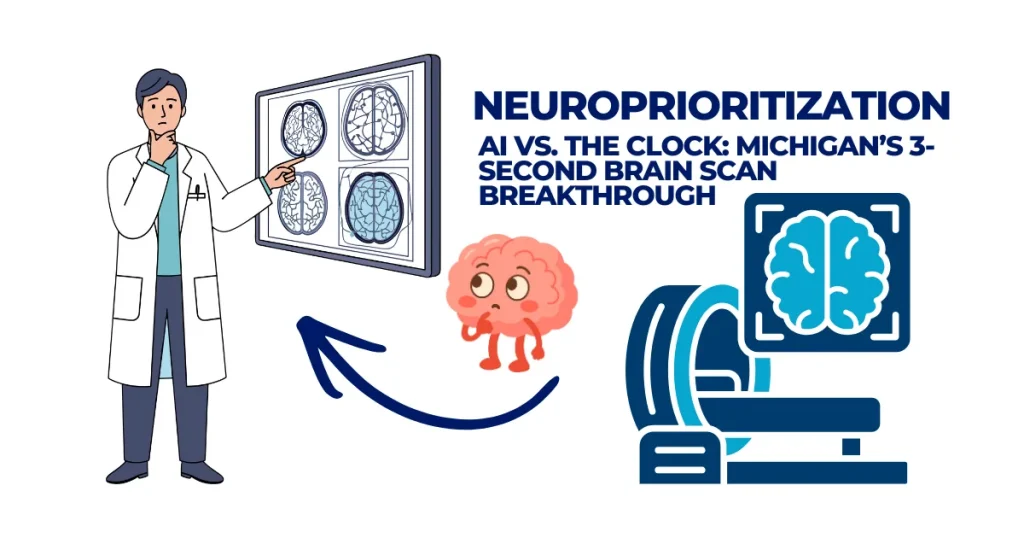
Researchers at Michigan Medicine have deployed a vision-language AI model named Prima. Unlike previous AI tools that only looked for one specific problem (like a single type of tumor), Prima is a generalist. It was trained on over 200,000 MRI studies and 5.6 million image sequences—essentially the entire digital history of Michigan’s radiology department.
The result? An AI “co-pilot” that can interpret a full brain MRI in just 3 seconds.
Why This Matters in the Emergency Room Neuroprioritization
Traditionally, the “door-to-treatment” pipeline looks like this:
- Patient arrives with symptoms.
- MRI is ordered and performed.
- The scan sits in a queue for a radiologist to review (which can take hours during busy shifts).
- Results are paged to the neurologist.
Prima cuts the middleman. It acts as an automated triage system. The moment a scan is finished, the AI analyzes it. If it detects a life-threatening condition like a hemorrhagic stroke or an acute blockage, it immediately alerts the specific subspecialist—such as a neurosurgeon or stroke neurologist—bypassing the standard waiting list. Neuroprioritization
Precision Meets Speed
In the study published in Nature Biomedical Engineering, Prima demonstrated a staggering 97.5% accuracy across more than 50 different neurological conditions. It doesn’t just look at the pictures; it “reads” the patient’s clinical history and the reason for the scan, mimicking how a human radiologist thinks.
Your Action Plan: Ask for “AI-Assisted Triage”
This technology is rolling out to emergency departments this month. If you or a loved one find yourselves in an ER with symptoms like sudden numbness, slurred speech, or the “worst headache of your life,” don’t be afraid to advocate for yourself.
Ask the medical team: “Is AI-Assisted Triage or the Prima system being used to prioritize these imaging results?”
In a crisis, the difference between a full recovery and permanent disability often comes down to seconds. With Michigan’s new AI, those seconds are finally on your side. Neuroprioritization
Health Disclaimer
This content is for informational purposes only and does not constitute medical advice. Always seek the advice of your physician or other qualified health provider with any questions you may have regarding a medical condition. In case of a medical emergency, call 911 or your local emergency services immediately. DrugsArea
Sources
- Michigan Medicine News: AI reads brain MRIs in seconds and flags emergencies (Feb 10, 2026)
- Nature Biomedical Engineering: General-purpose AI for clinical neuroimaging (Publication source for the Prima study)
- University of Michigan Health Lab: An AI model that can read and diagnose a brain MRI in seconds
People Also Ask
1. What is the “Prima” AI system mentioned in the 2026 Michigan study?
Prima is a cutting-edge “vision-language model” developed by researchers at University of Michigan Health. Unlike older AI that only looked at images, Prima acts like a digital radiologist; it processes brain MRI scans alongside the patient’s medical history and clinical notes simultaneously to provide a comprehensive diagnosis in seconds.
2. How accurate is the Michigan AI at detecting brain emergencies?
The study, published in Nature Biomedical Engineering, shows that Prima achieved an incredible 97.5% accuracy in identifying neurological conditions. It doesn’t just find the problem; it also accurately assesses the “triage” level—deciding how urgently a patient needs a neurosurgeon or a stroke specialist.
3. Can this AI actually replace human radiologists?
No. The lead researchers, including neurosurgeon Dr. Todd Hollon, describe Prima as a “co-pilot” or “assistant,” not a replacement. Its job is to handle the “heavy lifting” of scanning thousands of image sequences to flag emergencies, allowing human doctors to focus on the final diagnosis and immediate patient care.
4. Which brain conditions can the Michigan AI detect?
The 2026 study tested Prima against more than 50 different radiologic diagnoses. This includes critical emergencies like:
- Brain hemorrhages (bleeding)
- Acute ischemic strokes
- Brain tumors (and their genetic mutations)
- Traumatic brain injuries
5. How does AI detect a brain emergency in “seconds”?
Traditional MRI review requires a specialist to manually scroll through hundreds of “slices” of a brain scan. Prima uses a foundation model trained on over 200,000 historical studies. Because it processes the data “natively” and in real-time, it can flag a life-threatening clot or bleed the moment the scan is finished.
6. Why is this study being called “ChatGPT for medical imaging”?
It earned this nickname because, like ChatGPT, Prima is a “foundational” model. It wasn’t built for just one task (like finding a single type of tumor). Instead, it understands the “language” of brain anatomy and medical records, allowing it to “chat” with the data and provide a broad range of neurological insights.
7. How will this technology help patients in rural or small hospitals?
One of the biggest impacts is for hospitals that don’t have a 24/7 neuroradiologist on-site. Prima can act as an instant triage tool, automatically alerting specialized stroke teams or neurosurgeons at larger centers if a scan looks critical, effectively “shrinking” the distance between a rural patient and expert care.
8. Does the AI use my personal medical history to make a diagnosis?
Yes. One of Prima’s unique strengths is that it incorporates the reason the doctor ordered the scan and the patient’s clinical history. This context prevents “false positives” and helps the AI understand, for example, if a spot on a scan is a new emergency or a stable, pre-existing condition.
9. Is this AI already being used in all Michigan hospitals?
As of February 2026, Prima is in the early evaluation and implementation phase. While the study results are revolutionary, the system is being carefully integrated into clinical workflows at University of Michigan Health first to ensure it meets strict safety and “human-in-the-loop” standards before a wider rollout.
10. What makes this study different from AI tools used in 2024 or 2025?
Previous AI tools were usually “narrow”—they could only look for one thing, like a fracture or a specific tumor. The 2026 Michigan study represents a shift to Multimodal AI. By combining 5.6 million imaging sequences with text-based patient data, it offers a holistic view of the patient that older, single-task models simply couldn’t achieve.