The Neurowellness Pivot: Why 2026 is Trading Data Points for Inner Peace
The Great Tracking Burnout
For nearly a decade, we have lived under the tyranny of the “perfect score.” We’ve worn rings that tell us how we slept, watches that judge our recovery, and sensors that track every glucose spike. But by the start of 2026, a collective realization hit the global wellness community: We are stressed out by the tools meant to reduce our stress.
As a health professional, I’ve seen this manifest in my clinic as “orthosomnia”—a literal inability to sleep because of the anxiety caused by sleep trackers. We’ve been “performing” wellness rather than actually being well.
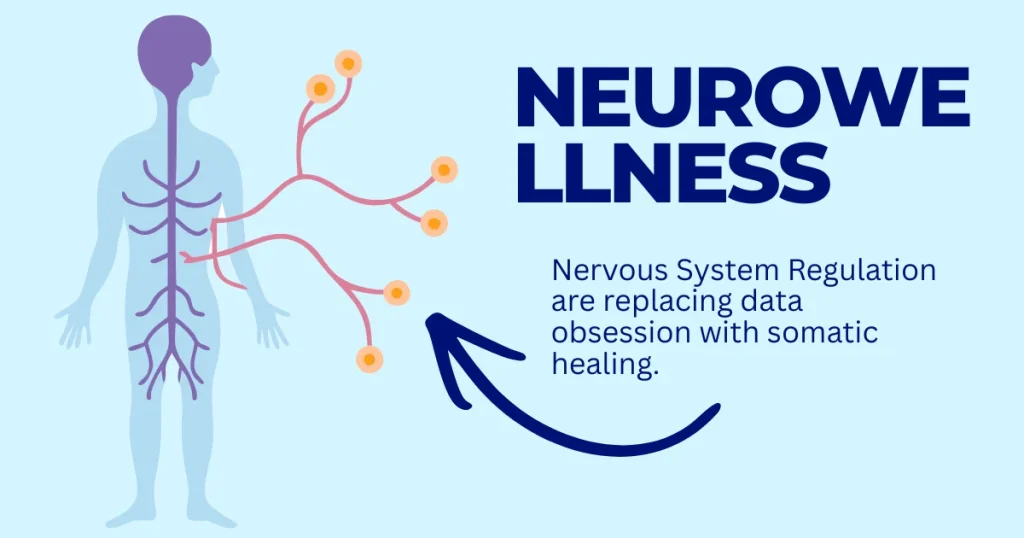
Enter Neurowellness. This isn’t just a buzzword; it’s a fundamental shift from external data to internal safety. We are moving away from “How many steps did I take?” and toward “How safe does my nervous system feel right now?”
Understanding the Shift: Data vs. Regulation
In the past, wellness was treated like a math problem. If you add amount of protein and hours of REM sleep, you should get health. However, the human body is a biological ecosystem, not a spreadsheet.
The Problem with Over-Optimization
When we obsess over data, we remain in a state of “High Beta” brainwave activity—the zone of constant analysis and alertness. Ironically, trying to “hack” our health keeps us trapped in the Sympathetic Nervous System (the “Fight or Flight” response).
The Neurowellness Solution
Neurowellness focuses on the Autonomic Nervous System (ANS). Instead of tracking how high your heart rate went during a workout, the focus is now on how quickly you can return to a “Ventral Vagal” state—a state of social engagement, calm, and restoration.
The Star of 2026: The Vagus Nerve
If 2020 was the year of immunity and 2023 was the year of gut health, 2026 is the year of the Vagus Nerve. This is the longest cranial nerve in your body, acting as the “superhighway” between your brain and your vital organs. It is the primary driver of the Parasympathetic Nervous System (the “Rest and Digest” mode).
1. Vagus Nerve Stimulators (VNS)
We are seeing a move away from passive trackers toward active modulators. Non-invasive VNS devices, worn like headphones or placed against the neck, use mild electrical pulses to signal the brain to “chill out.” In 2026, these are becoming as common as noise-canceling headphones.
2. Somatic Breathing
Instead of “box breathing” to hit a metric, somatic breathing is about feeling the expansion of the ribs and the release of the diaphragm. It’s about the sensation, not the count. This helps “unstick” stored tension that data simply can’t measure.
3. Soundscapes and Frequency Healing
Neurowellness spaces are replacing high-intensity gyms. These centers focus on binaural beats and haptic (vibration) therapy to shift the brain from a state of anxiety to a state of flow.
The Philosophy of “Feeling Safe”
The most profound change in 2026 is the goal. We’ve stopped asking, “How do I perform perfectly?” and started asking, “How do I feel safe?”
- From Sleep Scores to Sleep Sanctity: In 2026, we don’t check an app to see if we slept well. We check our bodies. If we feel rested, we trust that—even if a device says otherwise.
- From Calorie Counting to Interoception: Interoception is the ability to sense what is happening inside your body (hunger, fullness, heartbeat). Neurowellness prioritizes this “sixth sense” over external calorie counters.
How to Transition to Neurowellness
You don’t need expensive tech to join the 2026 wellness revolution. You can start regulating your nervous system today:
- Cold Exposure (The Gentle Way): A splash of cold water on the face stimulates the “mammalian dive reflex,” which instantly slows the heart rate via the vagus nerve.
- Longer Exhales: Make your exhale twice as long as your inhale. This is a physical “hack” that tells your brain you are not in danger.
- The “Tech Sabbath”: Designate hours where you wear no sensors. No rings, no watches, no phones. Reconnect with the raw data of your own senses.
The Verdict
The “backlash” against over-optimization isn’t a rejection of science; it’s an evolution of it. We now understand that a body under constant surveillance is a body under stress. By pivoting to Neurowellness, we are finally giving ourselves permission to stop “tracking” and start “living.”
Health Disclaimer
This content is for informational and educational purposes only and does not constitute professional medical advice, diagnosis, or treatment. Always seek the advice of your physician or other qualified health provider with any questions you may have regarding a medical condition. Never disregard professional medical advice or delay in seeking it because of something you have read here. DrugsArea
Sources & References
- Harvard Health: Understanding the Stress Response,
- Cleveland Clinic: Vagus Nerve Functions,
- Nature Journal: The Science of Somatic Experiencing,
- Psychology Today: Why Biohacking is Making Us Anxious
People Also Ask
1. What exactly is the “Neurowellness Pivot” of 2026?
The Neurowellness Pivot represents a major cultural shift where people are moving away from “quantified self” metrics—like counting every calorie or step—and focusing instead on qualitative mental well-being. In 2026, the trend is less about what your smartwatch says and more about how your brain actually feels. It’s a transition from digital tracking to emotional grounding.
2. Why are people stoping their obsession with data points this year?
After years of “optimization fatigue,” many have realized that hitting data targets doesn’t automatically equal happiness. Constant tracking often leads to performance anxiety rather than health. In 2026, the collective focus has shifted toward “inner peace” because people are prioritizing nervous system regulation over digital validation.
3. How does Neurowellness differ from standard mental health?
While mental health is a broad term, Neurowellness specifically targets the health of the nervous system and brain function through lifestyle. It’s more proactive than reactive, utilizing tools like breathwork, neuroplasticity exercises, and “digital fasting” to create a calmer internal environment.
4. Can I achieve inner peace without deleting all my health apps?
Absolutely. The pivot isn’t about being anti-technology; it’s about changing your relationship with it. Instead of letting an app tell you if you “slept well,” 2026 is about checking in with your body first. Use data as a secondary reference point, not the ultimate authority on your well-being.
5. What are the core pillars of the Neurowellness movement?
The movement stands on four main legs:
- Sensory Regulation: Reducing overstimulation.
- Somatic Movement: Physical activity that connects the mind and body.
- Cognitive Rest: Intentional periods of “doing nothing.”
- Subconscious Rewiring: Practices like meditation or journaling to shift deep-seated stress patterns.
6. Is the “Neurowellness Pivot” just a passing trend?
Unlikely. This shift is a direct response to the burnout culture of the early 2020s. As AI and automation handle more “data” tasks, the human premium is shifting toward emotional intelligence and mental clarity, making Neurowellness a long-term lifestyle evolution rather than a fad.
7. How does “trading data points for inner peace” impact daily productivity?
Surprisingly, it usually increases it. By lowering cortisol levels and reducing the “noise” of constant tracking, individuals often find they have better focus and more sustainable energy. You’re moving from a state of “frenetic doing” to “calm efficiency.”
8. What are some simple ways to start my own Neurowellness pivot?
Start by implementing “data-free” mornings—don’t check your stats or phone for the first hour. Replace one metric-heavy workout with a mindful walk, and practice “interoception,” which is simply the act of noticing internal bodily sensations without trying to fix them.
9. Does this mean wearable technology is becoming obsolete?
Not at all, but the type of technology is changing. We’re seeing a rise in wearables that measure vagus nerve tone or brain wave states (EEG) rather than just heart rate or steps. The tech is becoming a coach for your peace of mind, rather than a judge of your activity level.
10. How can I explain the Neurowellness Pivot to someone who loves their data?
Think of it as upgrading from a “dashboard” view of life to an “experiential” one. You aren’t ignoring the facts of your health; you’re simply choosing to prioritize the feeling of being well over the proof of being well.