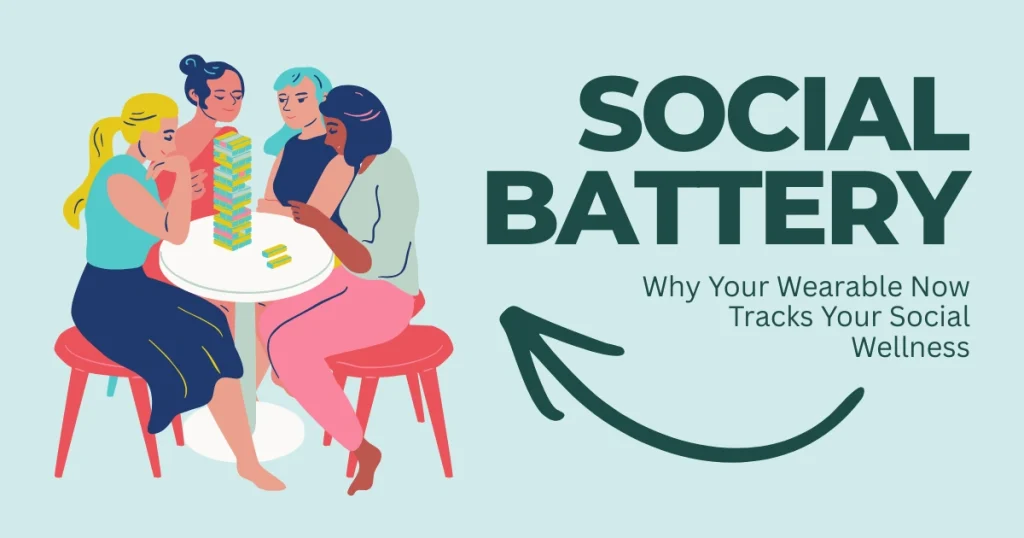
The “Social Battery” Metric: Why Your Wearable Now Tracks Your Social Wellness
Introduction: The New Frontier of Personal Metrics
As a health professional who has spent years analyzing the physiological markers of stress, I’ve watched the wearable industry evolve from simple step-counters to sophisticated clinical companions. However, the most significant shift of 2026 isn’t a new heart rate sensor; it is the quantification of Social Health.
We have long understood that “Social Battery” is a valid psychological concept—the finite amount of energy we have for interpersonal interaction before needing solitude. Today, that concept has moved from a meme to a metric. With the integration of voice-analysis AI and cortisol-proxy monitoring, your smartwatch now knows when you’re “peopled out” before you even feel the first headache.
The Science of Social Fatigue and Cortisol Spikes
Social interaction, while vital for human longevity, is metabolically and neurologically expensive. Every conversation requires the brain to process non-verbal cues, tone, and social context—a heavy “cognitive load.”
When we push past our natural social limits, the body enters a state of Social Fatigue. This isn’t just a mood; it’s a biological event. Research in 2025 and 2026 has confirmed that prolonged social over-extension triggers the hypothalamic-pituitary-adrenal (HPA) axis, leading to:
- Cortisol Spikes: Sustained “social “stress” keeps cortisol levels elevated, disrupting sleep and metabolic function.
- Reduced HRV (Heart Rate Variability): A clear indicator that the nervous system is stuck in “fight or flight” mode rather than “rest and digest.”
- Vocal Biomarker Shifts: Subtle changes in the pitch, pace, and resonance of our speech that signal neurological exhaustion.
How 2026 Wearables Detect the “Drain”
The breakthrough in 2026 comes from Passive Voice-Analysis AI. Unlike early voice assistants that listened for commands, modern social health modules analyze the biometrics of sound without recording the content of your private conversations.
1. Vocal Fatigue Sensing
Using sensors that detect throat vibrations and acoustic patterns, wearables now monitor “vocal load.” AI algorithms (like those developed by institutions like Northwestern and refined by tech leaders in 2026) can distinguish between enthusiastic engagement and the “flat” or “strained” tone associated with burnout.
2. The “Social Strain” Algorithm
By cross-referencing your vocal patterns with your heart rate and skin temperature, your device calculates your Social Strain. If your heart rate stays elevated during a three-hour dinner party while your vocal pitch becomes monotonous, your wearable identifies a mismatch—a sign that you are performing socially while your body is internally retreating.
3. Proactive “Digital Quiet Time”
When the “Social Battery” reaches a critical 10%, the 2026 generation of smartwatches doesn’t just send a notification; it suggests a Digital Quiet Time. This might involve:
- Auto-enabling “Do Not Disturb” on your phone.
- Suggesting a 10-minute somatic breathing session.
- Informing you that your recovery time will be 30% longer if you attend another “high-social-load” event tonight.
Why Social Wellness is the Key to Burnout Prevention
In my practice, I’ve found that many patients confuse professional burnout with social burnout. They think they hate their jobs, but they actually just have “leaky” social boundaries.
By tracking social health, we can finally address the interpersonal dimension of burnout. When a wearable validates that your “battery” is low, it removes the guilt often associated with “canceling plans.” It turns a subjective feeling into an objective health data point, making it easier to prioritize the solitude required for nervous system regulation.
Comparative Analysis: Wearable Capabilities in 2026
| Feature | 2024 Standards | 2026 Social Wellness Standards |
|---|---|---|
| Primary Metric | Steps & Sleep Stages | Social Battery & Cognitive Load |
| Sensor Tech | Optical Heart Rate | AI Vocal Biomarkers & Sweat Cortisol Proxies |
| Feedback | “Move more” reminders | “Digital Quiet Time” & Social Recovery alerts |
| Focus | Physical Fitness | Holistic Social-Biological Resilience |
Practical Steps to Manage Your Social Battery
Even with the best tech, the goal is to develop internal awareness. Here is how you can use these metrics effectively:
- Honor the “Amber” Alert: When your device shows your social energy dipping into the yellow zone, take a 5-minute “micro-break” away from people. This can prevent a full cortisol spike.
- Schedule Recovery: If you have a high-social-demand day (weddings, conferences, back-to-back meetings), treat the following day as a “Low-Social-Load” day.
- Monitor the Link to Sleep: Notice how your “Social Battery” levels correlate with your Deep Sleep scores. Often, social over-extension leads to “wired but tired” nights.
Health Disclaimer
The information provided in this article is for educational purposes only and is not intended as medical advice. While wearable technology provides valuable insights, it should not replace professional mental health diagnosis or clinical monitoring. Always consult with a qualified healthcare provider regarding symptoms of chronic burnout, anxiety, or stress-related disorders. DrugsArea
Sources & References
- American College of Sports Medicine (ACSM): Worldwide Fitness Trends for 2026 – The Rise of Wearable Tech as the #1 Trend. acsm.org
- Northwestern University Feinberg School of Medicine: First Wearable Device for Vocal Fatigue and Voice Monitoring. news.feinberg.northwestern.edu
- MDPI Digital Health: Passive AI Detection of Stress and Burnout Among Frontline Workers (2025/2026). mdpi.com
- World Health Net: Wearables for Wellness: Monitoring Hormones and Stress in Real-Time. worldhealth.net
People Also Ask
1. What is a “Social Battery” metric on a wearable?
It’s a digital estimation of your emotional and mental energy for social interaction. Unlike physical “Body Battery” features that track muscle recovery, this metric uses Heart Rate Variability (HRV) and stress patterns to show how much “charge” you have left for meetings, parties, or even basic small talk.
2. How does my watch know I’m socially drained?
Wearables look for “social strain” by monitoring your autonomic nervous system. When you’re in a high-stakes social environment, your sympathetic nervous system (fight-or-flight) often spikes. If your watch detects prolonged high stress without physical movement, it flags that your social battery is depleting.
3. Which wearables currently track social wellness?
Brands like Garmin (via Body Battery and Stress tracking), Whoop, and newcomers like NOWATCH are leading the charge. Many now offer “Social Stress” overlays that highlight how your physiological recovery drops during or after social events.
4. Is the social battery metric actually accurate?
It’s highly accurate at measuring physiological stress, but it can’t read your mind. It might confuse the “good” stress of an exciting date with the “bad” stress of a toxic meeting. Think of it as a helpful mirror for your body’s internal state rather than an absolute medical truth.
5. Why should I care about tracking my social battery?
Tracking helps you identify “social energy vampires”—the specific people or environments that drain you fastest. It allows you to schedule your life more effectively, ensuring you don’t book a high-pressure presentation right after a draining family gathering.
6. Can a wearable tell me when to leave a party?
Some advanced models now send “vibration prompts” or “check-in” alerts when they detect your stress levels climbing. If your social battery hits a “low” threshold (usually under 20%), the watch might suggest it’s time to head home and recharge.
7. Does “Body Battery” mean the same thing as “Social Battery”?
Not quite. Body Battery is your total fuel tank (physical + mental). Social Battery is a subset of that. You might have a 90% Body Battery (you’re well-rested) but a 10% Social Battery (you’re mentally “done” with people for the day).
8. How can I “recharge” my social battery according to the data?
The data shows that “quiet recovery” works best. Wearables often see the fastest recharge during NSDR (Non-Sleep Deep Rest), meditation, or solo time in nature. Interestingly, scrolling on social media rarely helps the metric “charge” because your brain stays in an active state.
9. Will tracking my social battery make me more introverted?
Actually, the goal is intentionality. For extroverts, it helps prevent burnout by showing when they’ve pushed too hard. For introverts, it provides “permission” to say no to events without feeling guilty, backed by objective data.
10. Is my social data private?
Most top-tier brands encrypt this data, but it’s a valid concern. Because social wellness tracking involves “contextual data” (like where you were or who you were with via Bluetooth proximity), you should always check your app’s privacy settings to ensure your “social map” isn’t being shared.