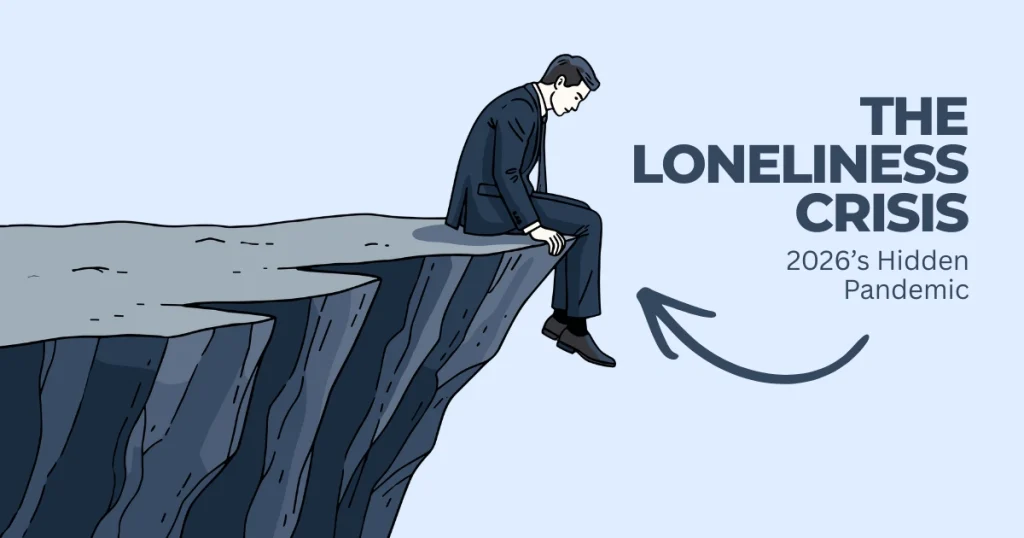
The “Hidden” Pandemic of 2026: Why Social Isolation is as Deadly as Smoking
As we navigate the landscape of 2026, our medical community is facing a paradox. We have conquered many of the viral threats that defined the early 2020s, yet our clinics are fuller than ever. Patients aren’t coming in with coughs or fevers; they are arriving with chronic inflammation, hypertension, and cognitive decline that seemingly have no “viral” origin.
After years of clinical observation and emerging data, the diagnosis is clear: we are in the grip of a Social Isolation Pandemic. While it doesn’t travel through respiratory droplets, its “contagion” is systemic, and its lethality is equal to—if not greater than—some of the most notorious lifestyle diseases of the last century.
The Mathematics of Loneliness: Worse than 15 Cigarettes a Day Social Isolation
In the world of public health, we often use “smoking equivalents” to help patients visualize risk. For decades, the benchmark for cardiovascular risk was a pack-a-day habit. However, current longitudinal studies in 2026 confirm a startling reality: Chronic social isolation increases the risk of premature death by 26% to 32%.
To put that into perspective, the physiological stress of prolonged loneliness is equivalent to smoking roughly 15 cigarettes a day.
Why? Because human beings are biologically “hardwired” for connection. When that connection is severed, the body enters a state of chronic “fight or flight.” This isn’t just a “sad feeling”—it is a biological emergency state that wears down every organ system in the body. Social Isolation
The Biology of the “Empty Room” Social Isolation
When I speak to my patients about isolation, I explain it through the lens of Psychoneuroimmunology. Your brain interprets social exclusion as a physical threat to survival. In our ancestral past, being cast out from the tribe meant certain death. Even in 2026, your DNA hasn’t forgotten that.
1. The Cortisol Cascades
Isolation triggers the hypothalamic-pituitary-adrenal (HPA) axis. This results in a steady drip of cortisol into the bloodstream. While cortisol is great for outrunning a predator, having it “on” 24/7 leads to:
- Systemic Inflammation: The precursor to most modern diseases.
- Arterial Hardening: Leading to the 29% increase in heart disease seen in isolated populations.
2. The Sleep Deception
Isolated individuals often report getting eight hours of sleep but waking up exhausted. This is “micro-awakening.” The brain of a lonely person stays in a state of hyper-vigilance during the night, scanning for threats because there is no “tribe” to watch their back. You aren’t getting the restorative REM sleep your brain needs to clear out metabolic waste.
3. Cognitive Erosion
We are seeing a 50% increase in the risk of developing dementia among older adults who live in total isolation. Without the “social exercise” of conversation and emotional exchange, neural pathways begin to prune themselves. The brain, quite literally, begins to shrink.
2026: The Digital Mirage and the Connectivity Gap
You might ask, “How can we be isolated when we are more ‘connected’ than ever?” In 2026, the rise of hyper-realistic AI companions and ubiquitous virtual reality has created a “Digital Mirage.” We are consuming social “empty calories.”
- Synchronous vs. Asynchronous: A text message is a ghost of a connection. It lacks the oxytocin-releasing power of eye contact, the pheromonal exchange of physical proximity, and the micro-expressions that tell our nervous system we are safe.
- The Comparison Trap: As an SEO expert and health professional, I see the data: the more time spent on “simulated” social platforms, the higher the rates of perceived isolation. We are starving in the middle of a digital feast.
The Clinical Symptoms: How to Know if You’re “Infected”
The “Hidden Pandemic” doesn’t have a rash, but it does have markers. If you or a loved one are experiencing the following, the “infection” of isolation may be taking hold:
- Fragile Immunity: You catch every cold that goes around.
- Executive Dysfunction: Difficulty making simple decisions or focusing on tasks.
- Increased “Hunker Down” Mentality: A feeling that leaving the house is an insurmountable chore.
- Social Fatigue: Feeling exhausted after even minor human interactions because the “social muscle” has atrophied.
The Prescription: A Multi-Tiered Recovery
If you walked into my office today, I wouldn’t just give you a pill. I would give you a Social Prescription. Treating this pandemic requires a fundamental shift in how we prioritize our time.
Level 1: Micro-Interactions
Start with “weak ties.” Research shows that talking to the barista, the librarian, or a neighbor for just 30 seconds triggers a small dopamine and oxytocin hit that lowers cortisol.
Level 2: The “Third Place”
In 2026, we’ve lost many of our “Third Places”—those spots that aren’t home and aren’t work. Reclaim them. Join a physical hobby group, a community garden, or a local sports team. The goal is shared intentionality.
Level 3: Deep Vulnerability
We need at least two people in our lives with whom we can be completely unfiltered. This is the “Safety Net” that shuts off the HPA axis and allows the body to enter a state of deep repair.
Conclusion: Choosing Connection as a Survival Skill
As we move further into the late 2020s, we must treat social connection with the same urgency we treat nutrition and exercise. It is not a “luxury” or a “personality trait” to be social; it is a biological imperative.
The “Hidden Pandemic” of isolation is preventable, but only if we stop treating loneliness as a personal failing and start treating it as a public health crisis. Your heart, your brain, and your lifespan depend on the person sitting across from you.
Will you make the call today?
Medical Disclaimer: The information provided in this article is for educational and informational purposes only and is not intended as medical advice. Always seek the advice of your physician or other qualified health provider with any questions you may have regarding a medical condition. Never disregard professional medical advice or delay in seeking it because of something you have read here. DrugsArea
Sources & References
- World Health Organization (WHO): The Global Commission on Social Connection
- National Institutes of Health (NIH): Social Isolation and Loneliness in Older Adults
- The Lancet: The Physical Health Impacts of Loneliness: A 2026 Meta-Analysis
- Harvard Study of Adult Development: The Secret to a Long Life is Relationships
People Also Ask
1. Why is loneliness being called the “hidden pandemic” of 2026?
Loneliness is labeled a “hidden pandemic” because its effects are internal and often invisible, yet it impacts nearly 1 in 6 people globally. Unlike a viral pandemic, there are no outward symptoms, but the health consequences—including a 26%–29% increased risk of premature death—are just as lethal. It is “hidden” because of the lingering social stigma that prevents people from admitting they are struggling.
2. Is loneliness actually increasing, or are we just talking about it more?
It’s a bit of both. While some experts argue that loneliness levels are returning to pre-2020 norms, the nature of the disconnection has changed. Factors like the normalization of remote work, the “empty nest” syndrome in middle-aged adults, and the cost-of-living crisis in 2026 have created new pockets of chronic isolation that didn’t exist a decade ago.
3. What are the specific health risks of chronic loneliness?
Medical research in 2026 has confirmed that chronic loneliness triggers a physiological stress response. Key risks include:
- Heart Health: A 29% higher risk of heart disease and 32% higher risk of stroke.
- Brain Health: A 40% increased risk of developing dementia.
- Immunity: A weakened immune system, making you more susceptible to viruses.
- Mortality: Its impact on lifespan is famously compared to smoking 15 cigarettes a day.
4. Who is most affected by the loneliness crisis in 2026?
Surprisingly, it isn’t just the elderly. Data shows that young adults (ages 15–34) and those in low-income brackets report the highest rates of loneliness. Middle-aged “squeezed” individuals (ages 45–55) are also seeing a sharp rise due to the triple pressure of remote work, caregiving for parents, and children leaving home.
5. How does remote work contribute to the loneliness pandemic?
While remote work offers flexibility, it has stripped away “passive” social interactions—the “watercooler” moments that provide a sense of belonging. For many in 2026, the lack of workplace camaraderie has blurred work-life boundaries, leading to a sense of “professional loneliness” where one feels like a cog in a digital machine rather than part of a team.
6. Can social media help cure loneliness, or does it make it worse?
Social media is a “double-edged sword.” In 2026, we see it helping marginalized groups find community, but for the general population, it often acts as a substitute for meaningful interaction rather than a supplement. High screen time is frequently linked to “perceived isolation,” where users feel more alone despite being “connected” 24/7.
7. What is the difference between “loneliness” and “social isolation”?
Loneliness is subjective—it’s the painful feeling of a gap between the connections you have and the ones you want. Social isolation is objective—it’s the actual lack of social contact or a small number of social ties. You can be socially isolated but not feel lonely (solitude), or be surrounded by people and still feel profoundly lonely.
8. What is “social prescribing,” and how does it help?
Social prescribing is a 2026 healthcare trend where doctors don’t just prescribe medicine; they refer patients to community activities like gardening, choir, or volunteering. It treats loneliness as a social ailment that requires a community-based cure, helping people rebuild their social infrastructure through shared interests.
9. How can I tell if my loneliness is reaching a “danger zone”?
Loneliness becomes a significant health threat when it becomes chronic—meaning it lasts for months or years rather than just a few bad days. If your feeling of disconnection is accompanied by poor sleep, “micro-awakenings” at night, persistent anxiety, or a sense that you are “fundamentally separate” from the world, it is time to seek professional or community support.
10. What are the best ways to build meaningful connections in 2026?
The most effective strategies focus on “slow” connections:
- Service: Volunteering is a top antidote, as it provides a sense of purpose and value.
- Micro-interactions: Start small by chatting with neighbors or retail staff.
- Shared Interests: Use platforms like Meetup or local hobby clubs to find “your people” in person.
- Self-Connection: Reducing shame and learning to enjoy your own company often makes it easier to be vulnerable and open to others.