The 3mL Syringe Phase-Out: What Every Parent and Patient Needs to Know in 2026
The Important Update Your Pharmacist Wants You to Know
As a healthcare professional, I’ve seen my fair share of “medicine cabinet mishaps.” Usually, it’s a tired parent at 3:00 AM trying to squint at a tiny plastic tube while a toddler is crying. It is exactly in those high-stress moments where dosing errors happen.
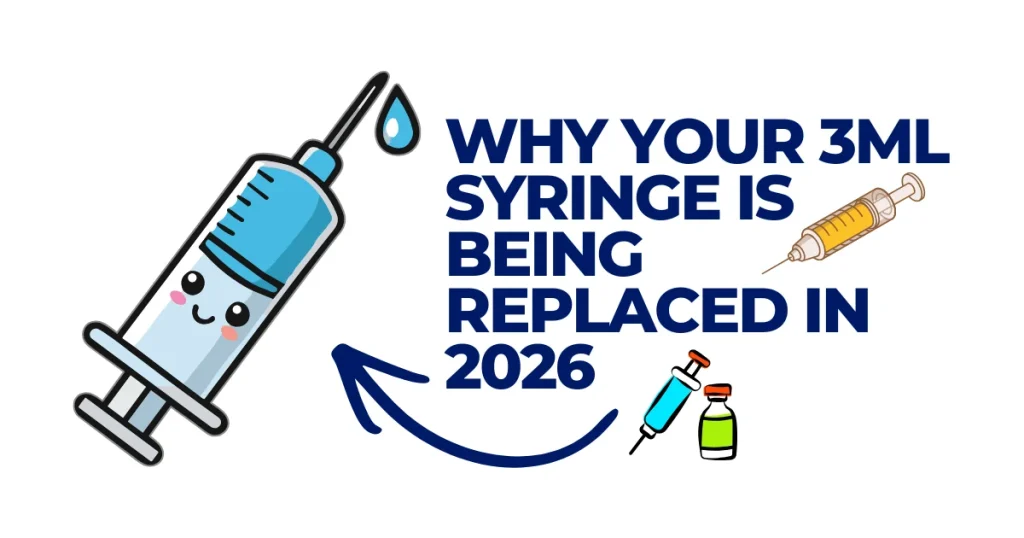
According to the ISMP (Institute for Safe Medication Practices) 2025-2026 guidelines, we are seeing a massive shift in how liquid medications are handled. If you’ve picked up a prescription recently and noticed the syringe looks “different” or “bigger,” you aren’t imagining it. The standard 3mL syringe is officially being phased out in favor of a new 5mL metric-only standard.
This isn’t just a manufacturing change; it is a vital safety mandate designed to save lives and keep children out of the Emergency Room. Here is the breakdown of why this is happening and how to protect your family.
1. Why is the 3mL syringe being replaced?
For years, the 3mL syringe was the “go-to” for pediatric antibiotics and pain relievers. However, data from 2024 and 2025 showed a recurring problem: the markings on 3mL syringes were often too crowded or used confusing “teaspoon” (tsp) increments alongside milliliters (mL).
The healthcare industry has moved to a “Metric-Only” Mandate. By moving to a standardized 5mL syringe, manufacturers can provide:
- Clearer markings: More space between the lines means less squinting.
- Uniformity: Every pharmacy, from the local corner store to the massive hospital, will now use the same measurement language.
- Error Reduction: It eliminates the “Is this 0.5 or 5.0?” confusion that often leads to 10x dosing errors.
2. The Danger of the “Kitchen Spoon” Myth
If there is one thing I wish I could shout from the rooftops, it’s this: Never, under any circumstances, use a kitchen spoon to give medicine.
I know it’s tempting when you can’t find the plastic syringe, but kitchen silverware is not a measuring device. Research shows that household spoons can hold anywhere from 2mL to 10mL of liquid. This winter, 10x dosing errors—where a child receives ten times the intended dose—have become the #1 cause of pediatric ER visits. If your pharmacy provides a new 5mL syringe, use it. If you lose it, go back and ask for another one. They will almost always give you a replacement for free because your safety is the priority.
3. How to Read the New 5mL Markings
The new syringes are designed for “Human Clarity.” Here is how to use them correctly:
- Find the “mL” mark: Ensure you are looking at the milliliter side.
- The Piston Rule: When drawing up medicine, align the top ring of the black rubber plunger (the part closest to the tip) with the line for your dose.
- Eye Level: Always hold the syringe at eye level to check the measurement.
4. Why “Metric-Only” Matters
In the past, a doctor might write “one teaspoon” on a script, the parent might use a “soup spoon,” and the label might say “5mL.” This “triple-language” system was a recipe for disaster.
In 2026, the mandate requires that the prescription, the bottle label, and the syringe all speak the same language: Milliliters. By sticking to a single metric unit, we remove the “translation” step where most dangerous mistakes occur.
Safety Checklist for Your Next Prescription
- Check the Box: Ensure a measuring device is included.
- Verify the Volume: Note if it is the new 5mL standard.
- Confirm the Dose: Ask the pharmacist, “Can you show me on this specific syringe where the line is for my child’s dose?”
- Wash and Store: Always wash the syringe with warm soapy water after use, but do not put it in the dishwasher, as the heat can fade the measurement markings.
Health Disclaimer
This information is provided for educational purposes and is not a substitute for professional medical advice. Always follow the specific dosing instructions provided by your healthcare provider or pharmacist. If you suspect a medication overdose, contact the Poison Control Center immediately or seek emergency medical care. DrugsArea
Sources & References
- Institute for Safe Medication Practices (ISMP) 2026 Guidelines, American Academy of Pediatrics – Dosing Safety, FDA – Oral Liquid Measurement Standards, CDC – Preventing Medication Overdoses
People Also Ask
1. Is the 3mL syringe being discontinued entirely in 2026?
No, the 3mL syringe itself isn’t going away, but the way you buy it is changing. While standard 3mL Luer-lok syringes remain a staple, many manufacturers are phasing out specific “legacy” models and certain 3mL pre-filled saline flushes. The biggest change is the shift toward pre-filled pens and cartridges, particularly for medications like insulin, which is making the traditional “vial and 3mL syringe” combo harder to find.
2. Why am I being told to switch from 3mL vials to pens?
In 2026, major pharmaceutical players (like Eli Lilly and Novo Nordisk) have largely completed the move away from 3mL vials for several insulin types and biologics. The “phase-out” is a move toward 3mL cartridges and pre-filled pens. These are considered safer and more accurate for home use, as they reduce the risk of dosing errors that can happen when manually drawing liquid into a traditional syringe.
3. My pharmacy is out of 3mL syringes; what is the safe alternative?
If you are used to a 3mL syringe for a small dose (under 1mL), your doctor may suggest a 1mL TB (Tuberculin) syringe. These have finer markings and provide better accuracy for tiny doses. However, never switch sizes without consulting your pharmacist first, as the needle length and gauge might differ from what you were originally prescribed.
4. Does the 3mL syringe phase-out affect pediatric medications?
It can. Many parents are used to using 3mL oral or hypodermic syringes for children’s liquid meds. As 2026 supply chains prioritize Safety-Engineered Devices (SEDs), you may notice your pharmacy providing different brands or “auto-retracting” syringes. The goal is to prevent accidental needle sticks and improve dosing precision for kids.
5. Are “Smart-Labels” related to the 3mL syringe changes?
Yes. Many of the new 2026 syringe formats and pre-filled pens now feature Smart-Labels. By scanning the label with your phone, you can verify that the syringe is authentic, check the exact expiration date, and even watch a video on how to use the new “safety” features that didn’t exist on older 3mL models.
6. How do I know if my 3mL syringe is still “safe” after the recent recalls?
Recent FDA and MHRA alerts in late 2025 and early 2026 have flagged certain syringe batches for “foil perforations” or “needle oxidation.” To stay safe:
- Check the seal: If the paper or plastic backing is even slightly torn, discard it.
- Look for the “CE” or “FDA-Approved” mark: Ensure you are using reputable brands like BD, Nipro, or Cardinal Health rather than unverified third-party imports.
7. What should I do if my medication only comes in 3mL cartridges now?
If your medication has phased out vials in favor of 3mL cartridges, you will likely need a reusable injection pen (like the Mypen2 or HumaPen). You can no longer “draw up” the medicine with a standard 3mL syringe from these cartridges. Talk to your clinic about a “device training” session to make the switch smoothly.
8. Can I still use my old stock of 3mL syringes?
As long as the syringes are individually sealed, sterile, and not expired, they are generally safe to use. However, be aware that many 3mL syringes manufactured before 2024 lacked modern safety-shielding technology. If you are a caregiver, upgrading to the newer “safety syringes” available in 2026 is highly recommended to prevent injury.
9. Is there a shortage of 3mL syringes in 2026?
Supply chains have stabilized significantly since the 2024-2025 disruptions, but “localized” shortages still happen. This is often because hospitals are getting priority for “bulk” shipments. If your local retail pharmacy is out, ask them to check for equivalent safety-engineered alternatives that are compatible with your medication.
10. How do I dispose of the newer 2026 safety syringes?
Even though many new syringes have “retractable” needles, they are still considered biohazardous “sharps.” Never throw them in the regular trash. Use an FDA-cleared sharps container or a heavy-duty plastic laundry detergent bottle with a screw-on lid, clearly labeled “SHARPS.”