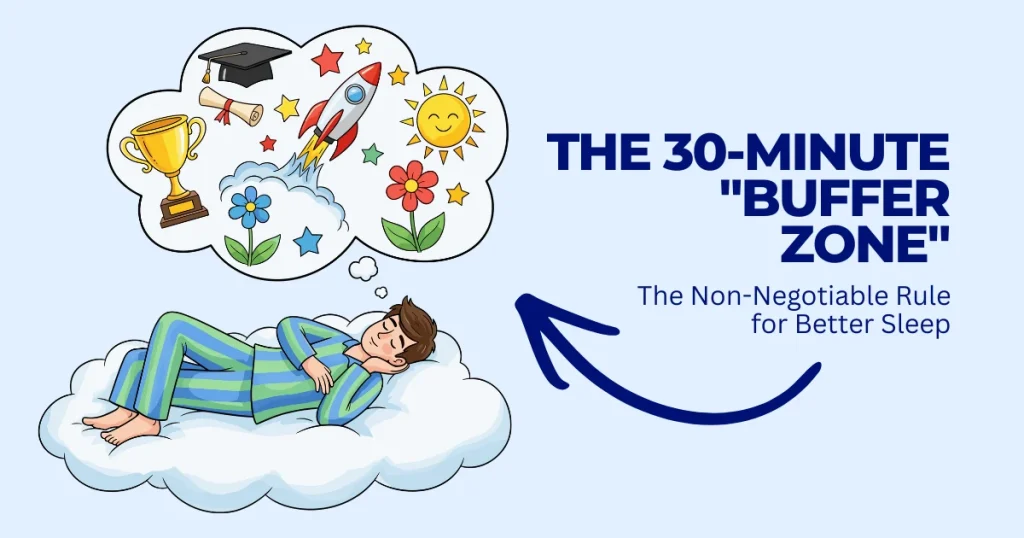
The 30-Minute “Buffer Zone”| The Non-Negotiable 2026 Rule for Better Sleep
In my years of clinical practice, I’ve seen the “always-on” culture of the 2020s evolve from a badge of productivity into a full-blown public health crisis. We are more connected than ever, yet our biological systems are fraying at the edges. As we navigate 2026, the most significant prescription I give my patients isn’t a pill or a supplement—it’s a boundary.
Specifically, I’m talking about the 30-Minute “Buffer Zone.”
This isn’t just a “nice-to-have” wellness tip. In an era of hyper-personalized algorithms and 8K screens, the Buffer Zone has become a non-negotiable rule for anyone serious about cognitive function, hormonal balance, and long-term health.
The Science of the “Buffer Zone”
To understand why this window is vital, we have to look at the neurobiology of sleep. Your brain does not have an “off” switch; it has a “fade” mechanism. When you engage with a screen—whether it’s a smartphone, laptop, or tablet—you are essentially shouting at your pineal gland to stop doing its job.
1. The Melatonin Suppression Factor
The blue light emitted by modern devices mimics the short-wavelength light of the morning sun. When this light hits the melanopsin-containing retinal ganglion cells in your eyes, it sends a signal to the suprachiasmatic nucleus (SCN). The message? “It’s daytime. Do not release melatonin.”
By 2026, our devices are brighter and more immersive than ever. Without a Buffer Zone, you are forcing your body to start its “wind-down” process from zero the moment you close your eyes, leading to what we call Sleep Onset Latency—that frustrating hour spent tossing and turning.
2. The Dopamine Loop and “Revenge Bedtime Procrastination”
It’s not just the light; it’s the content. Scrolling through social feeds or checking work emails triggers dopamine, the neurotransmitter associated with reward and “seeking.” This keeps your brain in a state of high arousal. The Buffer Zone allows your nervous system to transition from the Sympathetic (fight or flight) state to the Parasympathetic (rest and digest) state.
The Anatomy of a Perfect 30-60 Minute Buffer
If you want to see a measurable increase in your REM (Rapid Eye Movement) cycles and Deep Sleep architecture, your Buffer Zone should be sacred. Here is how to structure it:
Phase 1: The Digital Sunset (Minutes 0–10)
- The Rule: All personal electronics are placed in a charging station outside the bedroom.
- Why: Even the presence of a phone in the room has been shown to increase cognitive load. Physical distance creates mental distance.
Phase 2: Environmental Cues (Minutes 10–20)
- Lower the Lumens: Dim the lights in your home. Use warm-toned lamps rather than overhead LEDs.
- Temperature Regulation: Your core body temperature needs to drop by about 2 to 3 degrees Fahrenheit to initiate sleep. A warm shower followed by a cool room facilitates this “thermal dump.”
Phase 3: The Low-Arousal Activity (Minutes 20–30)
- Engage the Senses: This is the time for fiction reading (physical books), journaling, or light stretching.
- The Result: By the time your head hits the pillow, your brain has already been producing melatonin for 20 minutes. You aren’t “trying” to sleep; you are simply allowing sleep to happen.
The 2026 Impact: Why REM Matters More Than Ever
Why are wellness experts across the globe suddenly so adamant about this? Because REM sleep is the “emotional first aid” of the human experience. During REM, your brain processes the day’s emotions and clears out beta-amyloid—a metabolic waste product associated with neurodegenerative diseases.
When you bypass the Buffer Zone, you often truncate your first few REM cycles. This leads to:
- Brain Fog: Decreased executive function the following morning.
- Emotional Liability: Increased irritability and lower stress tolerance.
- Metabolic Disruption: Higher levels of cortisol and ghrelin (the hunger hormone).
Implementing the Rule: A Professional Strategy
If 30 minutes feels impossible, start with 15. The key is consistency over duration. Within seven days of implementing a strict Buffer Zone, most individuals report a noticeable “heaviness” in their eyelids at a consistent time each night—this is your internal clock (circadian rhythm) finally finding its beat again.
In 2026, the most radical act of self-care isn’t a luxury retreat; it’s the simple act of turning off the world before you turn off the lights.
Health Disclaimer
The information provided in this article is for educational and informational purposes only and is not intended as medical advice. Always seek the advice of your physician or other qualified health provider with any questions you may have regarding a medical condition or sleep disorder. Never disregard professional medical advice or delay in seeking it because of something you have read here. DrugsArea
Sources & References
- Harvard Health: Blue light has a dark side
- Sleep Foundation: How Electronics Affect Sleep
- Mayo Clinic: Sleep hygiene tips
- Nature Journal: Circadian Rhythms and Light
Frequently Asked Questions
1. What exactly is the 30-Minute “Buffer Zone” for sleep?
The Buffer Zone is a non-negotiable window of time—exactly 30 minutes before you intend to sleep—dedicated to disconnecting from the digital world. It’s a period where you swap blue light and high-stimulation activities for low-light, relaxing habits that signal to your brain that the day is officially over.
2. Why is this rule considered “non-negotiable” in 2026?
With the rise of hyper-personalized AI and 24/7 digital connectivity, our brains are more “on” than ever before. In 2026, the Buffer Zone is seen as a necessary survival tactic for mental health. Treating it as non-negotiable ensures you prioritize biological recovery over the infinite scroll, preventing chronic burnout.
3. Does looking at my phone really ruin my sleep that much?
Yes, and it’s not just about the blue light anymore. It’s about “cognitive arousal.” Checking an email or a social feed 10 minutes before bed spikes your cortisol and keeps your brain in “problem-solving mode.” The 30-minute rule allows those stress levels to drop so you can actually enter deep sleep faster.
4. What should I actually do during those 30 minutes?
Think low-tech and low-light. Great options include:
- Reading a physical book or an e-reader with warm-light settings.
- Light stretching or restorative yoga.
- Journaling or “brain-dumping” your to-do list for tomorrow.
- Listening to a calm podcast or ambient music.
5. Can I use the Buffer Zone to watch TV instead of using my phone?
Ideally, no. While a TV is further away than a phone, it still emits light and provides active stimulation. If you must watch something, choose something familiar and “boring,” but the gold standard for the 2026 rule is a completely screen-free environment.
6. Will this help if I struggle with insomnia?
Absolutely. Most insomnia is fueled by sleep anxiety—the fear of not falling asleep. By creating a consistent, 30-minute ritual, you build a Pavlovian response. Eventually, your body starts producing melatonin the moment the Buffer Zone begins, reducing the time spent tossing and turning.
7. Is 30 minutes enough, or should it be longer?
While an hour is great, 30 minutes is the “sweet spot” for sustainability. It’s long enough to meaningfuly lower your heart rate and shift your nervous system from “sympathetic” (fight or flight) to “parasympathetic” (rest and digest), but short enough to fit into a busy lifestyle.
8. What is the biggest mistake people make with the Buffer Zone?
The “Just One More” trap. People often try to squeeze in one last task or video at the 31-minute mark, which spills over. To make this work, you have to set a hard alarm on your devices that tells you it’s time to put them away—no exceptions.
9. Do I need to change my lighting during this time?
Yes, this is a huge part of the rule. Switch to warm, dim lamps or “sunset” modes. Avoid overhead fluorescent lights, which mimic the midday sun and trick your brain into thinking it should be wide awake.
10. How long does it take to see results from the 30-Minute Buffer Rule?
Most people notice a difference in their sleep quality (how rested they feel in the morning) within 3 to 5 nights. Within two weeks, it usually becomes a habit that you’ll find yourself looking forward to rather than seeing as a chore.