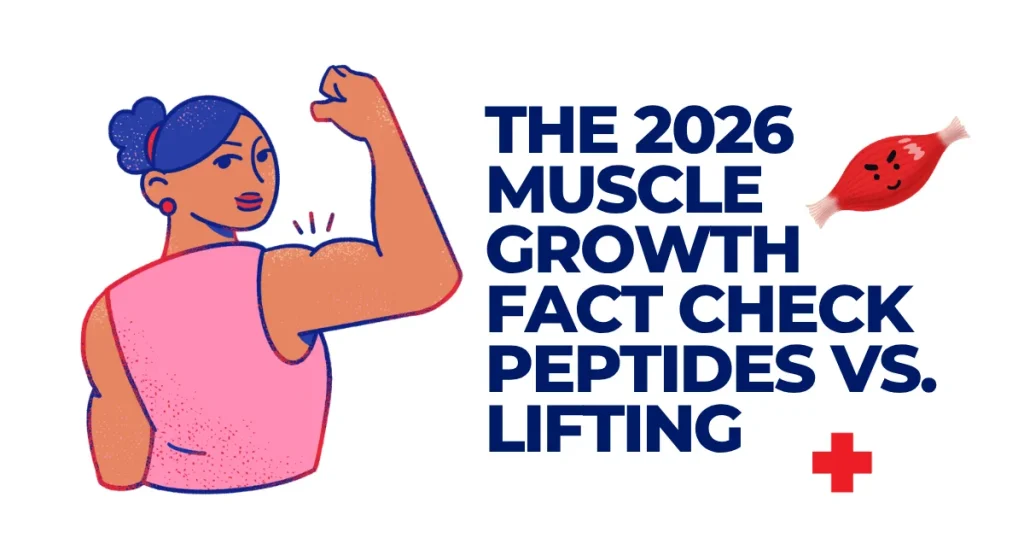
Fact Check: Can “Peptides” Really Replace the Gym in 2026?
The 2026 “Miracle Shot” Myth: A Pharmacist’s Perspective Muscle Growth
You may have seen the headlines on social media lately: “Build muscle while you sleep” or “The needle that replaces the bench press.” As a pharmacist, I see the science behind the counter every day. I have to be honest with you: the “miracle shot” myth is getting out of hand in 2026.
Peptide therapy has come a long way in helping people heal from injuries and balance their hormones, but there is a huge misunderstanding going around. A lot of people think that they can skip the hard work of resistance training by injecting peptides like BPC-157 or CJC-1295. Let’s compare the truth about medicine to the hype about it. Muscle Growth
What Are Peptides, Really?
Peptides are like “messengers” for cells. They are short chains of amino acids that tell your body to do things like release growth hormone or fix tissue that has been hurt. We use them in a clinical setting to help people heal faster or deal with certain metabolic problems.
But peptides are not builders; they are messengers. Think about sending a thousand text messages to a construction crew telling them to build a house, but not giving them the bricks or the work to do. The muscle, or in this case, the house, just won’t be built. Muscle Growth
The Hard Truth: Why You Still Need to Lift
When it comes to physiology, muscles need something called mechanical tension to grow. When you lift a heavy weight, you make small tears in your muscle fibers. Your body knows it needs to get stronger to handle the load next time when you put it under this kind of stress. Muscle Growth
Peptides can definitely speed up the repair process, but they can’t make the first “demand” for growth. The metabolic benefits of peptides are greatly reduced without the stimulus of exercise. This is why they don’t work as a gym substitute:
- Protein Synthesis Needs a Spark: Peptides can “prime” the environment for muscle growth, but resistance training is the spark that starts the fire.
- Bone Density & Joint Strength: Lifting weights strengthens your skeletal system in ways a peptide injection simply cannot.
- Functional Strength: You might see slight changes in body composition with peptides alone, but you won’t gain the real-world strength that comes from moving weight.
The “Adjunct” Approach: How to Use Tech Properly
If you’re thinking about peptide therapy in 2026, the best way to think about it is as an addition to your main foundation. There are three things that make up a “solid foundation”: Muscle Growth
- Resistance Training: You should do it for at least 3 to 4 days of progressive overload, which means lifting a little more each time.
- Protein-Rich Nutrition: You need the “bricks” (amino acids from food) to build the wall.
- Quality Sleep: This is when your body’s natural hormones and peptides work best.
Adding peptides to this base makes it work better, like a “force multiplier.” They can help you heal faster after a hard leg day or get better sleep so you can work out harder the next morning. They are like a “turbocharger” for an engine, but the engine still needs to be running! Muscle Growth
Pharmacist’s Final Word
Don’t take the “lazy” way out. We have more ways to stay healthy and strong than ever in 2026, but the biological laws of the human body are still the same. Your body has to work hard to keep muscle, and if you don’t give it a reason to do so (through exercise), it won’t.
Put down the “miracle shot” hopes and pick up a dumbbell if you want to change. Use science to back up your sweat, not to replace it. Muscle Growth
Health Disclaimer:
This information is for educational purposes only and is not a substitute for professional medical advice, diagnosis, or treatment. Peptides are powerful biological agents that should only be used under the direct supervision of a licensed healthcare provider. Improper use or sourcing from “research-only” gray markets can lead to serious health risks, including hormonal imbalances and contamination. Always consult your doctor or pharmacist before starting any new supplement or therapy. DrugsArea
Sources & References
- FDA 2026 Peptide Compounding Updates,
- National Institutes of Health: Peptides and Muscle Metabolism,
- Journal of Clinical Endocrinology & Metabolism,
- Pharmacist’s Guide to Growth Hormone Secretagogues