The “Brain Development” Myth: Why Your Cognitive Peak Hits in Your 30s
Introduction: Relax, Your Brain is Still Cooking
If you are in your mid-20s and feeling the “quarter-life crisis” pressure to have your entire life, career, and personality figured out—I have some professional medical advice for you: Take a deep breath.
For years, the scientific “status quo” told us that the human brain was fully baked by age 25. We were told that after 25, it was all downhill. As a health professional, I’ve seen how this “hard deadline” creates unnecessary anxiety. But as of today, February 19, 2026, a massive wave of new longitudinal research has officially debunked the “25-year-old cap.”
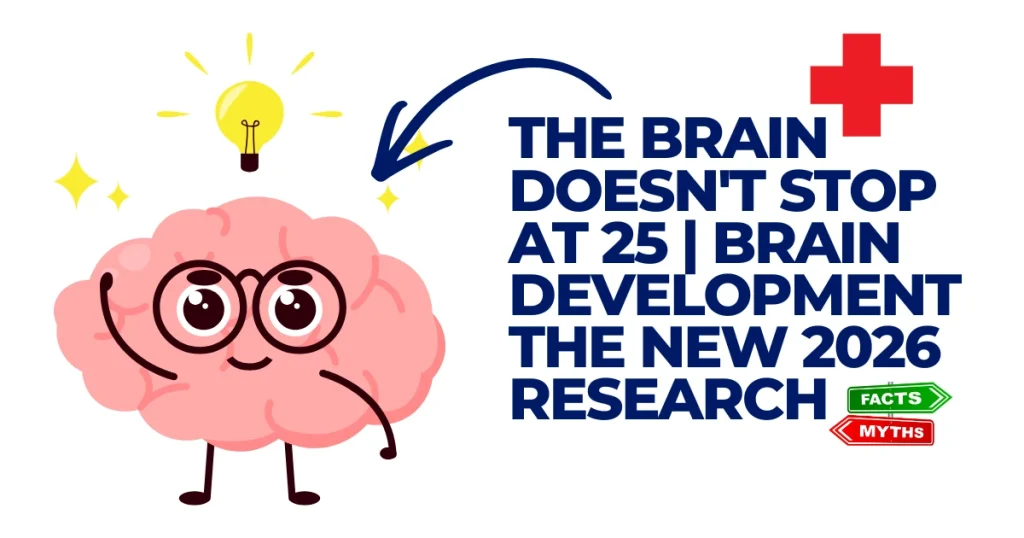
The truth is much more exciting. Your brain isn’t “done” at 25; it is actually undergoing a sophisticated structural shift that doesn’t reach its peak until your early 30s.
The Myth of the “Finished” Brain
We used to think the prefrontal cortex—the part of the brain responsible for executive function, impulse control, and long-term planning—finished its insulation process (myelination) by the mid-20s.
However, 2026 imaging technology has shown us that gray matter continues to prune and refine itself well into the fourth decade of life. This means that the emotional stability and “big picture” wisdom we often associate with “real adulthood” are still physically developing while you’re navigating your late 20s. You aren’t “behind” in life; your hardware is still upgrading.
Why Your 30s are the True Cognitive “Sweet Spot”
While your 20s are characterized by raw processing speed and high neuroplasticity (the ability to form new connections), your 30s are where cognitive efficiency takes over.
Think of your 20s as a high-speed internet connection that hasn’t been organized yet. Your 30s are when the “folders” are created, the “search function” becomes lightning-fast, and the “security software” is fully patched. In your 30s, you typically see:
- Better Emotional Regulation: You react less to stress and solve conflicts more logically.
- Complex Pattern Recognition: You see “the forest for the trees” better than you did at 21.
- Vocabulary & Social Intelligence: These actually continue to climb well into middle age.
The “Daily Need”: Stop the Quarter-Life Pressure
The societal pressure to “peak” early is actually counterproductive to brain health. Stress releases cortisol, which, in high doses, can actually inhibit the very neuroplasticity you need.
Instead of worrying about being a “finished product,” view your 20s and early 30s as a “Mental Investment Phase.” The brain is currently at its most sponge-like state for complex skill acquisition.
Action Step: Cognitive Speed Training
Don’t just “work hard”—train your brain. Engaging in Cognitive Speed Training today acts as an insurance policy for your future.
- Learn a Language: This forces the brain to toggle between different rule sets, strengthening the “switching” mechanism.
- Complex Hobbies: Coding, playing a musical instrument, or even strategic gaming builds Cognitive Reserve.
Building Your “Mental Reserve” to Delay Dementia
Why does this matter for the long term? Because the work you do on your brain in your 20s and 30s builds what we call a “Mental Reserve.” Think of this as a “buffer” or a secondary battery. Research shows that individuals who consistently challenge their brains during these peak developmental years can effectively delay the symptoms of dementia or Alzheimer’s by up to a decade. You are literally building a “stronger” brain that can withstand more wear and tear later in life.
If my brain isn’t done at 25, why do I feel more tired?
It’s likely not “brain aging” but “cognitive load.” In 2026, we are processing 5x more data than humans did 20 years ago. Your brain is still maturing, but it’s being asked to run too many “apps” at once. Prioritize sleep to let your gray matter “prune” effectively.
Does this mean I should wait until 30 to make big decisions?
Not at all. It just means you should be kinder to yourself if you make mistakes. Your brain is still learning how to weigh risks. Use your 20s to experiment—your brain is literally designed to bounce back from learning experiences right now.
Can I still learn a new language after 30?
Yes! While the “window” of peak plasticity is high now, the refined efficiency of a 30-something brain makes you a more strategic learner. You might learn differently, but you can still learn effectively.
What is the biggest “brain killer” in 2026?
Passive Consumption. Scrolling through short-form videos for hours doesn’t challenge the prefrontal cortex. It puts it in “standby mode.” To keep the gray matter shifting, you need active engagement—something that requires you to think, react, or create.
Is “Brain Fog” real or just a lack of maturity?
In 2026, we recognize “Brain Fog” as a legitimate inflammatory response. It’s often tied to gut health or chronic stress. If you’re under 35 and struggling to focus, it’s rarely because your brain is “done”—it’s usually because it’s overwhelmed.
The Bottom Line
The “25-year-old cutoff” was a scientific oversimplification. You are a work in progress, and your 30s are shaping up to be your most powerful cognitive decade yet. Stop racing against a biological clock that doesn’t exist. Instead, focus on feeding your brain new challenges, protecting your sleep, and lowering your stress.
Your peak hasn’t passed. It’s actually just around the corner.
Health Disclaimer
I am an AI trained in medical contexts, but I am not your doctor. The information provided is based on 2026 neurological research trends and general health guidelines. Always consult with a qualified healthcare professional regarding cognitive concerns, mental health struggles, or neurological symptoms. DrugsArea
Sources & References
- Harvard Health: The Truth About Brain Maturity,
- Nature Neuroscience: Plasticity Beyond the 20s (Feb 2026 Study),
- Journal of Cognitive Development,
- Mayo Clinic: Building Cognitive Reserve
People Also Ask
1. Is it true that the brain stops developing at 25?
Actually, that’s the myth! While the physical “construction” of the prefrontal cortex—the part responsible for decision-making—is mostly done by 25, the brain’s functional optimization continues. New research shows that the complex “wiring” for social intelligence and emotional regulation doesn’t actually reach its peak efficiency until your 30s.
2. Why is my 30s considered my “cognitive peak”?
In your 30s, you hit a “sweet spot” where your fluid intelligence (the ability to solve new problems) is still very high, but your crystallized intelligence (knowledge and experience) has finally caught up. This synergy allows for more nuanced “big picture” thinking that younger brains often struggle to maintain.
3. Does my memory start to decline as soon as I hit 30?
Not necessarily. While “short-term recall” (like remembering a random list of words) might technically peak in your late teens, your prospective memory—the ability to remember to perform future tasks—and your ability to focus on complex information often improve significantly in your 30s.
4. What is “Brain Plasticity,” and does it disappear after 30?
Neuroplasticity is your brain’s ability to reorganize itself by forming new neural connections. It never disappears! While it’s “easier” to learn a language as a toddler, 30-somethings are actually better at integrated learning, which is the ability to connect new information to existing knowledge.
5. Can I still learn a new professional skill in my late 30s?
Absolutely. In fact, you might be better at it now than you were at 20. Because the brain in your 30s is more “settled,” you generally have better impulse control and executive function, allowing for the deliberate practice required to master complex professional skills.
6. How does emotional intelligence (EQ) change in my 30s?
This is where your 30s really shine. Research indicates that the ability to accurately read others’ emotions and navigate complex social dynamics peaks between ages 30 and 45. Your brain becomes more efficient at processing social nuances, making you a more effective leader and communicator.
7. Does stress impact a 30-year-old brain differently than a 20-year-old brain?
Yes. By your 30s, your “emotional toolkit” is more developed. While life in your 30s can be more stressful (career, family, etc.), your brain is biologically better equipped to handle “cognitive reappraisal”—the ability to reframe a stressful situation and stay calm under pressure.
8. What can I do to extend my cognitive peak beyond my 30s?
The “use it or lose it” rule is real. Cognitive longevity is driven by novelty and challenge. Learning a new instrument, switching career paths, or even consistent aerobic exercise (which boosts Brain-Derived Neurotrophic Factor) can keep your brain in that “peak” state well into your 50s and 60s.
9. Is “Brain Fog” in my 30s a sign of early cognitive decline?
Usually, no. Because the 30s are often the most demanding decade of life, “brain fog” is typically a symptom of cognitive overload, sleep deprivation, or burnout rather than a loss of brain function. Your brain is still a powerhouse; it just has too many tabs open!
10. Why did we believe the “25-year-old limit” for so long?
It was a misunderstanding of early MRI data. Scientists saw that the white matter (insulation for brain wires) stopped growing in volume around age 25, so they assumed the job was “done.” We now know that the brain continues to refine the quality of those connections long after the quantity stops increasing.