The “Cold-Chain” Alert: Why Your 2026 Mail-Order Meds Need a “Thaw Check”
When “Special Delivery” Becomes a Safety Risk Cold Chain
As a healthcare professional, I’ve seen the incredible convenience of mail-order pharmacies transform lives—especially for those managing chronic conditions. But as we navigate the fluctuating temperatures of February 2026, that convenience comes with a hidden “Cold-Chain” risk.
If you rely on biologics (like Humira or Enbrel) or insulin, you aren’t just receiving a bottle of pills; you are receiving delicate proteins. These medications are “living” chemistry. When the mercury drops and your package sits on a frozen porch for three hours, the medicine can undergo a process called denaturation. Essentially, the protein “unravels,” turning your life-saving treatment into an expensive, ineffective liquid.
Here is your professional guide to performing a “Thaw Check” the moment your package hits the doorstep. Cold Chain
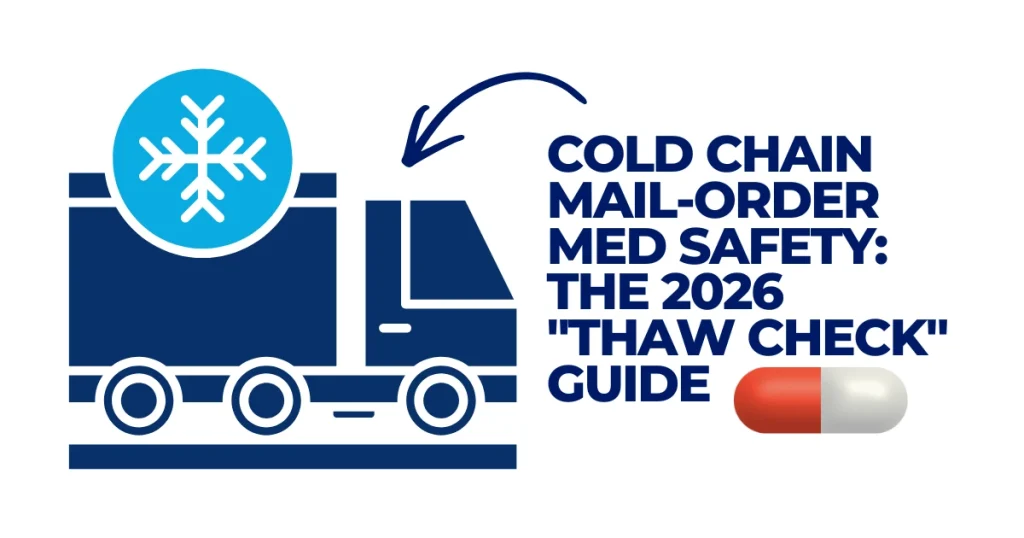
The 60-Second “Thaw Check” Protocol Cold Chain
Don’t just rip open the box and put the vial in the fridge. Follow these three steps first:
- The “Shake” Test: Gently rotate the vial or pen. For clear insulins and most biologics, the liquid should be crystal clear. If you see “frosty” flakes, white threads, or a cloudy “sand” at the bottom that won’t dissolve, the medication has likely frozen and thawed.
- The Container Check: Feel the ice packs. If the gel packs are solid ice or, conversely, bone-dry and warm, the temperature window has been breached.
- The Visual Alarm: Look for the Freeze-Indicator.
How to Read a 2026 “Freeze-Indicator”Cold Chain
Most high-value specialty pharmacies in 2026 now include a small, circular sticker or “tag” inside the insulated liner. This is your most honest witness. Cold Chain
- The Green/White State: This means the medication stayed within the “Strive for 5” range (roughly to or to ).
- The Red/Magenta State: If the indicator has turned red (or a dark magenta), it means the internal temperature dropped below freezing (/) for more than 60 minutes.
- The Verdict: If the dot is red, do not use the medication. Even if it looks clear now, the molecular structure may be compromised.
Why “Frozen” is Often Worse than “Warm” Cold Chain
We often worry about heat, but for proteins, freezing is the “silent killer.” When a biologic freezes, ice crystals form. These crystals act like microscopic shears, physically tearing the protein structures apart.
Once a protein is denatured, it can’t be “fixed” by thawing. Using denatured insulin is dangerous because its potency becomes unpredictable—it might work at 20% strength, or not at all, leading to dangerous blood sugar spikes.
What to Do if Your Meds Arrive “Frozen”
If your thaw check fails or the red indicator is staring back at you, follow this professional “Chain of Command”: Cold Chain
- Stop: Do not inject the medication.
- Document: Take a photo of the red indicator and the medication vial.
- Call: Contact your specialty pharmacy immediately. Tell them: “My medication arrived with a triggered freeze-indicator.” 4. Isolate: Keep the compromised medication in the fridge (but marked “DO NOT USE”) until the pharmacy tells you how to dispose of it. They will often ship a replacement overnight at no cost to you.
The “Safety First” Checklist
| Feature | Safe Range | Danger Sign |
|---|---|---|
| Appearance | Clear & Colorless | Cloudy, Flaky, or “Stringy” |
| Indicator | Green or White | Red or Magenta |
| Gel Packs | Cold & Slushy | Solid Ice or Room Temp |
| Vial Integrity | Intact | Hairline cracks (from ice expansion) |
Health Disclaimer
This content is for educational purposes only. If you suspect your medication has been compromised by extreme temperatures, do not use it. Contact your prescribing physician or pharmacist immediately for guidance. Using compromised medication can lead to treatment failure or adverse reactions. DrugsArea
Sources & References
- FDA: Information Regarding Insulin Storage,
- CDC: Vaccine Storage and Handling Toolkit 2026,
- WHO: The Vaccine Cold Chain,
- ISMP: Preventing Medication Errors with Biologics .
People Also Ask
1. What is a “Thaw Check” for mail-order medications?
A Thaw Check is the process of verifying that a temperature-sensitive medication (like insulin, GLP-1s, or biologics) remained within its required cold range during shipping. In 2026, this usually involves checking a Smart Cold-Chain Indicator on the package—a digital or color-changing sensor that “flags” the product if it got too warm (thawed) or too cold (frozen) before it reached your porch.
2. Why is everyone talking about the “Cold-Chain” in 2026?
The “Cold-Chain” refers to the uninterrupted series of refrigerated storage and distribution activities. With the 2026 rollout of stricter global regulations, pharmacies are now more transparent about this. We’re talking about it because many of today’s most effective life-saving drugs are “biologics” made from living cells, which can “die” or become toxic if they spend even a few hours at the wrong temperature.
3. How do I read the new temperature-sensitive smart labels?
Most 2026 mail-order meds come with an NFC-enabled tag or a visual e-ink display.
- Visual: Look for a green checkmark or a clear “OK” on the label. If it’s red or says “ALARM,” the cold chain was broken.
- Digital: Tap your smartphone to the label. It will instantly pull up a graph showing the exact temperature of your medicine every hour it was in transit.
4. Can I still use my medicine if the “Thaw Check” shows a brief spike?
Don’t guess—scan it. Many medications have a “stability budget,” meaning they can handle being at room temperature for a specific number of hours. The 2026 smart labels calculate this for you. If you scan the tag and it gives you a green light, the system has determined the “spike” wasn’t long enough to damage the molecules. If it’s red, the medicine is legally and medically considered “spoiled.”
5. What happens if my medicine arrives “thawed” or warm?
If your Thaw Check fails, do not inject or ingest the medication. Contact your mail-order pharmacy immediately. Because these 2026 smart labels record the exact moment the temperature failed, the pharmacy can see the data on their end, too. This makes getting a free replacement much faster than it used to be, as the digital proof is undeniable.
6. Does “thawed” medicine just become less effective, or is it dangerous?
It’s a bit of both. For some drugs, like insulin, heat makes them lose potency, meaning your blood sugar won’t drop as expected. For others, a “freeze-thaw” cycle can cause the proteins to clump (aggregate), which can trigger an unwanted immune response or cause an injection-site reaction. A Thaw Check isn’t just about “freshness”; it’s about preventing a medical complication.
7. Are these “Thaw Check” labels required by law?
By 2026, many regions (including parts of the EU and updated FDA guidance in the US) have implemented stricter “Last-Mile” traceability requirements. While not every generic pill needs one, any “Specialty Drug” shipped via mail that requires refrigeration ( to ) is now generally expected to have a verifiable temperature monitoring system.
8. Can I use a regular thermometer to check my meds when they arrive?
A regular thermometer only tells you the temperature at that second. It doesn’t tell you if the package sat in a 110°F delivery truck for four hours before being placed in your mailbox. That’s why the “Thaw Check” technology is vital—it acts like a “black box” flight recorder for your medicine’s environment from the moment it left the pharmacy.
9. Will the “Smart-Label” rollout make my mail-order meds more expensive?
While the technology adds a small cost to the packaging, it actually saves money long-term by reducing “blind returns.” In the past, people threw away perfectly good medicine because the ice pack felt slightly soft. Now, the Thaw Check provides certainty, reducing waste and keeping insurance premiums from rising due to discarded high-cost specialty drugs.
10. My ice pack is melted, but the Thaw Check is green. Is it safe?
Yes. Modern insulated shipping containers are designed so that the ice pack should be mostly melted by the time it reaches you—that’s the phase-change material doing its job by absorbing heat. As long as the Smart Label or Thaw Check indicator hasn’t triggered an alert, the internal environment of the medicine remained within the safe zone.