The Sperm Switch: A 2026 Breakthrough in Male Birth Control
Introduction: Why This Isn’t Just Another “Male Pill” Story
As a healthcare professional, I’ve seen the same headline for twenty years: “The male pill is coming soon!” But here’s the thing—it usually doesn’t arrive. Why? Because most previous attempts tried to mess with hormones like testosterone, leading to side effects like mood swings, weight gain, and acne.
But as of February 14, 2026, the game has officially changed. Researchers at Michigan State University (MSU) just published a study that doesn’t touch hormones at all. Instead, they’ve found a way to “flip a switch” on how sperm move. It’s elegant, it’s targeted, and it’s the breakthrough we’ve been waiting for.
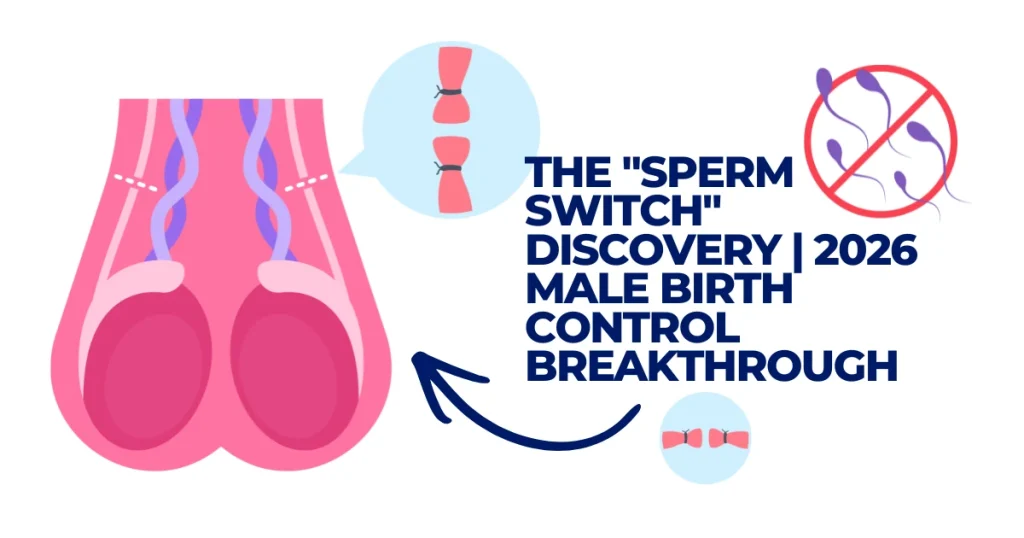
What is the “Sperm Switch”?
To understand this discovery, think of a sperm cell like a tiny biological race car. For that car to move, it needs fuel and an engine. The MSU team identified a specific enzyme called aldolase.
Aldolase acts as the “ignition switch” for the sperm’s metabolism. It is the primary enzyme that allows sperm to convert sugar into the energy they need to swim (motility). By identifying the exact molecular structure of this switch, scientists have figured out how to temporarily “jam” the ignition. If the sperm can’t “turn on” their engine, they can’t swim. If they can’t swim, they can’t reach the egg.
The Michigan State University Study (Feb 14, 2026)
The timing of this announcement on Valentine’s Day 2026 wasn’t lost on the medical community. The study, led by top molecular biologists, demonstrated that a specific non-hormonal compound can bind to the aldolase enzyme in sperm cells.
The key findings were groundbreaking:
- Precision: The compound only affects sperm; it doesn’t affect any other cells in the male body.
- Speed: In lab settings, sperm stopped moving within minutes of exposure.
- Reversibility: Once the compound wears off, new sperm produced by the body are completely unaffected and fully mobile.
Why “Non-Hormonal” is the Magic Word
The biggest hurdle for male contraception has always been the side effects of hormonal manipulation. Women have shouldered this burden for decades, dealing with the systemic effects of synthetic estrogen and progestin.
Because the “Sperm Switch” method focuses on a metabolic enzyme rather than testosterone, it avoids:
- Changes in libido (sex drive).
- Mood fluctuations or depression.
- Changes in muscle mass or hair growth.
- Impact on long-term fertility.
An “On-Demand” Male Pill?
This discovery paves the way for what we call “on-demand” contraception. Unlike the female pill, which must be taken daily at the same time to maintain hormone levels, a “switch-based” pill could potentially be taken just hours before intimacy.
In my clinical opinion, this increases “user compliance”—a fancy medical term for “actually remembering to take the medicine.” If a man only needs to take a pill when he needs it, the margin for error drops significantly.
Is it Safe?
While we are in the early human trial stages following the 2026 announcement, the safety profile looks incredibly promising. Aldolase in sperm is slightly different from aldolase in other muscles or organs. This means researchers can design a drug that is “highly selective.”
Imagine a key that only fits one specific lock in the entire house. This drug is the key, and the sperm’s energy source is the lock. By not interfering with the rest of the body’s chemistry, the risk of “off-target” effects is minimized.
When Will it Be in Pharmacies?
As of early 2026, we are looking at an accelerated clinical trial timeline. Because this isn’t a “systemic” drug (it doesn’t change your fundamental biology), the FDA and other global health bodies may move it through the “Fast Track” process. We are likely looking at a 2-to-3-year window before this becomes a prescription reality.
How Does This Change Relationships?
From a health professional’s perspective, this is about reproductive equity. For too long, the responsibility—and the physical side effects—of preventing pregnancy have fallen almost exclusively on women.
A reliable, side-effect-free male option allows couples to have a real conversation about who takes the lead on contraception. It empowers men to take control of their reproductive health without feeling like they are “changing who they are” hormonally.
The Bottom Line
The MSU discovery of the aldolase “Sperm Switch” is the most significant leap in male reproductive health since the vasectomy. It moves us away from the “hormonal hammer” and toward a “molecular scalpel.” As we move through 2026, keep your eyes on this technology—it’s about to redefine modern family planning.
Health Disclaimer
This information is based on recent 2026 clinical breakthroughs and is for educational purposes only. It is not a substitute for professional medical advice. Always consult your doctor or a urologist regarding reproductive health and contraception options currently available to you. DrugsArea
Sources & References
- Michigan State University – Department of Biomedical Sciences, Journal of Molecular Biology – Feb 2026 Edition, National Institutes of Health (NIH) – Male Contraceptive Initiative, World Health Organization (WHO) Reproductive Health Updates
People Also Ask
1. What is the “Sperm Switch” breakthrough discovered in 2026?
The 2026 breakthrough refers to the discovery of a molecular “switch”—specifically a metabolic pathway involving enzymes like aldolase—that acts as the “on” button for sperm. Scientists found that by temporarily “flipping” this switch off, they can prevent sperm from gaining the energy needed to swim toward an egg. Unlike older mechanical ideas, this is a biological, non-hormonal method of contraception.
2. Is “The Sperm Switch” a physical device or a pill?
While there is a mechanical valve called the Bimek SLV, the 2026 headline-making breakthrough is pharmacological. It’s a non-hormonal treatment (often discussed as a pill or a fast-acting “on-demand” medication) that targets sperm metabolism rather than physically blocking the anatomy or altering testosterone levels.
3. How does this new method differ from the traditional “male pill”?
The “traditional” male pill attempts to stop sperm production using hormones (like testosterone and progestin), which can cause side effects like weight gain or mood swings. The 2026 Sperm Switch method is non-hormonal; it allows the body to produce sperm normally but renders them “powerless” and unable to fertilize an egg by blocking their fuel source (glucose metabolism).
4. How long does it take for the Sperm Switch to work?
Because this method targets the activation of sperm rather than their production, it has the potential to be “on-demand.” Early research suggests it could be effective within hours of taking it, unlike hormonal methods that require weeks or months of daily use to suppress sperm counts to zero.
5. Is this breakthrough reversible?
Yes. One of the most attractive features of the 2026 metabolic breakthrough is its rapid reversibility. Because it only affects the sperm’s ability to “turn on” for a short window, once the medication leaves your system, the next batch of sperm functions normally. It’s designed to be as “off-and-on” as a light switch.
6. What are the side effects of non-hormonal male birth control?
Early clinical data for metabolic “switches” (like those targeting the aldolase enzyme or retinoic acid receptors) show minimal side effects. Since it doesn’t mess with your hormones, users shouldn’t experience the libido changes, acne, or mood shifts commonly associated with hormonal birth control.
7. Will the Sperm Switch affect my sex drive or performance?
No. Because the 2026 breakthrough targets sperm-specific enzymes that aren’t found in the brain or muscles, it does not interfere with testosterone. Your sex drive (libido), energy levels, and ability to perform remain completely unaffected.
8. Can I get the Sperm Switch at my pharmacy right now?
Not quite yet. While 2026 marks a “breakthrough” in human safety trials and molecular discovery, these medications are still moving through the FDA clinical trial phases. Most experts predict that while the science is “unlocked,” widespread pharmacy availability is still a few years away.
9. Is this the same as a “temporary vasectomy”?
Technically, no. A “temporary vasectomy” usually refers to a physical block, like the ADAM hydrogel (which is also in the news in 2026). The Sperm Switch metabolic breakthrough is even less invasive—it’s a chemical way to achieve the same result without any needles or procedures.
10. Does this protect against STIs (Sexually Transmitted Infections)?
No. Like almost all forms of internal birth control (pills, gels, or implants), the Sperm Switch only prevents pregnancy. Condoms are still the only effective method for protecting against STIs.